Chevron wood flooring (point de Hongrie)
Quick answer
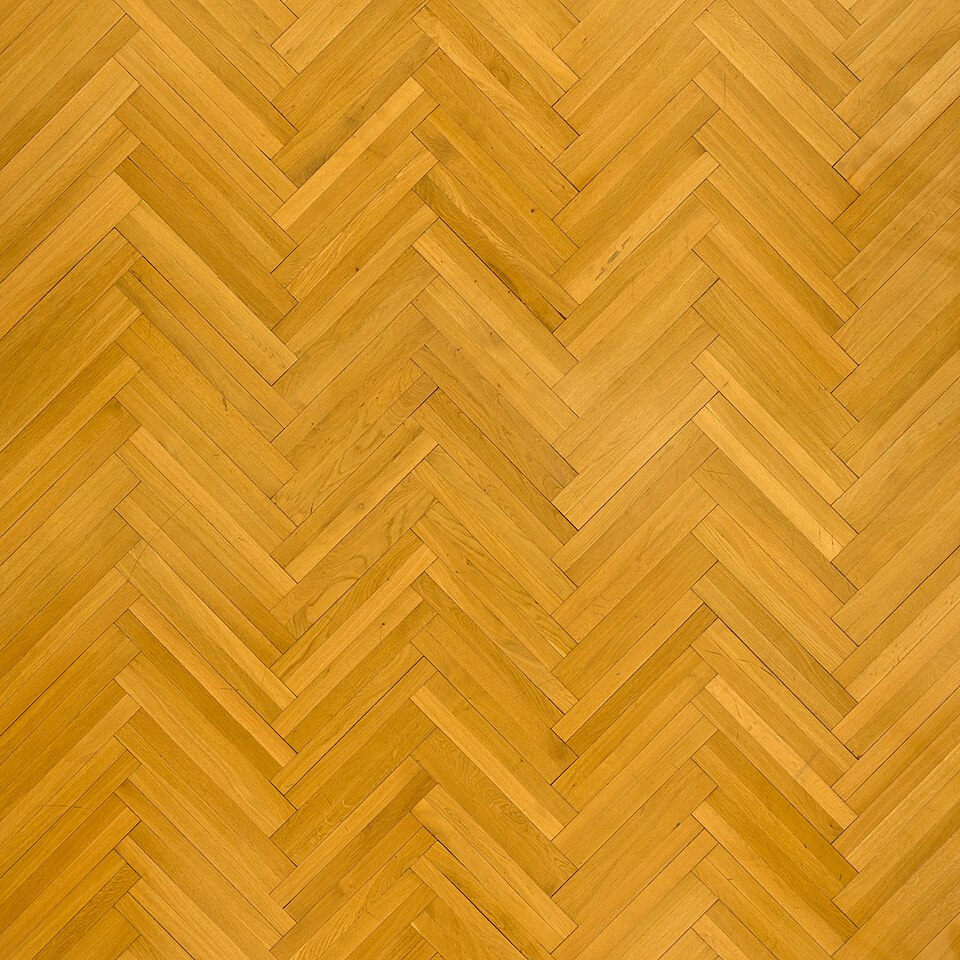
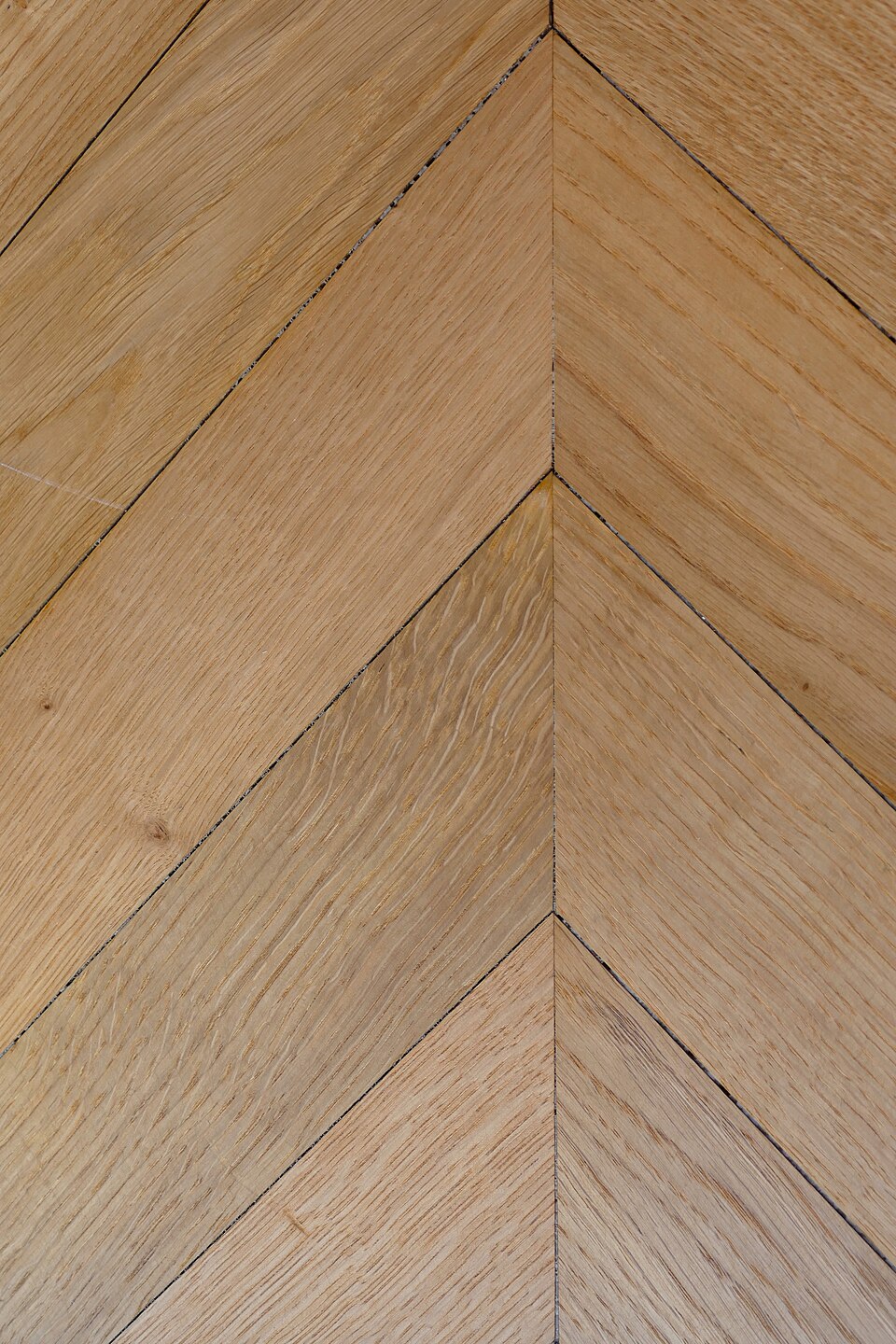
Chevron flooring has both ends of each board cut at an angle, commonly 45 degrees, so the boards meet in a continuous point. In French it is called parquet en point de Hongrie. Herringbone, by contrast, uses square ends meeting at right angles.
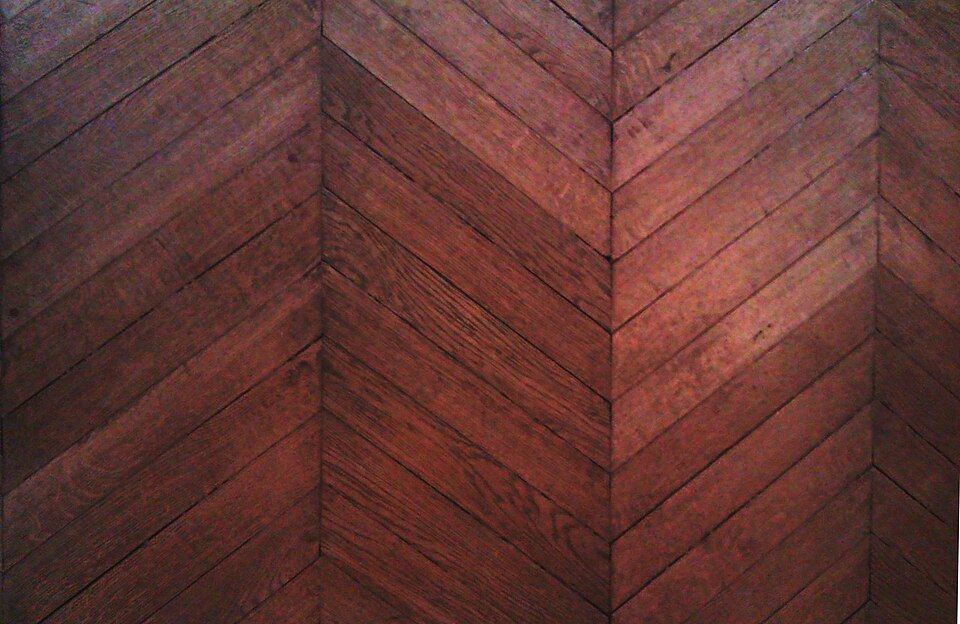
Chevron flooring is a parquet pattern in which the ends of every board are cut at an angle, so that neighbouring boards meet in a continuous V-shaped point1. In French it is parquet en point de Hongrie, laid like herringbone but with mitred ends2 (explore our side-by-side comparison of herringbone vs chevron). The angle is commonly 45 degrees, although 60 degrees is also made1.
What is chevron flooring?
Havwoods explains that chevron pieces have their short ends cut at an angle, typically 45 or 60 degrees, so that boards meet at a perfect point and form a continuous zigzag line1.
The National Wood Flooring Association (NWFA) lists chevron with herringbone, rhombus and standard block-pattern parquet among the geometric parquet patterns6. As with herringbone, the boards can be solid or engineered: Dinesen offers solid Douglas planks in a chevron pattern5, and Bauwerk makes a 2-ply engineered board with a 45 degree blade angle for chevron laying4.
How does chevron differ from herringbone?
| Feature | Chevron | Herringbone |
|---|---|---|
| Board ends | Cut at an angle, typically 45 or 60 degrees | Square, complete rectangles |
| How boards meet | At a perfect point | At a right angle in a broken V, staggered |
| French name | Point de Hongrie | Bâtons rompus |
Sources:1,6,2. See our herringbone flooring page for how its left and right boards work. The CNRTL dictionary's wording is the cleanest definition: a point de Hongrie parquet has its blades laid as in a bâtons rompus parquet, but with their ends cut on the mitre2.
Why "point de Hongrie"?
The name means "Hungary point". A French library research service, the Guichet du Savoir of the Bibliothèque municipale de Lyon, looked into the origin in 2016 and reported that it found no link between this type of parquet and Hungary, or the embroidery stitch of the same name. It lists the alternative names parquet point de Hongrie, chevron, arêtes de poisson, fougères and en épis3.
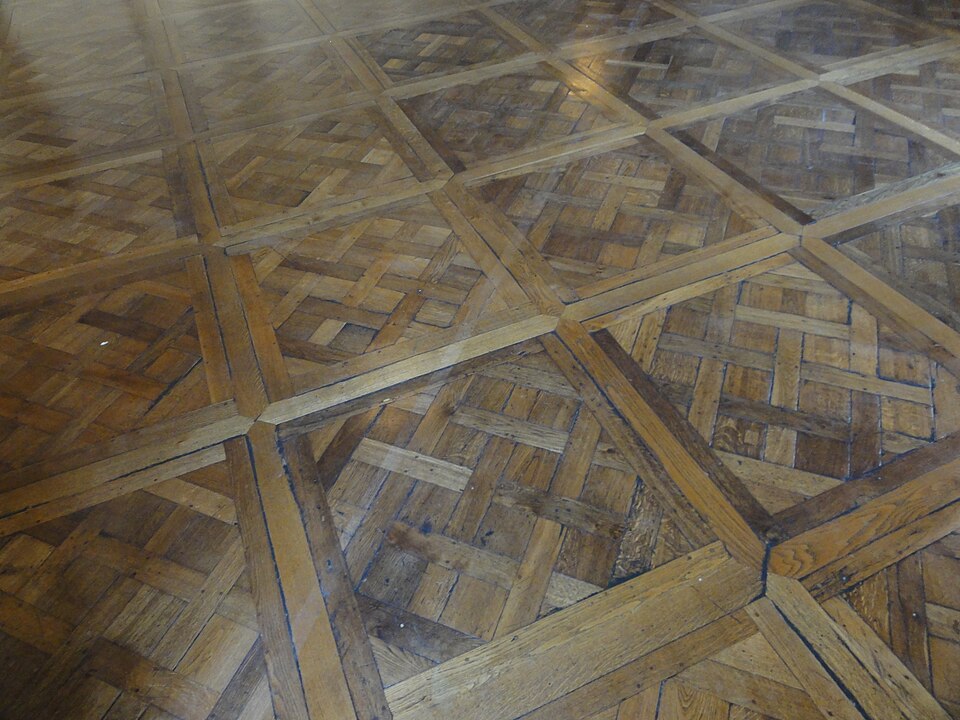
On dating, it cites Franck Briatte's Art et techniques du parquet for the statement that point de Hongrie parquets appear in the 17th century, and a parquet maker's blog for an old laying pattern dating from the early 17th and 18th centuries3. Those are second-hand citations, so we treat the 17th century as a reported date, not a settled one. For the best-documented panel tradition of the same period, see Versailles panels. The French terms and history are covered in more depth on our Hungarian point parquet page.
What sizes and angles are available?
| Example | Build | Dimensions | Angle | Source |
|---|---|---|---|---|
| Bauwerk Formpark Rombico | 2-ply engineered | 735 x 130 x 9.5 mm | 45 degrees | 4 |
| Dinesen Douglas Pattern | Solid | One chevron project: 35 mm thick, 250 mm wide, 1.4 m long | Not stated | 5 |
| OscarOno Hongrie | Flatgrain select oak, 12 mm with 4 mm top layer | 150 or 190 mm widths | Not stated | 7 |
Bauwerk describes the 45 degree blade angle as making the board suited to chevron laying, "also known as point de Hongrie"4. The OscarOno Paris Hongrie collection is an oak chevron in point de Hongrie, lacquered in twelve colours7. Always confirm the angle with the manufacturer, since one maker's boards are not interchangeable with another's.
How is chevron flooring installed?
NWFA treats chevron and herringbone installation together. Chevron patterns are often glued down. They can be nailed using the schedule for the flooring as long as the pattern keeps an exposed side tongue, and the guidance warns that a pneumatic nailer's impact can force boards out of their intended position and knock the pattern out of square6. A nail-assisted glue-down is another option, with fasteners strictly as a supplement to the adhesive6.
Setting out differs slightly from herringbone. To find the centre of a chevron pattern, measure the entire pattern width and divide by 2: the mitred point is the centre. Working lines for chevron fall on the opposite mitred end of each picket, rather than through the corners of alternating slats as in herringbone6. Because the pattern relies on every mitre meeting exactly, it is worth keeping the substrate flat and following the manufacturer's tolerances. Our installation methods guide covers the fixing methods in general.
Which wood and construction should you choose?
The pattern does not decide durability; the wood and the build do. Solid chevron gives a thicker surface, as in Dinesen's 28 mm and 35 mm Douglas patterns, while engineered boards such as Bauwerk's 9.5 mm 2-ply or OscarOno's 12 mm board with a 4 mm top layer have a wear layer bonded to a backing547. Our engineered wood flooring and solid wood flooring pages explain the trade-offs, and European oak is a common species in both patterns.
What should you check before ordering chevron?
Four checks come straight from the sources above. First, confirm the cut angle with the manufacturer, because 45 and 60 degrees are both used and the OscarOno Hongrie page gives no angle17. Second, check the thickness and wear layer: the NWFA says parquet thickness varies from 5/16 in to 3/4 in and may be solid or engineered6. Third, order by the actual dimensions of the pattern, because the NWFA notes that the quantity of pieces depends on the jobsite layout and the repetition of the pattern itself6. Fourth, plan the layout from several bundles or packages so that colour and grain vary across the floor6.
Frequently asked questions
What is the difference between chevron and herringbone flooring?
Why is chevron flooring called point de Hongrie?
What angle are chevron boards cut at?
Can chevron flooring be nailed?
Sources
- Chevron flooring vs herringbone flooring, Havwoods. Accessed .
- Parquet (definition), CNRTL, Trésor de la langue française informatisé (CNRS / ATILF). Accessed .
- Question d'origine : parquet point de Hongrie, Le Guichet du Savoir, Bibliothèque municipale de Lyon. Accessed .
- Formpark Rombico product leaflet, Bauwerk Parkett. Accessed .
- Douglas Pattern: herringbone and chevron, Dinesen. Accessed .
- Wood Flooring Installation Guidelines (revised 2025), National Wood Flooring Association. Accessed .
- Hongrie collection, OscarOno Paris. Accessed .
This page compiles published data from the sources listed above. Read our editorial policy. Last updated .