Mosaic parquet
Quick answer
Mosaic parquet is a traditional solid wood flooring format composed of small, slim finger slats—typically 8 mm thick, 22.8 mm wide, and 160 mm long—assembled into square panels or geometric laying units32. Standardised in Europe under EN 13488, it is glued directly to the subfloor with full-surface adhesive, sanded, and finished on site13. Its compact 8 mm solid profile provides exceptional stability, low thermal resistance, and repeated renovation cycles.
Mosaic parquet (often referred to as finger parquet or five-finger parquet) is one of the most durable and resource-efficient forms of solid wood flooring. Milled from small, solid hardwood slats—typically 8 mm thick, approximately 23 mm wide, and 160 mm long—mosaic parquet elements are grouped into geometric squares or parallel bands and bonded directly to the subfloor with full-surface adhesive32. Regulated across Europe under standard EN 13488, mosaic parquet combines the longevity of solid timber with the low installation height required for modern refurbishment projects1.
What is mosaic parquet and how is it constructed?
Unlike traditional tongue-and-groove boards or multi-layer boards, mosaic parquet consists entirely of square-edged, solid wood fingers (also called lamellas or slats) without mechanical interlocking joints13.
Under European standardisation, mosaic parquet products conform to specific technical parameters:
- European Standard EN 13488: Governs the dimensions, moisture tolerances, and appearance grading of mosaic parquet elements1. Elements must also satisfy the harmonised CE-marking requirements of EN 14342 for reaction to fire, thermal conductivity, and formaldehyde release2.
- Dimensions: Slat thickness is standardised at 8 mm32. Slat widths range up to 35 mm, while lengths typically span between 115 mm and 165 mm2. Bembé Parkett, one of Germany's historic parquet specialists, cites standard dimensions of 8 mm thickness, 22.8 mm width, and 160 mm length3.
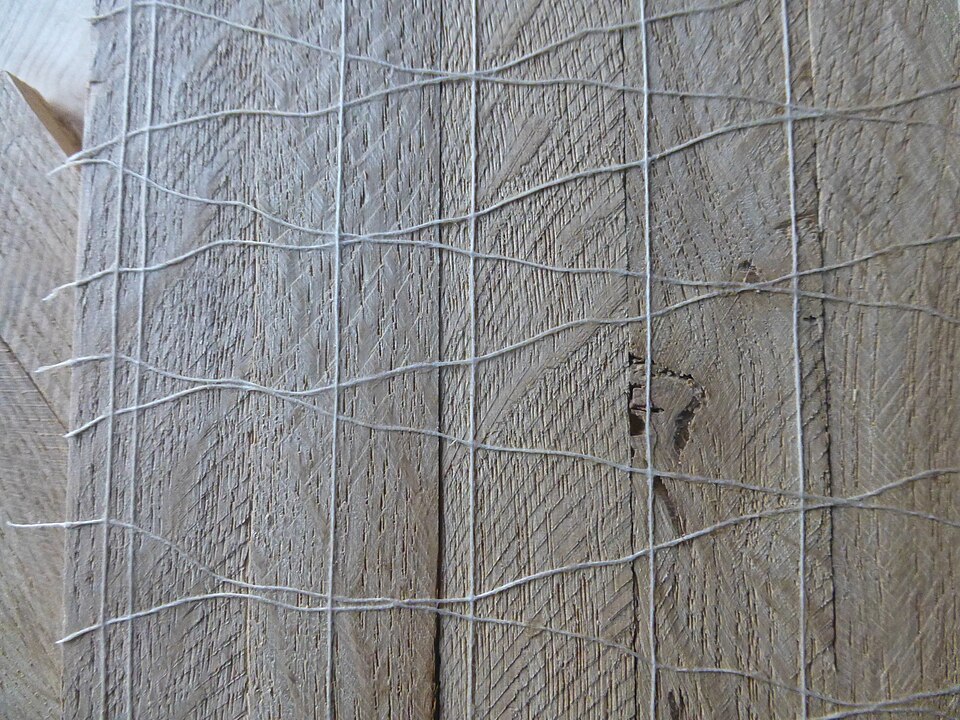
- Pre-assembled laying units: Because placing thousands of individual 8 mm slats by hand would be impractical on site, manufacturers assemble slats into pre-configured panels (often 320 mm × 320 mm or 640 mm × 320 mm)2. These panels are held together either by an elastic mesh glued to the underside (which embeds permanently into the parquet adhesive) or by Kraft paper taped to the top face (which is wetted and peeled away once the adhesive cures)23.
Because there are no tongues and grooves taking up depth, virtually the entire 8 mm thickness functions as a usable wear layer3.
What patterns can be created with mosaic parquet?
The modular geometry of mosaic slats allows several classic architectural layouts:
- Checkerboard (Würfel / Cube pattern): The most widespread pattern. Slats are grouped into small squares (typically five, six, or seven slats per square) where the grain of each square runs at a 90° angle to its neighbours32. This alternating grain orientation cancels out directional wood movement across the floor.
- Diagonal checkerboard: Checkerboard panels oriented at a 45° angle to the primary walls of the room, adding dynamic perspective to square or compact spaces3.
- Parallel / Stave bond: All slats are laid in the same direction, either in a continuous uniform line or staggered by half-lengths like miniature decking or brickwork.
- English bond / Ladder pattern: Slats laid in stepped parallel groups separated by cross-oriented bands3.
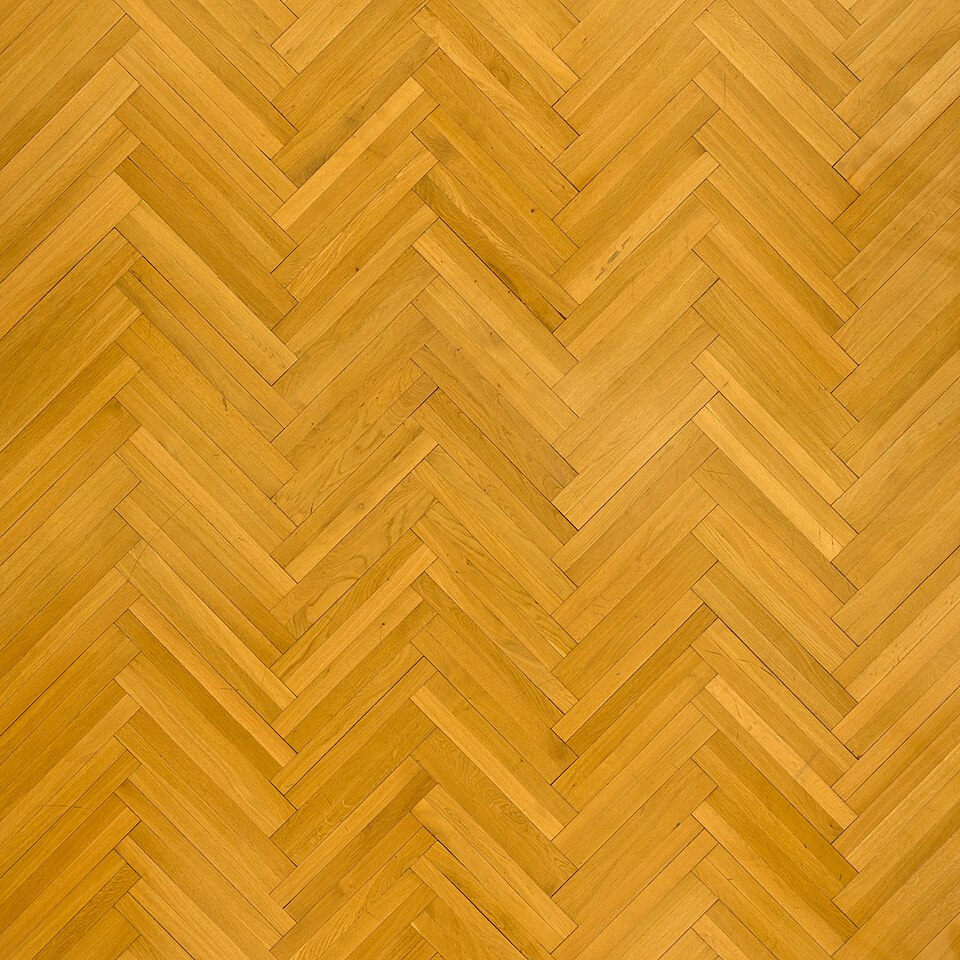
- Herringbone: Slats arranged in traditional V-shaped zig-zag courses, echoing the geometry of classic herringbone parquet.
Which wood species are used for mosaic parquet?
Because mosaic slats are small, sawmills can produce them from offcuts and high-grade timber pieces that are too short for wide planks, making mosaic parquet ecologically efficient.
Common species published by flooring manufacturers include3:
- European oak: The dominant species in European architecture, chosen for its warm colour, pronounced ring porous grain, and proven hardness.
- European ash: Offers high elasticity and impact resistance with a distinctive cream-to-light-brown grain.
- European beech: Dense and homogeneous, with an even pinkish hue when steamed.
- Hard maple: Dense, fine-textured, and exceptionally pale, suitable for bright minimalist interiors.
- Smoked oak (Räuchereiche): Oak timber treated with ammonia vapour, darkening the core fibres to deep chocolate or near-black tones throughout the entire 8 mm thickness3.
How is mosaic parquet installed?
Installing mosaic parquet requires professional subfloor preparation and specialised adhesion techniques, detailed in our comprehensive installation methods guide:
- Subfloor flatness and moisture testing: The concrete screed, anhydrite base, or plywood subfloor must be dry, structurally sound, and flat. Under national building codes, screed moisture must not exceed 2.0% for cementitious screeds or 0.5% for calcium sulfate screeds.
- Full-surface adhesive application: Mosaic parquet must never be installed as a floating floor. It is fully bonded to the substrate using low-emission silane-modified polymer (SMP) or two-component polyurethane parquet adhesives, spread with an appropriate notched trowel3.
- Laying and rolling: Mesh-backed panels are set into the wet adhesive bed and rolled firmly with a heavy flooring roller to ensure 100% adhesive transfer without hollow spots.
- Acclimatisation and curing: Once the adhesive has fully hardened (typically 24 to 48 hours), the floor settles to the ambient room climate.
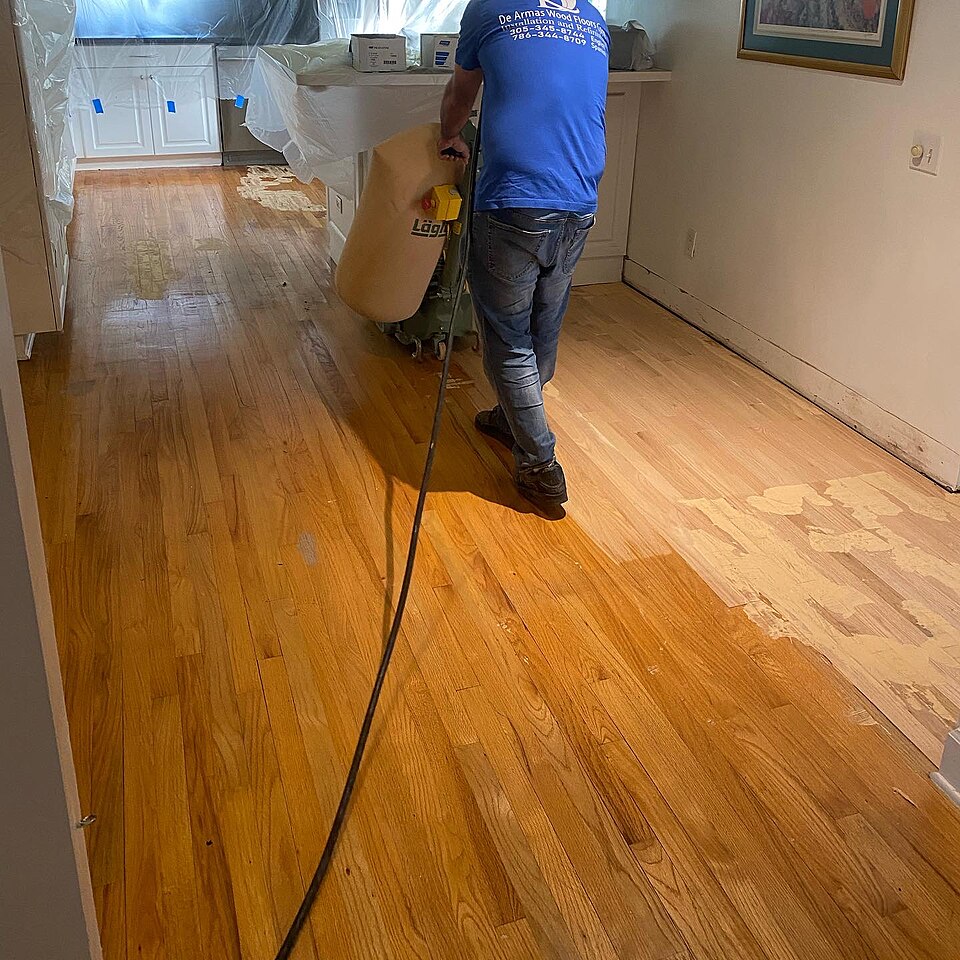
- On-site sanding and filling: Mosaic parquet is supplied unfinished. Installers sand the surface in multiple passes (coarse, medium, and fine grits), fill fine joints with timber sanding dust mixed with resin binder, and vacuum clean. Detailed procedures are explained in our guide to sanding and refinishing.
- Surface protection: The sanded timber is finished with hardwax-oil or polyurethane lacquer according to the anticipated traffic levels3.
How does mosaic parquet behave with underfloor heating?
Mosaic parquet is one of the best solid timber floorings for radiant underfloor heating systems2.
Solid wood planks often expand and contract significantly across their width when heated from below, which can cause visible gap formation. Mosaic parquet mitigates this risk through two structural mechanisms:
- Low thermal resistance: At only 8 mm thick, mosaic parquet has a thermal resistance ($R$-value) of approximately 0.05 to 0.06 m²K/W, allowing heat from water-fed or electric screed systems to conduct rapidly into the living space.
- Alternating grain equilibrium: In the classic checkerboard pattern, adjacent squares run in perpendicular directions32. When relative humidity changes, any shrinkage in one square is counteracted by the cross-grain resistance of the next, preventing wide continuous gap lines.
How does mosaic parquet compare with industrial wood block flooring?
Both mosaic parquet and industrial wood block floors utilise small, solid timber elements without tongues and grooves, but their grain orientation and thickness differ:
| Feature | Mosaic parquet (EN 13488) | Industrial wood block (Hochkantlamelle / EN 14761) |
|---|---|---|
| Timber orientation | Flatgrain (radial / tangential face exposed) | Upright edge grain (end lamellas set vertically) |
| Standard thickness | 8 mm3 | 10 mm, 16 mm, or 22 mm |
| Common pattern | Checkerboard cubes, parallel staves, herringbone3 | Continuous linear parallel bands |
| Primary environment | Residential living rooms, offices, schools, cultural venues3 | High-traffic commercial interiors, workshops, galleries |
| Installation height | Very low (8 mm + adhesive)3 | Moderate to high (10–22 mm + adhesive) |
Because of its slim profile, mosaic parquet remains the preferred option for domestic renovations where door clearances and threshold transitions are constrained.
Frequently asked questions
What is mosaic parquet?
What is the European standard for mosaic parquet?
Can mosaic parquet be used with underfloor heating?
How many times can an 8 mm mosaic parquet floor be sanded?
Sources
- EN 13488:2002 Wood flooring - Mosaic parquet elements, Genorma (CEN standards catalogue). Accessed .
- Mosaikparkett - Klebeparkett, dataholz.eu (Holzforschung Austria). Accessed .
- Mosaikparkett massiv - Lexikon, Bembé Parkett. Accessed .
This page compiles published data from the sources listed above. Read our editorial policy. Last updated .