Moisture and acclimatisation
Quick answer
Wood settles at an equilibrium moisture content set by the surrounding relative humidity, roughly 6% at 30% RH and 9% at 50% RH at room temperature. Installers check room conditions, the floor's moisture content and the subfloor before laying; NWFA allows immediate installation when all three already match, while some makers, such as Junckers, tell you not to acclimatise on site at all.
A wood floor takes on and gives up moisture until it reaches equilibrium with the air around it, so its dimensions follow the room's humidity. The practical job is to install it when the room, the boards and the subfloor already agree. The USDA Forest Products Laboratory defines equilibrium moisture content (EMC) as the moisture content at which wood is neither gaining nor losing moisture, set by the relative humidity (RH) and temperature of the surrounding air1.
What is equilibrium moisture content?
The Wood Handbook's table of EMC at 21.1°C (70°F) shows how strongly humidity drives moisture content1:
| Relative humidity | EMC of wood at 21.1°C |
|---|---|
| 30% | 6.2% |
| 40% | 7.7% |
| 50% | 9.2% |
| 60% | 11.0% |
| 70% | 13.1% |
The same chapter notes that changes in service are usually gradual, that short-term fluctuations mostly affect the surface, and that coatings such as varnish or lacquer retard moisture changes but cannot prevent them1. It also stresses that table values are suitable for practical applications and that actual EMC can vary considerably between species and pieces1. Wood shrinks and swells about twice as much tangentially as radially1, and NWFA notes that plainsawn flooring is less stable in width3.
For interior wood, NWFA cites USDA figures of 8% average moisture content (6 to 10% range) in most of the United States, 6% (4 to 9%) in dry southwestern regions and 11% (8 to 13%) in damp, warm coastal areas, and warns that actual conditions in any location may differ significantly3.
What humidity should a wood floor live in?
Makers set different working ranges, so match your product's own sheet.
| Source | Humidity and temperature stated |
|---|---|
| NWFA (sports floor maintenance guidance) | 30 to 50% RH and 60 to 80°F year-round3 |
| Junckers | Instructions based on 35 to 65% RH; floors can be laid in 25 to 85% RH if the annual swing stays within 30% RH4 |
| Weitzer | Seasonal range 30 to 65% RH; ideal climate for maximum stability is 20°C and 50% RH7 |
| Kährs | 30 to 60% RH and at least 59°F in the room before installation8 |
NWFA also says wood flooring made for use above 9% moisture content or above 50% RH should not be installed over radiant heating unless the maker approves it3. The underfloor heating guide covers that case.
How do installers test the moisture content of the boards and the room?
NWFA frames testing as essential quality control: installers must know the ambient conditions, the moisture content of the flooring and that of the substrate, using thermo-hygrometers and moisture meters3. Its procedure for solid wood is to record jobsite temperature and RH on delivery and take at least 40 board readings for the first 1,000 square feet, plus 4 more per extra 100 square feet, averaging the results and isolating unusually high or low boards3. Engineered and parquet floors follow a similar schedule, and parquet and end-grain use 40 panels or blocks3.
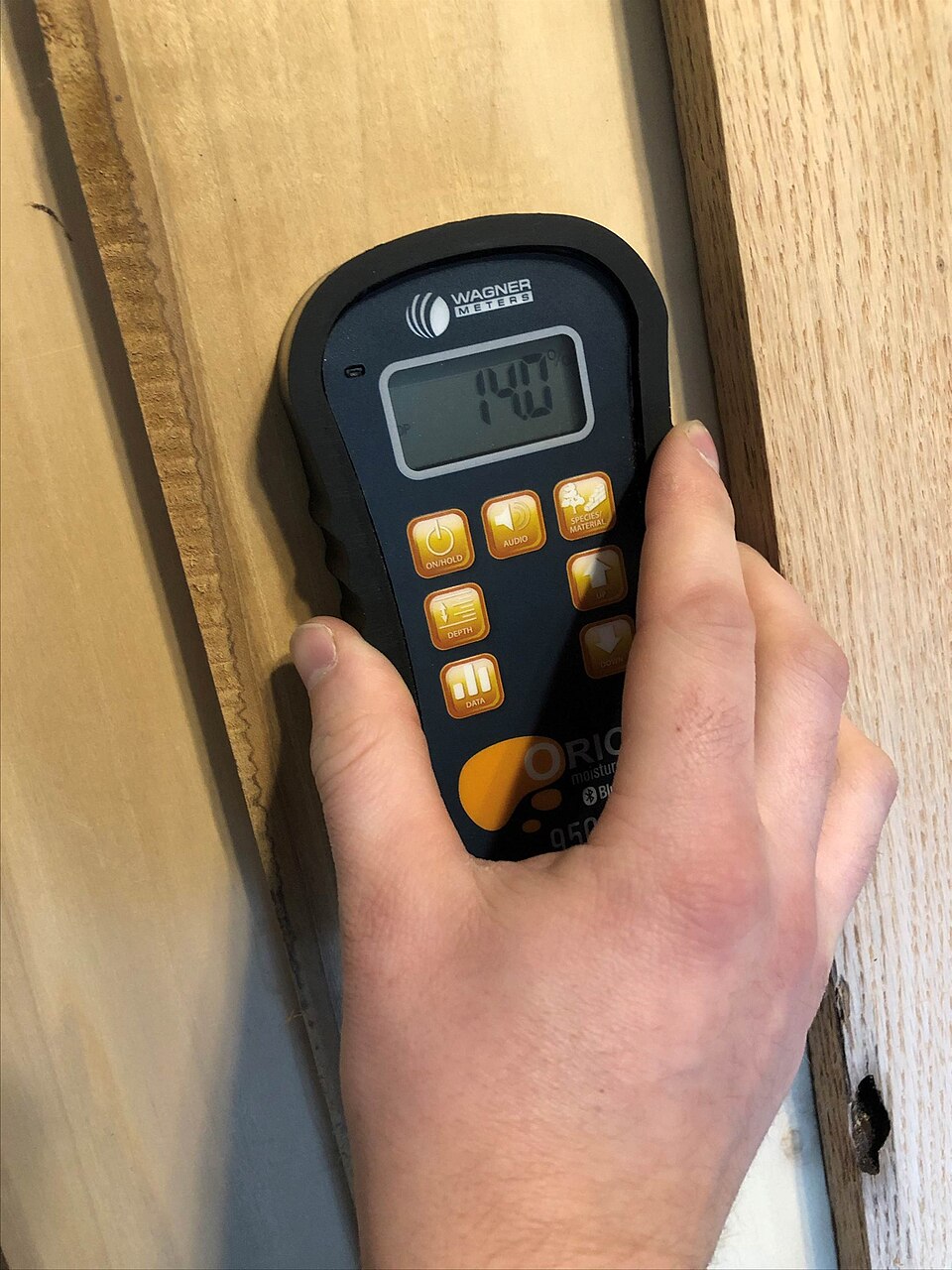
Meter choice matters. NWFA describes pinless (dielectric) meters whose signal penetrates from 1/4 to 1 1/2 inches and pin-type (resistance) meters, notes that most meters are calibrated to pine, Douglas fir and hemlock so species correction is needed, and warns that engineered floors' cores and adhesives can change a pinless reading3. It also says moisture content values above the fibre saturation point are only qualitative, and that the laboratory oven-dry method (ASTM D4442, 102 to 105°C) is the reference method used to calibrate other methods3.
How should you test a wood subfloor?
NWFA asks for at least 20 test locations for the first 1,000 square feet plus 4 per additional 100 square feet, with at least three tests per room and extra attention to exterior walls and plumbing3. Its rule of thumb where the subfloor is not aligned with the room's conditions is a subfloor moisture content no more than 4% above strip flooring (under 3 inches wide) and no more than 2% above plank flooring (3 inches or wider)3. In hot, humid climates it says the subfloor should not exceed 13% moisture content, and notes mould growth is possible above 15% and fastener corrosion above 18%3.
Junckers expects wooden subfloors to sit at 6 to 12% moisture content in balance with room humidity6. NWFA also says to compare against other properly conditioned wood in the building when the subfloor is hard to read, and to find and fix any elevated reading before flooring is delivered3.
How do you test a concrete subfloor?
NWFA says to test every job, even when the adhesive maker states no moisture testing is required, and notes that a test shows the slab's condition at the time of the test, not a permanent state, especially without an effective vapour retarder under the slab3. Its main tests, with the thresholds it states:
| Test | Method summary | Threshold (NWFA) |
|---|---|---|
| ASTM F1869 calcium chloride | Sealed dish of anhydrous calcium chloride left 60 to 72 hours on a prepared area; result in pounds of water per 1,000 sq ft per 24 hours3 | Above 3 lbs: wait for further drying or apply a minimum Class 1 impermeable vapour retarding membrane3 |
| ASTM F2170 in-situ RH | Probes in drilled holes at 40% of slab thickness (drying from top only) or 20% (drying top and bottom), left at least 24 hours, no drift over 1% RH in five minutes3 | Above 80% RH: wait or apply a Class 1 membrane3 |
| ASTM F2659 electrical meter | Non-destructive scan of the upper inch of the slab3 | Mapping only; not decisive alone3 |
| ASTM D4944 calcium carbide | Pulverised sample in a pressure vessel3 | Above 2.5%: Class I vapour retarder; above 4% may be unacceptable3 |
Makers add their own limits. Junckers requires residual moisture not to exceed 65% RH for glue-down, with its liquid moisture barrier for 65 to 95% RH or underfloor heating; for its clip floors it allows 90% RH (UK: 75% RH according to BS 8201)65. Junckers also drills in-situ holes to about half the slab thickness and measures at a subfloor temperature of 17 to 25°C6. For heated screeds, Weitzer gives maximum CM residual moisture of 1.8% for cement screed and 0.3% for anhydrite screed7.
The sources therefore disagree on depth and limits: NWFA's probe depth is 40% or 20% of the slab with an 80% RH trigger, while Junckers uses about half the slab and stricter RH ceilings for glue-down. Use the flooring maker's number.
How do you acclimatise a floor?
NWFA prefers the word conditioning: aligning the flooring and the building3. If boards arrive at the expected in-use moisture content, the room conditions are right and the subfloor matches, flooring may be installed immediately3. If not, NWFA says moisture content may need adjusting, and cautions that altering it can make boards shrink or swell outside their manufactured size and that solid wood does not change uniformly3. Its conditioning steps:
- Separate solid flooring into small lots or open the packaging, then cross-stack with 3/4 to 1 inch stickers between layers until EMC is reached3.
- Allow two to three times longer for imported or tropical species3.
- Condition off-site only where those conditions mirror the building's expected conditions3.
- For unfinished solid wood, let the installed floor stabilise 5 to 7 days before sanding and finishing, longer if adhesive off-gassing needs time3.
For end-grain flooring NWFA says it tends to equilibrate relatively fast and conditioning is faster when blocks are restacked on edge and spread out3.
Other sources differ. The Wood Handbook's finished-flooring guidance, which cites a 1961 Forest Products Laboratory publication, says to break open bundles, close the house at night and raise the temperature about 8°C (15°F) above outdoor temperature for about three days before laying2. NBS (2007) advises acclimatising in the room for at least seven days before installation9. Junckers instructs differently for its boards: before delivery the building must already be at 35 to 65% RH and about 20 °C, and the boards are then laid immediately, with wrapping removed only just before laying and no acclimatising on site6. The aim is the same, matching floor and room, but the method differs. The practical rule is to follow the instructions for your product, and read our installation methods guide alongside.
What conditions does the building need first?
Junckers says the building must be weathertight, the heating installed and tested, and wet trades such as screeding, tiling and plastering finished and dried4. The Wood Handbook adds practical timing: deliver flooring after masonry and plaster are fully dry and install the heating plant before flooring arrives2. For reclaimed wood, NWFA says milled boards must be dried to a moisture content that matches the home and then conditioned like solid, engineered, parquet or end-grain flooring3.
What happens when moisture is wrong?
Seasonal change is normal. Junckers says all hardwood floors expand as RH rises and contract as it falls, producing occasional minor gaps between boards in winter4. NWFA's firm rule is never to install a wood floor over a known moisture condition, and always to test so unknown conditions become known3. Kährs says floors can lift from over-wet cleaning or from moisture rising from below when a vapour barrier is missing8. Humidity management afterwards is covered in cleaning and maintenance.
Frequently asked questions
What moisture content should a wood floor have when it is laid?
How long should a wood floor acclimatise?
Which concrete moisture test should be used?
What relative humidity is right for a wood floor?
Can a moisture meter tell me the concrete is dry?
Sources
- Wood Handbook (FPL-GTR-282), Chapter 4: Moisture Relations and Physical Properties of Wood, USDA Forest Products Laboratory. Accessed .
- Wood Handbook (FPL-GTR-282), Chapter 13: Drying and Control of Moisture Content and Dimensional Changes, USDA Forest Products Laboratory. Accessed .
- Wood Flooring Installation Guidelines, revised 2025 (Acclimation/Conditioning; Moisture Testing), National Wood Flooring Association (NWFA). Accessed .
- General information, solid hardwood floors, C 1.0, Junckers. Accessed .
- Clip floors, specifier's and installation instructions, C 1.1, Junckers. Accessed .
- Glued hardwood floors, specifier's and installation instructions, C 1.3, Junckers. Accessed .
- Information Sheet MB 020: Parquet on subfloor heating (07-2025), Weitzer Parkett. Accessed .
- FAQ about flooring, Kährs. Accessed .
- Underfloor heating: the cover up, NBS (Norman Carless, 2007). Accessed .
This page compiles published data from the sources listed above. Read our editorial policy. Last updated .