Charred wood (shou sugi ban) flooring
Quick answer
Charred wood, called yakisugi or shou sugi ban, is timber whose surface has been deliberately burnt to a black char layer, a technique used in Japan for centuries. Published tests give a mixed picture: a US Forest Products Laboratory study found no systematic improvement in flammability or durability of commercial siding, while a small Latvian study found better fire performance when the char was left in place. On a floor, the char layer is thin and soft, so interior products are sealed with a varnish or similar finish.
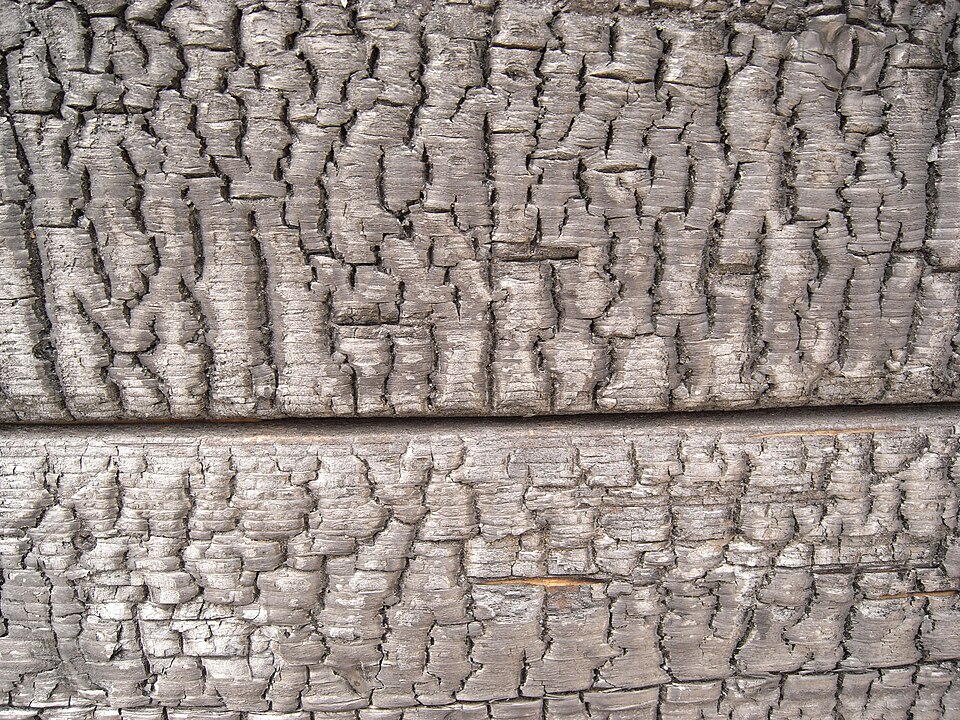
Charred wood is timber whose face has been burnt on purpose to leave a black, textured surface. It is sold as shou sugi ban or yakisugi, and a research team at the US Forest Products Laboratory describes the process as a surface treatment that chars the face of lumber such as exterior siding1. In flooring it is a look more than a performance upgrade, and the published research is about cladding rather than floors.
What do shou sugi ban and yakisugi mean?
The two names describe the same family of treatments. The Forest Products Laboratory paper says shou sugi ban is also called yakisugi or sugi ban1. Sugi is Japanese cedar, Cryptomeria japonica, a wood endemic to Japan. The Wood Database says it is sometimes traditionally charred black using the technique called shou sugi ban, and that flame-treated planks are commonly used as siding4.
Researchers who study the method call it a traditional Japanese technique used for centuries2. We found no university, museum or standards source that gives a reliable start date, and trade articles disagree, so we do not date it. The Latvian authors note that the method is now popular in EU countries mainly for decorative purposes3. The name alone does not tell you which species lies beneath the char.
How is wood charred?
The traditional approach described in a 2023 study chars boards on one face by fixing three planks together into a triangular prism that acts as a chimney. The authors call this the Yakisugi method2. In their test the charring was uneven along the chimney: carbonisation was more pronounced at the bottom than at the top2.
A Latvian group combined charring with brushing. The brushing leaves a dark texture from the latewood and a lighter one from the earlywood3.
How deep is the char layer?
Thin. In the silver fir boards of the 2023 study, the charred layer averaged 2.7 mm, measured with a digital caliper2. The same study measured the surface density: uncharred oven-dry wood averaged 488 kg/m³, while the charred surface ranged from 383 kg/m³ at the bottom of the chimney to 424 kg/m³ at the top2. Charring significantly reduced surface density2.
Does charring protect wood from fire and decay?
The research is mixed, and it concerns cladding.
| Study | What was tested | Result |
|---|---|---|
| Forest Products Laboratory (2021) | Flammability with a cone calorimeter; decay with a soil block assay using one white-rot and one brown-rot fungus | "The shou sugi ban process did not systematically improve the flammability or durability of the siding"1 |
| Latvian institute (2021) | Cone calorimeter and Single Burning Item test, classified under EN 13501-1:2018 | Fire performance improved when the char layer was kept as the facing, and declined when brushing removed it3 |
| BioResources (2023) | Silver fir, density, 24-hour water absorption, Brinell hardness | Thicker char layers absorbed more water and had lower hardness2 |
Some sources claim that charring raises resistance to fire and rot. The Wood Database says the technique increases fire and rot resistance4, and the Latvian authors say the charred layer has long protected outdoor timber3. The laboratory tests above do not bear that out consistently. The sensible reading is that results depend on the species, the way it was charred, whether the char was brushed or sealed, and the test used. Treat any single claim of "fireproof" or "rot-proof" with caution.
How are charred surfaces used on facades and indoors?
The traditional use described in the literature is outdoor timber, and the studies above all examine siding or cladding123. Indoors it appears on feature walls, stair parts and joinery, and on floors made with a charred top layer.
Floors are the most demanding use. They add foot traffic, grit and cleaning to the exposure, and none of the research cited here tests that. If you are choosing a charred floor, ask the maker for the construction, the finish and the stated usage class rather than relying on the term "shou sugi ban". The guide to flooring standards lists the standards, and our guide to fire and slip ratings explains classes such as Cfl-s1.
How does a charred surface wear underfoot?
The charred layer is soft. In the silver fir test, charred specimens averaged only 3.2% of the hardness of the uncharred back side, and thicker char layers gave lower hardness2. That is a measurement on cladding boards, not a floor wear test, but it is a reason to expect an unsealed char to rub off, mark and shed soot. Charred wood also absorbed water readily in that test: 24-hour uptake was 3,684 g/m² for the bottom samples and 2,533 g/m² for the top samples, and the authors attribute the higher uptake to increased porosity in thicker char layers2.
For these reasons floors with a charred look are normally sealed. One maker of end-grain oak flooring describes a Black finish based on the Japanese shou-sugi-ban technique, with the hardened surface sealed by a two-component invisible varnish and no stain used5.
What is an example of a charred floor?
A floor built on end grain shows the technique well, because the blocks are cut so the ends of the growth rings face up (see end-grain flooring). The Paris maker OscarOno offers Opus end-grain oak in its charred Black finish, with an 8 mm oak top layer on 12 mm birch plywood, usage class 34 and a Cfl-s1 fire rating5. The page says only "oak"; for background on the most common European flooring oak, see our European oak page.
How do you seal and maintain charred wood?
The maker-led answer is that the finish should be sealed. The general options for oils, lacquers and colour treatments are set out in our guide to wood floor finishes. For cleaning, see cleaning and maintenance. We found no research that tests sealers on charred floors, so for care instructions, follow the manufacturer's data for your product. The Latvian finding that fire performance declined when brushing removed the char layer is a reminder that the char surface is part of the system3.
Frequently asked questions
What is shou sugi ban?
Does charring make wood last longer or resist fire?
Is a charred surface hard-wearing underfoot?
Do floors use the same charring as facades?
Where did the technique come from?
Sources
- Durability and Fire Performance of Charred Wood Siding (Shou Sugi Ban), USDA Forest Service, Forest Products Laboratory (Hasburgh, Zelinka, Bishell, Kirker; Forests 12(9), 2021). Accessed .
- Physical properties of silver fir (Abies alba L.) wood cladding modified by traditional Japanese charring method, BioResources 18(4) (Ebner, Gryc, Barbu, Čermák, 2023). Accessed .
- Solid wood surface modification by charring and its impact on reaction to fire performance, Engineering for Rural Development, Latvia University of Life Sciences and Technologies (Buksans, Laiveniece, Lubinskis, 2021). Accessed .
- Sugi, The Wood Database. Accessed .
- Opus collection, OscarOno Paris. Accessed .
This page compiles published data from the sources listed above. Read our editorial policy. Last updated .