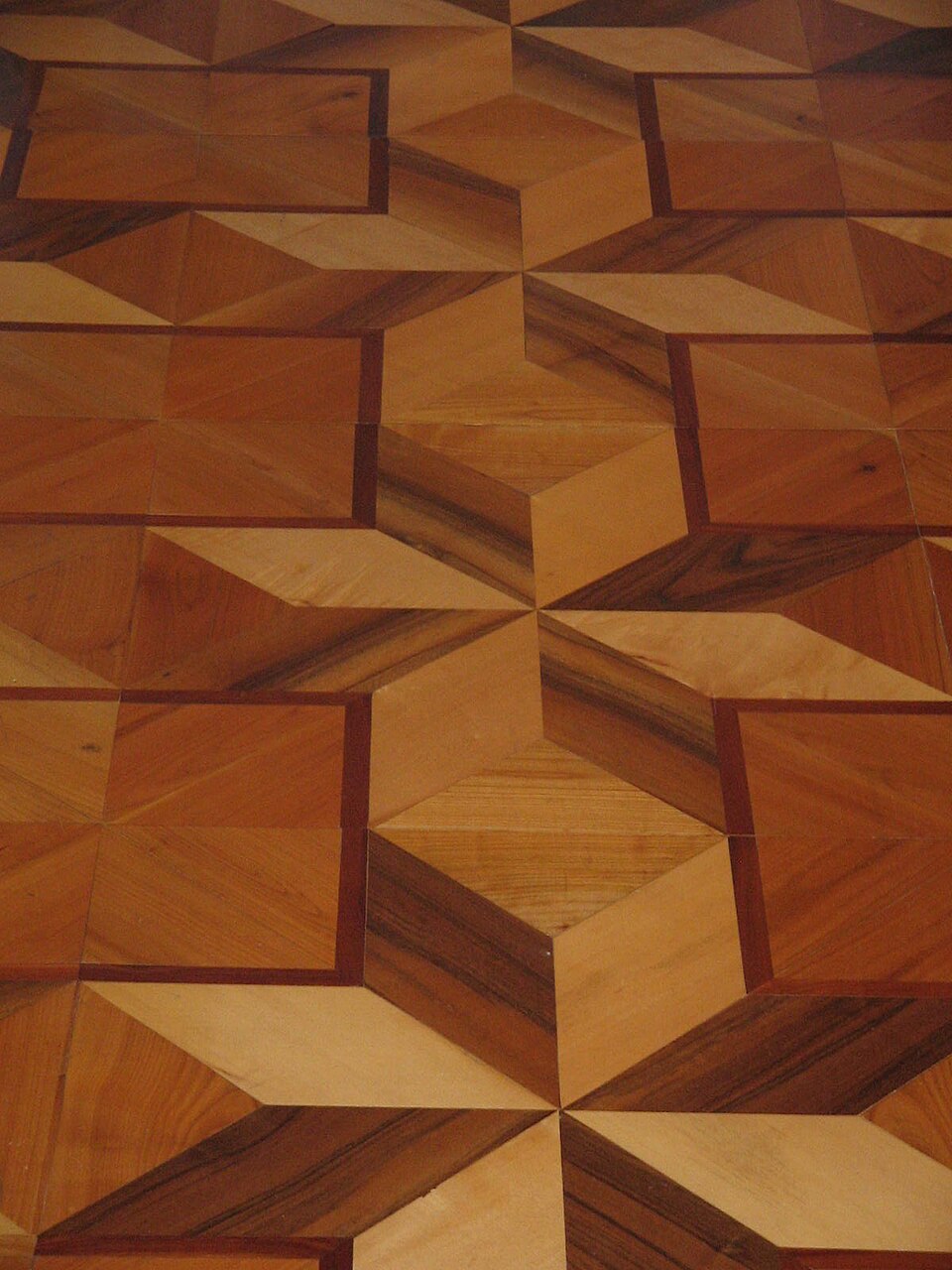
Sanding and refinishing
Quick answer
Solid wood floors can be sanded and refinished numerous times, while engineered floors can be sanded only as often as their wear layer allows: from once to about four times, depending on the maker. Sand when the finish is worn through or the surface is damaged, not for dullness, which needs only a maintenance coat. Work through grits in sequence, and control dust with extraction and a suitable respirator.
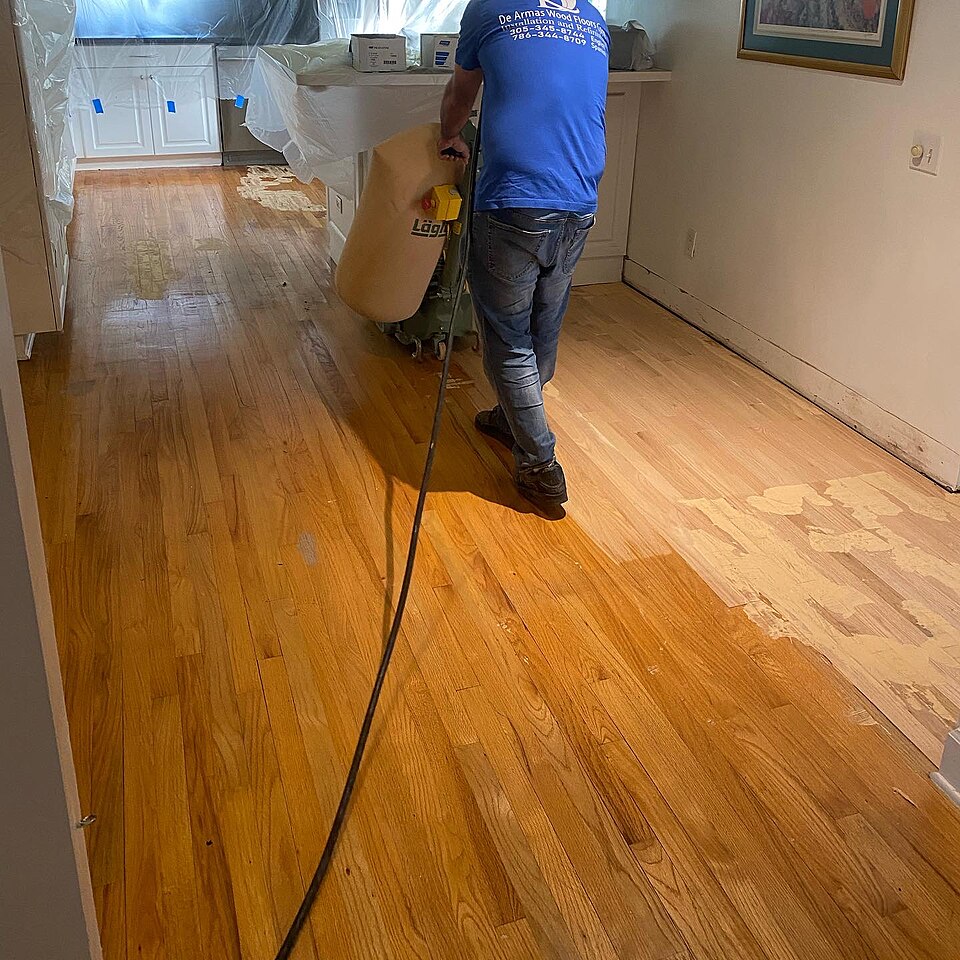
You can sand a solid wood floor many times, but an engineered floor has only as many sandings as its top layer allows. NWFA says solid wood floors can be sanded and refinished numerous times during their service life1. Engineered floors vary: the visible wear layer is real wood bonded to core layers, and its thickness decides how much can be removed1. This guide covers when to sand, how thick a wear layer needs to be, the process, and dust control.
When does a floor need sanding?
Sanding removes finish and wood, so it is a last step. NWFA says that when a floor loses its luster, it is time for a maintenance coat, not a sand1. Junckers says a lacquered floor can be refreshed by lightly sanding and applying a single layer of lacquer, but where lacquer has worn through to bare wood the whole area should be sanded back to bare wood and rebuilt with one primer and two lacquer coats6. Floors maintained with wax or polish must also be sanded to bare wood before resealing6.
NWFA's damage categories help you judge the need1:
- Surface scratches sit only in the finish coats; a fingernail cannot feel the ridge, so recoating or isolated repair may be enough.
- Deep scratches go through the finish and tear wood fibres and may need isolation repairs, recoating or resanding of the area.
- Dents and gouges may need resanding or replacement of the affected boards.
- Stains such as pet urine or chemical spills often require resanding or replacement.
For oiled floors, Junckers says its maintenance oil cannot be used once the oil has worn through to bare wood; the floor must then be sanded and re-oiled7. Compare oils and lacquers in our wood floor finishes guide.
How thick must the wear layer be?
Wear-layer limits are set by the product, so check the maker's sheet. ISO's vocabulary defines multi-layer parquet as having a solid wood top layer of at least 2,5 mm, with wood-based material making up at least 75% of the assembly's mass; a "wood floor covering" has a solid top layer of more than 0,3 mm and less than 2,5 mm11. NWFA says engineered products range from 3/8 to 3/4 inch thick1.
| Product | Wear layer | Sanding limit stated |
|---|---|---|
| Solid wood, any maker | Whole board | Numerous times1 |
| Kährs 3-layer and 2-layer engineered | Varies by product | Multiple times9; its FAQ says up to four times, depending on wear layer thickness8 |
| Kährs veneer floors (7 or 10 mm) | Thin veneer | Cannot be re-sanded9 |
| HARO 3-layer, series 2500 and 3500 | About 2.5 mm | Can be sanded down once10 |
| HARO 3-layer, series 4000 | About 3.5 mm | Can be sanded down several times10 |
| HARO 2-layer, series 4000 | About 3.5 mm | Can be sanded several times10 |
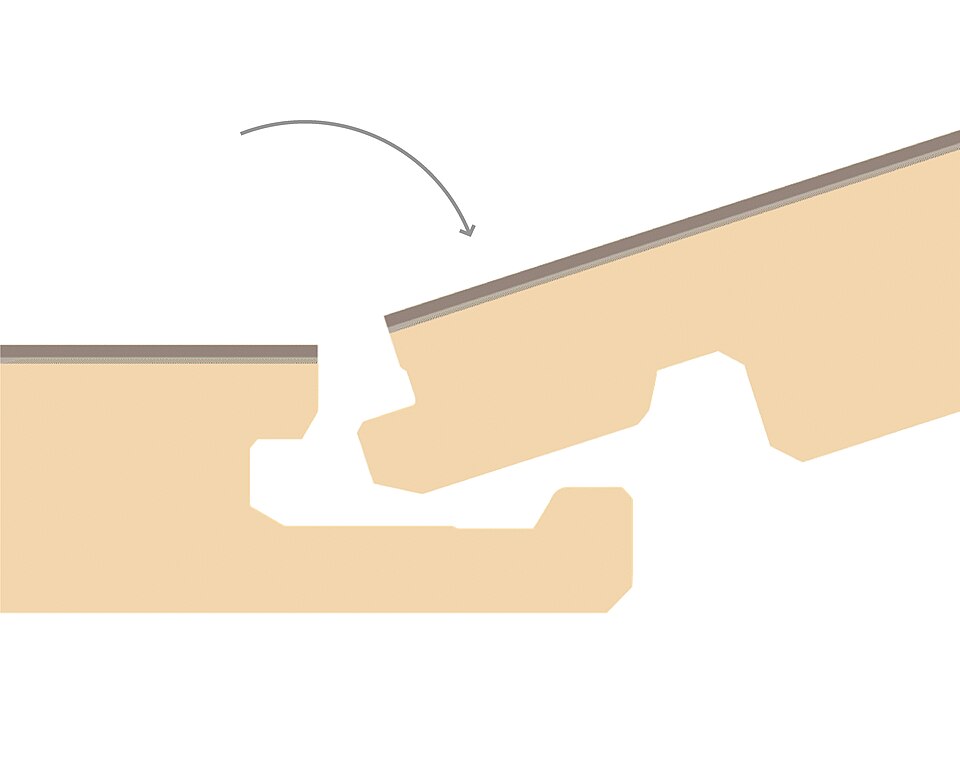
A UK supplier lists engineered constructions with a 4 mm oak top layer on 6 mm birch plywood (10 mm), a 4 mm top layer on 11 mm plywood (15 mm) and a 6 mm top layer on 14 mm plywood (20 mm), showing how widely wear layers vary12. For construction detail see engineered wood and solid wood.
No source opened gives a standard depth of wood removed per sanding, so ask the maker or a sanding professional to measure before any refinish of a thin-layer floor.
What are the steps in sanding a floor?
Bona's homeowner guide sets out a coarse, medium and fine sequence2:
- Coarse (grit 40). Remove the old coating and flatten the surface. Raise the drum before starting the motor, lower it slowly and lift it only while the machine is moving. Sand in strips with about 5 to 10 cm of overlap, in the direction of the wood; if the floor is very uneven, sand diagonally.
- Medium (grit 60). Go back along the same path.
- Edges. Use an edger in small circles at each stage, with grit 40, 60 and 100 respectively, and scrape corners before finishing with fine paper.
- Final (grit 100). For oil or hard wax oil, which tend to highlight abrasive scratches, use grit 100 on the edges and 120 on the main surface.
Bona's professional article uses a different sequence for raw wood: 50, 60, 80, then 80 or 120 for the fine stage, followed by a tampico brush pass, a vacuum and a dry tack before finishing3. It quotes NWFA's rule never to skip more than one grit of paper between cuts3. The two sequences differ in starting grit and final grit, so pick one that matches your machine and finish.
Junckers sets finish-specific rules45:
- Before its hardwax oil, final sanding must be with sandpaper grit 100 to 120, followed by vacuuming of the dust.
- Before its water-based lacquer, apply one coat of primer, sand with grit 150 to 180 along the fibres, vacuum, wipe with a cloth well wrung in clean water, then lacquer. If the final coat is applied after more than 24 hours, sand again.
- To strip wax or polish before lacquering, sand first with grit 24 to 36, then 60 to 80, then 120 to 150.
Bona adds that gaps of 0.1 to 2 mm can be filled with a mix of wood dust and filler on dimensionally stable floors, but that joint filling is not recommended for large cracks, plank or end-grain floors, or parquet with bevelled edges2. If your floor has a smoked or fumed colour, ask the maker how deep that colour goes before sanding; one supplier states smoking penetrates the veneer by 0.5 to 2 mm12.
What dust controls are needed?
Wood dust is a health hazard. The UK Health and Safety Executive says wood dust causes asthma, hardwood dust can cause cancer, particularly of the nose, and the workplace exposure limit is 3 mg/m³ for hardwood dust and 5 mg/m³ for softwood dust, as 8-hour time-weighted averages14. For sanding it advises specially adapted equipment with on-tool extraction, an H or M class extraction unit with antistatic hoses, and respiratory protective equipment with a minimum assigned protection factor of 20, for example an FFP3 mask13. HSE's guidance applies in Great Britain; check local rules elsewhere.
Bona advises emptying the dust bag before it is completely full and, in its professional sequence, connecting sanders to a dust-containment vacuum23. NWFA likewise warns that wood dust becomes a potential health problem when sanding and cutting particles become airborne1.
What happens after sanding?
New unfinished solid floors should stabilise for 5 to 7 days after installation before sanding and finishing, longer where adhesive off-gassing needs time1. After finishing, allow cure time: Junckers' hardwax oil is fully cured after 6 days and its MT500 lacquer after 72 hours45, and NWFA says to keep area rugs off a newly finished floor for at least seven days unless the finish maker says otherwise1. Routine care afterwards is in cleaning and maintenance. Standards that define wear-layer terms are summarised in our flooring standards guide.
Frequently asked questions
How many times can a wood floor be sanded?
What is the minimum wear layer on an engineered floor?
Which sandpaper grits should I use?
Is sanding dust a health risk?
Sources
- Wood Flooring Installation Guidelines, revised 2025, National Wood Flooring Association (NWFA). Accessed .
- How to sand a wood floor, Bona. Accessed .
- Best sanding sequences, Bona. Accessed .
- Hardwax Floor Oil, product information F 3.4, Junckers. Accessed .
- MT500 Floor Lacquer, product information F 5.1, Junckers. Accessed .
- Cleaning and maintenance, lacquered floors, G 4.0, Junckers. Accessed .
- Cleaning and maintenance, oiled hardwood floors, G 2.0, Junckers. Accessed .
- FAQ about flooring, Kährs. Accessed .
- Construction of engineered wood floors, Kährs. Accessed .
- Parquet plank construction: multi-layer construction and solid wood planks in comparison, HARO. Accessed .
- ISO 5323:2019 Wood flooring and parquet - Vocabulary (preview), ISO (preview hosted by iTeh Standards). Accessed .
- Construction, grading, textures and smoking/fuming, Wood Floors & Accessories Ltd. Accessed .
- Construction dust: Cutting and sanding wood, Health and Safety Executive (HSE), Great Britain. Accessed .
- Wood dust, Health and Safety Executive (HSE), Great Britain. Accessed .
This page compiles published data from the sources listed above. Read our editorial policy. Last updated .