Cleaning and maintenance
Quick answer
Care for a wood floor with daily dry sweeping or dust mopping, vacuuming with the hard-floor setting, a well wrung-out damp mop and a cleaner approved for your finish. Oiled floors are refreshed with maintenance oil; lacquered floors are renewed by a light sand and a fresh coat. Avoid steam, wet mops, vinegar and polish products, and keep indoor humidity steady.
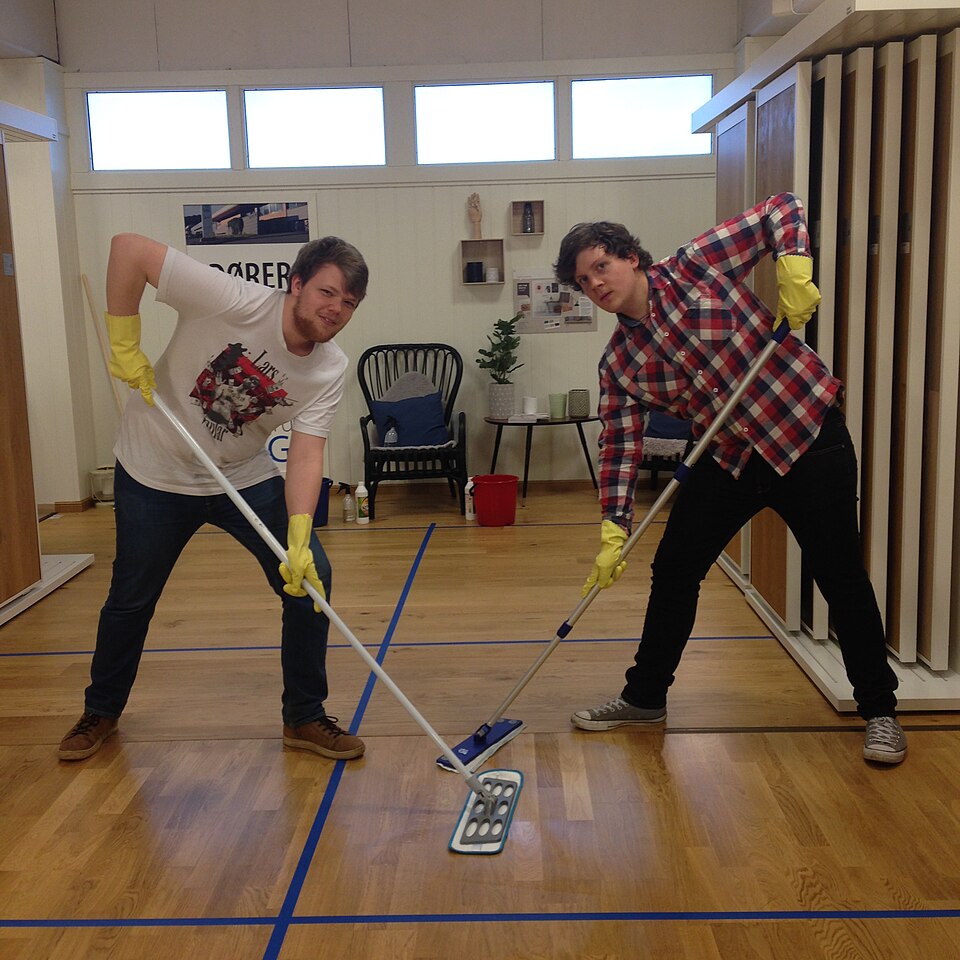
Routine care for a wood floor is mostly dry: sweep or dust-mop daily, vacuum weekly with the hard-floor setting, wipe spills at once, and damp-mop only with a well wrung-out mop and a cleaner approved for your finish. NWFA says particles ground into the surface can damage a finish, and that fine dirt combined with moisture can leave a film that dulls the wood1. The right products depend on whether your floor is oiled, lacquered or waxed.
What is the basic cleaning routine?
NWFA's guidelines set out a regimen1:
- Dry sweep daily with a high-quality dry dusting mop with disposable or washable cloths.
- Use only vacuum cleaners with a hard-surface setting, with the carpet beater bar turned off.
- Wipe up spills immediately to prevent damage from standing liquid.
- Damp mop regularly (weekly), with the mop slightly moistened and well wrung out so minimal moisture is left on the floor. Spray mops should be high quality with absorbent pads.
- Follow the flooring or finish maker's recommendations on cleaning products.
NWFA's consumer site frames the same routine as sweeping or dusting daily, vacuuming weekly, using a wood floor cleaner monthly, and avoiding wet or steam mops, which it says cause more damage over time2. Junckers adds that on large floors a scrubber-dryer can be used, with water use of no more than 40 litres per 1,000 m² and water loss not exceeding 10 litres per 1,000 m² for its lacquered floors4.
Film finishes help here. The Wood Handbook says smooth film-forming finishes such as varnish are generally easier to clean than oils that leave the surface texture intact, though films can be worn away by repeated cleaning or abrasion7.
How should you protect the floor?
Protection prevents most damage. NWFA's guidance includes1:
- Use breathable throw rugs inside and outside doorways to catch grit, salt, sand and moisture; shake them out, clean them and dry them before placing them on the floor.
- Fit fabric-faced glides under furniture legs and check them periodically for embedded soil.
- Avoid walking on wood floors in cleats, sports shoes and high heels, and keep pet claws trimmed.
- Do not slide heavy furniture; lift it. Use safety glides when moving appliances.
- Beware of non-skid rug pads: some can imprint their pattern into the finish or wood.
Junckers recommends checking felt pads every 3 to 6 months, depending on how often furniture is moved, and using plastic mats under wheeled chairs and door mats in entrances3. Rugs also screen light, so NWFA warns of colour differences in the wood where it is covered1. If you cover a new floor temporarily, NWFA says to cover it completely, use a breathable material with a vapour permeance of at least 1 perm, and tape only to the base or shoe mouldings, not the finished floor1.
Heated floors need extra care: NWFA says rugs, mattresses, pet beds and similar insulating items trap heat and can cause irreversible damage1. See underfloor heating.
How do you keep humidity steady?
Consistent conditions reduce gaps and cupping. NWFA recommends a humidifier through dry winter months and a dehumidifier in humid months1, and its consumer site suggests a home temperature between 60 and 80 degrees Fahrenheit and 30 to 50 percent humidity2. The reasoning is in our moisture and acclimatisation guide.
How do oiled and lacquered floors differ in upkeep?
| Oiled and hardwax-oiled floors | Lacquered floors | |
|---|---|---|
| Routine cleaning | Sweep and vacuum; wipe with a well wrung-out mop; Junckers Floor Cleaner can be added to the water3 | Same; Junckers Floor Cleaner can be added4 |
| Refreshing | Maintenance oil on a cotton mop; dries in 30 to 60 minutes3 | Light sand, then a single coat of lacquer4 |
| Spot repair | Possible in walking lanes with maintenance oil3 | Harder; if worn to bare wood, sand the entire area and rebuild with 1 primer coat and 2 lacquer coats4 |
| Waiting after treatment | Do not clean for at least 72 hours after reoiling3 | Do not clean for at least 72 hours after relacquering4 |
| Wrong products | Never use traditional wood floor cleaners on natural oiled finishes1 | Do not use oil soaps on urethane or film-forming finishes, unless the finish maker says so1 |
NWFA notes that oil finish makers recommend a specific maintenance routine using oils and soaps, and that failing to follow it will result in a finish that does not last as intended1. Osmo says spills on oiled wood should be cleaned as soon as possible, and that leftover oil can be kept up to 5 years for touch-ups6. For waxed floors NWFA says never to use water-based cleaners, which can cause water spots1.
When should you re-oil or recoat?
Use the finish, not a calendar. NWFA says that when a floor loses its luster it is time for a maintenance coat1. Its consumer site's rule of thumb is to refinish every 3 to 5 years, with timing depending on lifestyle2. Bona says that in a domestic environment a lacquer finish easily lasts 15 years, while commercial floors often need maintenance and periodic recoating, and that polish build-up should be removed after about every 5 to 8 layers5. Junckers says lacquer frequency depends on wear, that retail and restaurant floors need resealing more often than private homes, and that you should reseal before the lacquer wears through to bare wood4.
These intervals are not directly comparable: one is a maintenance coat on a dull surface, another is the life of a lacquer finish. For a full strip and re-finish, read sanding and refinishing, and for which finish to choose see wood floor finishes.
What should you avoid?
NWFA's list of products and methods not to use1:
- Sheet vinyl or tile floor care products.
- Self-polishing acrylic waxes, which add a film that can leave floors slippery and dull.
- Cleaners that claim to restore, rejuvenate, add shine, polish or renovate the floor, unless the finish or flooring maker recommends them.
- Household wet dusting products.
- Wax on a non-waxed finish.
- Petroleum-based cleaners on waterborne finishes.
- Vinegar, because it is acidic and degrades the finish.
- A traditional mop and bucket, which can apply too much moisture, and steam cleaners.
Using a non-recommended cleaner can spoil the intended look and also cause finish adhesion problems when the floor is next recoated1.
How do you deal with stains and spills?
Act quickly: Junckers notes dried-out stains are often harder to remove than fresh ones3. For its finishes, Junckers says to remove fruit juice, milk, tea, coffee, wine and beer with its Floor Cleaner, grease and shoe-polish scuffs with Floor Cleaner or white spirit, ink and lipstick with Floor Cleaner or methylated spirit, and blood with cold water4. For solid and engineered floors alike, check the maker's care sheet before using solvents. Low-tack adhesive tape should be used on lacquered floors because high-tack tape can damage the lacquer when pulled off quickly4.
Cleaning and polish can also change how slippery a finished floor is; see fire and slip ratings for how slip resistance is measured.
Frequently asked questions
How often should I clean a wood floor?
Can I use a steam mop or vinegar on a wood floor?
How do I refresh an oiled floor?
How do I renew a lacquered floor?
How long before I can put rugs or furniture on a newly finished floor?
Sources
- Wood Flooring Installation Guidelines, revised 2025 (Protection, Care and Maintenance), National Wood Flooring Association (NWFA). Accessed .
- Here's Exactly How To Maintain Wood Floors, National Wood Flooring Association (NWFA). Accessed .
- Cleaning and maintenance, oiled hardwood floors, G 2.0, Junckers. Accessed .
- Cleaning and maintenance, lacquered floors, G 4.0, Junckers. Accessed .
- Frequently Asked Questions (professional), Bona. Accessed .
- Hardwax oil protects and seals wood floors, Osmo UK. Accessed .
- Wood Handbook (FPL-GTR-282), Chapter 16: Finishing Wood, USDA Forest Products Laboratory. Accessed .
This page compiles published data from the sources listed above. Read our editorial policy. Last updated .