Smoked and fumed oak flooring
Quick answer
Smoked or fumed oak is oak darkened by exposure to ammonia vapour, which reacts with the tannins in the wood and turns it brown. It is a chemical colour change inside the wood, not a pigment on top, but how deep it goes depends on the process, so ask a maker whether a floor is darkened through its whole thickness. Fuming itself is hazardous and is an industrial or workshop process, not a job for a home.
Smoked or fumed oak is oak that has been darkened by ammonia vapour, which reacts with compounds in the wood, tannins above all, and turns it brown1. The result runs from a light brown to chocolate brown or black, depending on how long the wood is exposed and on the wood itself1. Because the colour comes from a reaction inside the timber, it behaves differently from a stain, but how deep it goes depends on the process.
How does ammonia fuming work?
The Zagreb researchers describe fuming as a traditional colouring method based on chemical reactions between ammonia gas and wood compounds1. Researchers at the University of Zagreb note that the colour reaction in oak was reported to occur only when atmospheric oxygen is available, and that the change rests on partial inclusion of nitrogen, oxidation reactions and the presence of tanning agents1.
In their laboratory test, samples of pedunculate oak (Quercus robur) heartwood, 2.5 mm thick, were exposed to ammonia vapour from a 25% ammonium hydroxide solution for up to 16 days. After 16 days the lightness value L* of the oak fell from 60.9 to 35.5, tannin content fell from 15% to 5%, and nitrogen content rose from 0.107% to 1.815%1. The authors read the fall in tannin as evidence that ammonia reacted with it, and say oak reacted with ammonia intensively in a very short time compared with maple, spruce and larch1. That explains why the process is associated with tannin-rich oak rather than with pale woods: for maple and larch the same study found tannin had no major influence on colour change1.
Where does fumed oak come from?
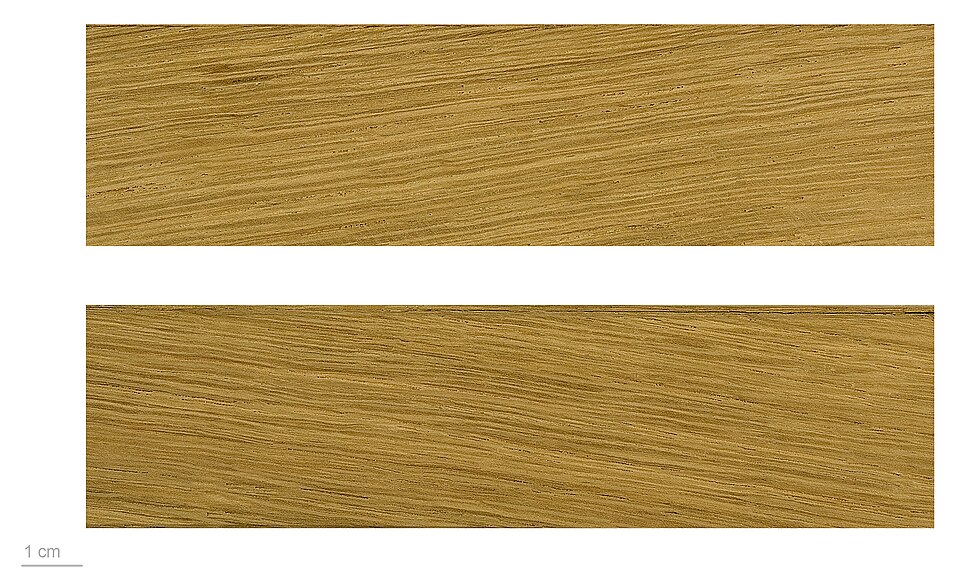
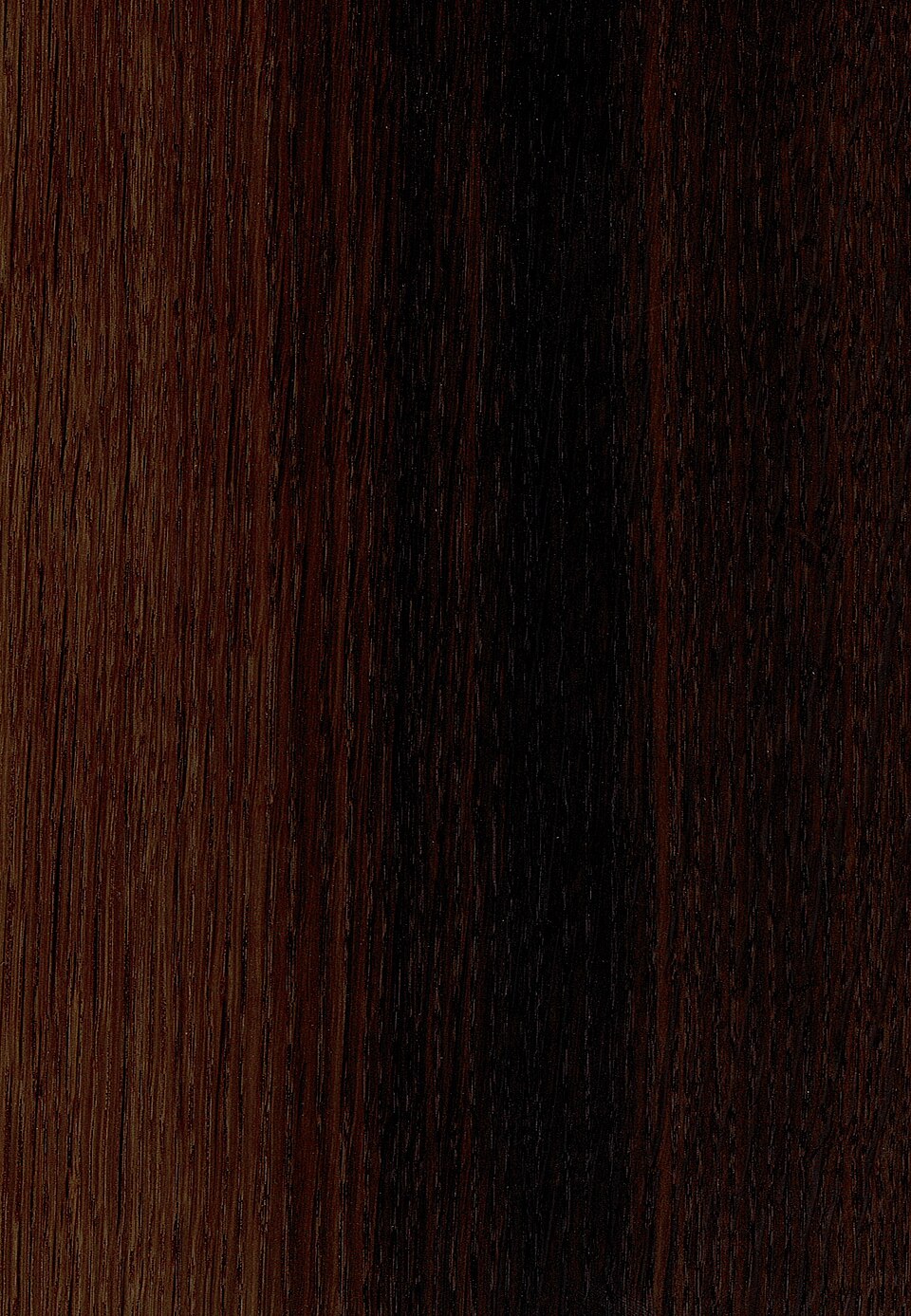
Fuming became popular with furniture makers during the Arts and Crafts movement in the early 1900s, and it created the classic rich warm brown that accentuates the ray fleck most notable in quarter-sawn white oak1. We found no source we could verify for when fumed oak was first laid as flooring, so we give no date. The photograph on this page shows an oak sample whose Commons description says it was smoked with ammonia4.
Is the colour only on the surface?
Not necessarily, and the answer varies by method. The Zagreb paper contrasts traditional surface ammonia fuming used by furniture makers with modern industrial vacuum-pressure fuming, which it says gives good fibre saturation and greater colour intensity over the entire depth of the wood1. That is the paper's description of the process, not a guarantee for any given floor.
A woodworking test gives a sense of the scale. Fine Woodworking fumed oak with three ammonia strengths for 72 hours and found colour about 1/16 in beneath the surface with household-strength ammonia, about 1/8 in with janitorial strength, and full penetration with the industrial sample2. The table summarises it.
| Ammonia used (72 hours) | Colour depth reported |
|---|---|
| Household strength | About 1/16 in |
| Janitorial strength | About 1/8 in |
| Industrial strength | Full penetration |
This is a single hobbyist test, so treat it as an indication rather than a standard. For a floor, the questions to put to a maker are whether the board is darkened through its full thickness, or only to a stated depth, and what that depth is.
How is it different from staining?
A stain deposits pigment or dye. Fuming adds no colour: ammonia reacts with the wood itself. The Zagreb authors say fuming tends to colour wood uniformly, giving it a natural look, and that it accentuates ray fleck in quarter-sawn white oak1. The reaction is strongest in tannin-rich oak, such as European oak and American white oak (the study tested Quercus robur)1. We found no source that quantifies board-to-board colour variation, so expect some natural difference between pieces, as with any solid wood. Bog oak darkens by a related tannin chemistry over centuries in the ground, but it is a different material and not a fuming product.
What does it mean for sanding and care?
If the colour runs through the board, a floor can be refinished without going back to pale wood. If it only reaches a shallow depth, aggressive sanding could reach unfumed timber. Fine Woodworking's article says the colour goes deeper than a stain, making sanding or planing after fuming a non-issue, but it did not test sanding and its own test shows depth depends on ammonia strength2. Ask the manufacturer for the depth and for its refinishing instructions, and read our guides to sanding and refinishing and wood floor finishes.
Is fuming safe?
Fuming uses concentrated ammonia solution, far stronger than household cleaning products. The US National Institute for Occupational Safety and Health lists a recommended exposure limit of 25 ppm as a time-weighted average and 35 ppm short-term, an OSHA permissible limit of 50 ppm, and an immediately-dangerous-to-life-or-health level of 300 ppm; the page is historical documentation, so confirm current values before relying on them3. Fuming is therefore done in workshops or industrial chambers. A finished, ventilated floor is a separate matter, and you should ask the maker how the boards were treated and aired.
Which floors use smoked oak?
Smoked finishes appear on several constructions, including end-grain blocks and engineered wood. As one example of a through-smoked product, the Paris maker OscarOno describes the Smoke finish of its Forêt end-grain oak as smoked through the full depth of the oak, with finishes Natural, Smoke and Black and no stain. Other makers use different methods, so compare their depth and finish claims in the same way.
Frequently asked questions
What is the difference between fumed and smoked oak?
Is fumed oak the same as stained oak?
Can fumed oak be sanded?
Does all oak fume to the same colour?
Sources
- Wood color changes by ammonia fuming (BioResources 7(3), 3767-3778), University of Zagreb, Faculty of Forestry (Miklečić, Španić, Jirouš-Rajković), BioResources. Accessed .
- The Best Ammonia for Fuming White Oak, Fine Woodworking. Accessed .
- Ammonia: IDLH documentation (CAS 7664-41-7), CDC, National Institute for Occupational Safety and Health. Accessed .
- File:Räuchereiche.jpg, Wikimedia Commons (photograph by Böhringer Friedrich, CC BY-SA 2.5). Accessed .
This page compiles published data from the sources listed above. Read our editorial policy. Last updated .