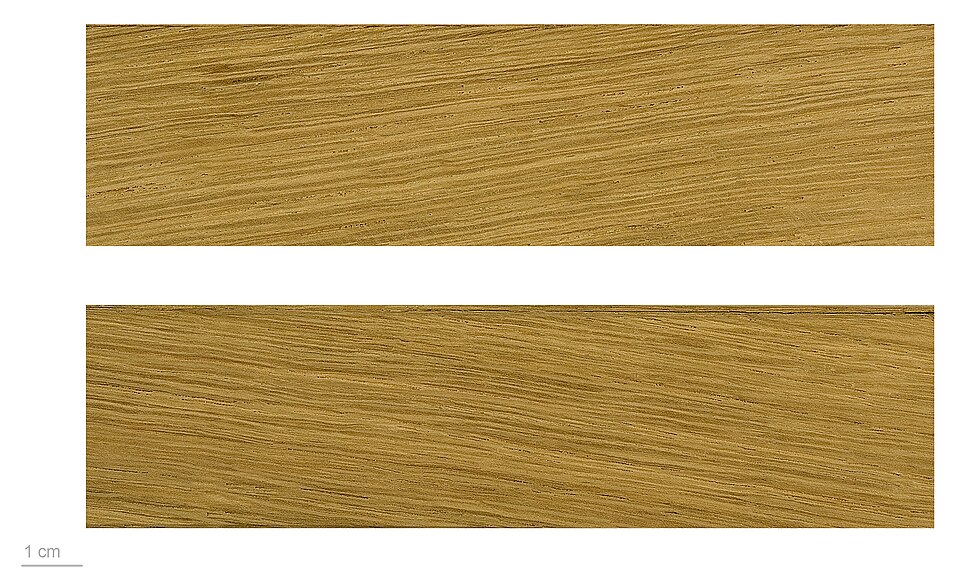
Parquet de Versailles panels
Quick answer
Parquet de Versailles is a floor of pre-assembled square panels of oak, taking its name from the Château de Versailles. Parquet laid in large quantities there under Louis XIV was widely copied across Europe. Traditional panels are jointed with tenons and mortises inside a frame, while modern versions are often engineered.
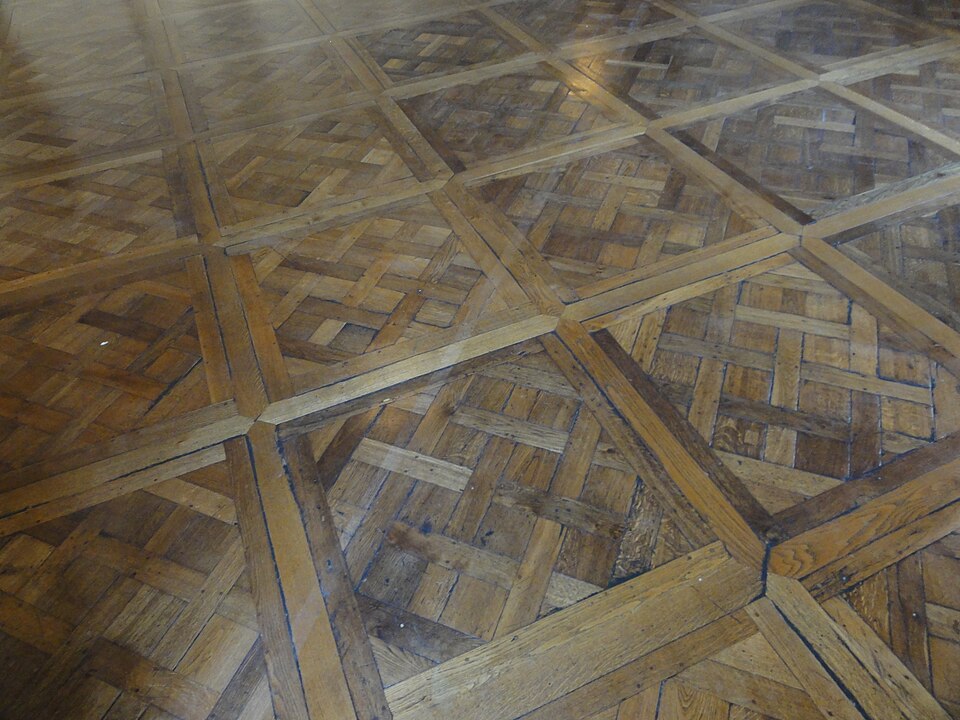
Parquet de Versailles is a panel parquet: oak pieces are assembled into square panels that are then laid as a floor. It takes its name from the Château de Versailles, where Louis XIV had parquet laid in large quantities in the late 17th century2. The pattern then became the standard flooring for the formal rooms of French châteaux of that century3. The panels are traditionally joined with tenons and mortises, and modern versions are often engineered.
What is parquet de Versailles?
The French dictionary CNRTL defines panel parquet as a parquet, called parquet à compartiments, "where the strips are grouped according to set designs, generally forming panels or compartments"1. Havwoods describes parquet de Versailles as pre-assembled square panels of timber, with a pattern of geometric blocks crafted together to form a modular, tile-like surface5. The Building Conservation Directory describes the pattern as based on mid-16th-century designs by Sebastiano Serlio and Andrea Palladio3. In contrast with herringbone and chevron, which are set out piece by piece from working lines6, the panel is the unit of design.
The photograph on this page shows parquet in the Salle des Gardes du Roi (King's Guard Room) at the Château de Versailles, filed on Wikimedia Commons under "Versailles wooden flooring style"7.
What is the history of parquet de Versailles?
The word parquet is much older than the pattern. CNRTL's earliest cited use as a floor covering is from 1664, in the accounts of the royal buildings (Comptes des bâtiments du Roi): an assembly of compartments laid on joists to serve as a floor in an apartment1.
Trinity College Dublin's CRAFTVALUE project explains the Versailles connection. It says parquet de Versailles originated in France in the last three decades of the 17th century, that Louis XIV laid parquet in great quantities while enlarging the old hunting lodge into a palace, and that this was the first time parquet had been used on such a scale. The style was widely admired and copied, particularly at the Prussian and Saxon courts in Germany, and CRAFTVALUE calls this panel parquetry the basis for later decorative developments in parquet floors. Its examples include the Galerie des Glaces at Versailles, dated to the late 17th century2. The Building Conservation Directory adds that parquetry reached England in the 17th century through Queen Henrietta Maria's court, and that Ham House has a dais made from parquet de Versailles3.
Exact years differ between commercial sources. Parqueterie Beau Soleil says the style was introduced when marble floors were replaced in 16934, while Havwoods says parquet de Versailles was introduced in 1684 as an alternative to marble flooring that needed constant upkeep5. We could not confirm either year from the château's own pages or an academic source, so this page says "late 17th century", which CRAFTVALUE supports2.
How are the panels built?
Traditionally, the panel is a small piece of joinery. Parqueterie Beau Soleil, a French maker that says it produced panels for the Galerie des Glaces during its 2007 restoration, describes the squares and leaves of each panel as hand-machined for tenon and mortise assembly, held in a frame pegged at the corners and grooved on the sides, with no glue needed. Its panels are French oak, at 1000 x 1000 mm and 23 mm thick with a 9 mm wear layer4. That is one maker's description of a modern reproduction, not a specification of the historic panels.
Engineered panels are also sold. Havwoods lists pre-assembled European oak Versailles panels of 800 x 800 mm, 20 mm thick, with a 6 mm wear layer, described as engineered5. For comparison, the NWFA says parquet thickness varies from 5/16 in to 3/4 in and that pieces are assembled into panels held together by wire, mesh, tape or paperface6. The word parquet covers both small tiles and large framed panels, so always check what a supplier means. Our solid wood flooring page explains what "solid" means in a floor.
| Example | Panel size | Thickness and wear layer | Construction | Source |
|---|---|---|---|---|
| Parqueterie Beau Soleil | 1000 x 1000 mm | 23 mm with 9 mm wear layer | Tenon and mortise, framed, French oak | 4 |
| Havwoods | 800 x 800 mm | 20 mm with 6 mm wear layer | Engineered, European oak | 5 |
How should panels be laid and cared for?
The Building Conservation Directory focuses on the base. It says the subfloor is critical because softwood subfloors expand and contract and weaken the glue, so they often have to be rebuilt in cross-bonded, waterproof plywood. Historically animal glues were used, which moisture pushes to their limit3. For restoration it records the use of antique oak from European sources, and says red, green and yellow dyes popular in the 18th and 19th centuries are especially prone to bleaching in sunlight. Original finishes are kept where possible, new sections are dyed and French polished to match, and natural waxes and polishes are recommended for upkeep3.
Modern panels follow the same rule of a flat, dry, stable base. Our installation methods guide covers glue-down and other fixings, and old panels reclaimed from buildings raise their own questions, covered under reclaimed wood flooring.
Where do Versailles panels suit?
Their historical setting is the formal room, as the Building Conservation Directory says they became standard in the formal rooms of French châteaux in the 17th century3. The two modern examples above are both oak, French and European respectively45; see European oak for how that species behaves in flooring.
Frequently asked questions
Why is it called parquet de Versailles?
When was parquet de Versailles introduced?
How are traditional Versailles panels built?
What does a Versailles floor need underneath?
Sources
- Parquet (definition), CNRTL, Trésor de la langue française informatisé (CNRS / ATILF). Accessed .
- Tread softly...: Richard Castle's parquetry floors (Nele Lüttmann), CRAFTVALUE, Department of the History of Art and Architecture, Trinity College Dublin. Accessed .
- Parquetry Floors (Jasper Weldon), The Building Conservation Directory. Accessed .
- Panneaux de parquet chêne massif à motif Versailles, Parqueterie Beau Soleil. Accessed .
- Versailles Parquetry: The French Pattern, Havwoods. Accessed .
- Wood Flooring Installation Guidelines (revised 2025), National Wood Flooring Association. Accessed .
- Parquet Versailles - Château de Versailles - Salle des Gardes du Roi (photograph by Trizek, 2011), Wikimedia Commons. Accessed .
This page compiles published data from the sources listed above. Read our editorial policy. Last updated .