Fire and slip ratings for wood floors
Quick answer
In Europe a wood floor's reaction to fire is given as a class from Afl to Ffl; most coated wood floors are Cfl-s1 or Dfl-s1, which depends on thickness, density, coating and what the floor sits on. The EU lists generic constructions that need no testing. Slip resistance is a separate property: the UK Health and Safety Executive prefers the pendulum test, where a value of 36 or more means low slip potential, and warns that German R-classes such as R9 are slippery when wet.
Fire and slip ratings are two separate checks on a wood floor. In Europe, reaction to fire is a class from Afl to Ffl; most coated wood floors reach Dfl-s1 or Cfl-s1, depending on thickness, density, coating and substrate21. Slip resistance is measured with different tests, and the UK Health and Safety Executive (HSE) prefers the pendulum test over the German ramp classes that many flooring makers quote4. This guide explains both in plain terms and says what to ask a maker.
What is a reaction-to-fire class?
The EU's classification system has two sub-systems: one for construction products such as wall and ceiling linings, and one for floorings, which carry the suffix fl. Both run from class A to class F, where A1 and A2 are non-combustible1. A flooring class has a letter and a smoke suffix, for example Cfl-s1.
For floorings the main test is the radiant panel test, EN ISO 9239-1, which gives a critical heat flux, the radiant level at which the flame goes out or the level reached after 30 minutes, whichever is lower. A flooring must also pass the small-flame test EN ISO 11925-2 with flame spread under 150 mm within 20 s for classes B to E1. The thresholds are:
| Class | Critical heat flux (EN ISO 9239-1) | Typical products in the Swedish report |
|---|---|---|
| Bfl | more than 8.0 kW/m² | PVC and some textile floorings |
| Cfl | more than 4.5 kW/m² | Some wooden floors |
| Dfl | more than 3.0 kW/m² | Most wooden floors |
| Efl | small-flame test only | Some synthetic polymers |
| Ffl | no performance determined | none |
The smoke suffix is s1 where smoke production is below 750 %·min, and s2 where it is not1. So Cfl-s1 means a critical heat flux above 4.5 kW/m² and low smoke. It describes how a floor reacts to a small fire starting in the room; it is not a measure of the fire resistance of the structure, which the Swedish report treats as a separate characteristic1.
Which wood floors are classed without testing?
Testing every product is costly, so the Commission lists generic wood floor constructions whose class is known and stable. Two instruments apply, one for coated floors and one for uncoated floors.
Coated floors (Decision 2006/213/EC). Table 1 of the Decision gives the class for coated wood floors by minimum mean density, minimum overall thickness and end-use condition. Some entries2:
| Product | Density | Thickness | Condition | Class |
|---|---|---|---|---|
| Solid oak or beech with surface coating | oak 650, beech 680 kg/m³ | 8 mm | Glued to substrate | Cfl-s1 |
| Solid oak, beech or spruce with surface coating | oak 650, beech 680, spruce 450 kg/m³ | 20 mm | With or without air gap beneath | Cfl-s1 |
| Solid wood floor with surface coating, not specified above | 390 kg/m³ | 8 mm | Without air gap beneath | Dfl-s1 |
| Multilayer parquet, oak top layer of at least 5 mm, with coating | 650 kg/m³ (top layer) | 10 mm | Glued to substrate | Cfl-s1 |
| Multilayer parquet with coating, not specified above | 500 kg/m³ | 8 mm | Glued to substrate | Dfl-s1 |
The table's notes give the conditions behind these classes. Testing is on a substrate of at least class D-s2,d0 with a density of at least 400 kg/m³, or with an air gap; the glued entries need a substrate of at least class A2-s1,d0; and the coating types and amounts are acrylic, polyurethane or soap at 50 to 100 g/m² and oil at 20 to 60 g/m²2. The table also applies to steps of stairs2.
Uncoated floors (Delegated Regulation 1292/2014). Uncoated wood floors under EN 14342 have their own list. Examples are solid wood parquet of oak, maple or ash at 8 mm glued to a substrate of at least D-s2,d0, which is Dfl-s1 at an oak density of at least 720 kg/m³, and solid wood floor and parquet not specified elsewhere at 400 kg/m³ and 6 mm, which is Efl3.
Anything outside these tables has to be tested, or is class Ffl, meaning no performance is determined1. A fire-retardant lacquer or a different build-up could earn a better class if tested1.
We read the 2006 text as adopted; check the Official Journal for later amendments before using a figure in a specification.
Does a charred or heavily finished floor change this?
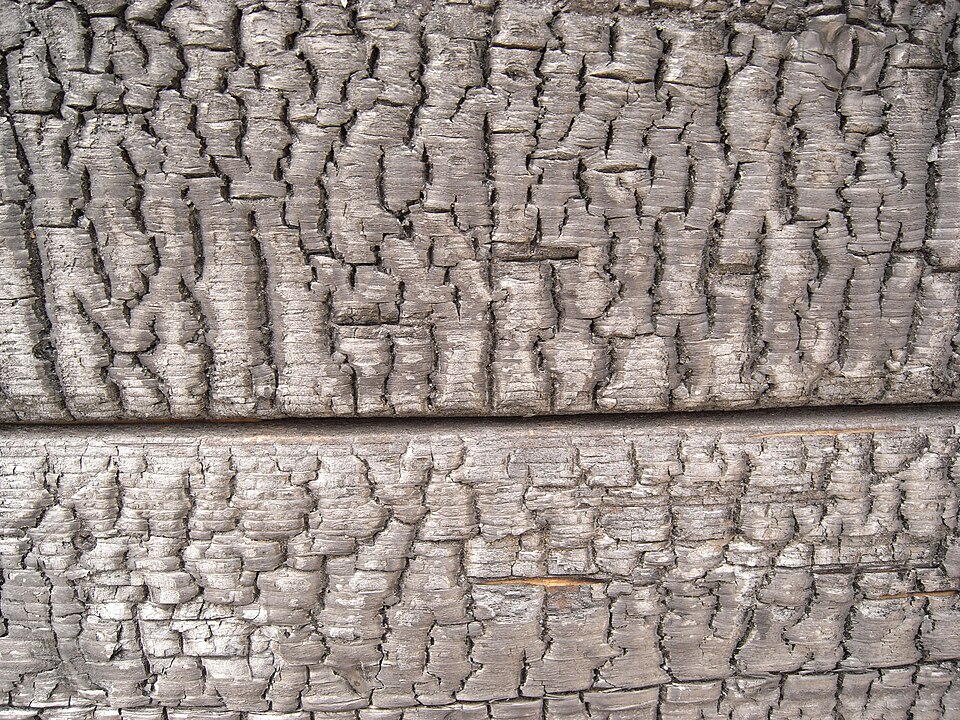
The tables assume stated coatings and thicknesses. A different surface treatment is a different product for classification, which is why a maker's Cfl-s1 should come with a test report or a table entry. Our page on charred wood reviews research on how charring affects fire performance. Wall products use a separate table, covered in wood wall panelling.
How is slip resistance measured?
HSE's technical information sheet describes several tests4. Its preferred method is the pendulum coefficient of friction test, where a swinging imitation heel with a standard rubber slider sweeps a set area of floor and gives a pendulum test value (PTV). The test is the subject of BS 7976 (parts 1 to 3, 2002), and HSE says it should be operated by a trained, competent person, with tests in several directions for profiled floors4. The sheet cites the 2002 edition of BS 7976, so check which edition and method apply today.
Pendulum results are read with these bands, from the UK Slip Resistance Group4:
| Pendulum test value | Slip potential |
|---|---|
| 0 to 24 | High |
| 25 to 35 | Moderate |
| 36 and above | Low |
A slider known as Slider 96 gives enough information for shod pedestrians, and Slider 55 is used for barefoot areas4.
HSE also describes a surface microroughness test using the Rz parameter. For water-wet pedestrian areas, Rz below 10 µm means high slip potential, 10 to 20 µm moderate and above 20 µm low4. Roughness is a useful guide, but not a replacement for the pendulum; the Zagreb study of oak and beech floors found that roughness should be used as a guide and not as the sole indicator of slip potential6.
What are R-values and the DIN ramp classes?
Many European makers state a German ramp-test class. DIN 51130 gives R9 to R13, where R9 is slippery when wet and R13 the least slippery; DIN 51097 gives classes A to C for barefoot wet areas4. HSE has reservations about these tests because neither uses contaminants typical of workplaces, and says floors classified R9, and in some instances R10, will be slippery when wet or greasy. R10, for example, covers a very wide range of friction values4. Its FAQ adds that if a manufacturer does not claim a floor is slip resistant when wet, it will probably be slippery when wet5.
What do studies of wood floors show?
The 2021 Zagreb study tested oak and beech floors finished with oil and with polyurethane, by pendulum in dry, water-wet and oily conditions. It found that slip potential was low in dry conditions for all the finished floors, and that water and oil contamination reduced slip resistance for both species6. A finish, a cleaning product or a coat of polish can change results, which is why HSE warns that ex-factory data can change after installation, cleaning, polishing, wear and poor maintenance4. See our guides to wood floor finishes and cleaning and maintenance.
What should you ask a maker?
- Which fire class applies, and is it from a Decision table or a test report? For what thickness, density, coating and substrate?
- For slip, which test was used (pendulum, ramp or other), in what condition (dry, wet, oily), and on a finished floor or a bare one?
- Is the data for the floor as installed and maintained, or ex-factory?
- Is the class valid for stairs or walls, if that is your use?
For how these ratings sit alongside other standards, see flooring standards and our guide to usage classes.
Frequently asked questions
What does Cfl-s1 mean on a wood floor?
Is Cfl-s1 better than Dfl-s1?
Do wood floors need to be tested for fire?
How is slip resistance of a wood floor measured?
Is an R9 or R10 floor safe when wet?
Are finished wood floors slippery?
Sources
- European classes for the reaction to fire performance of wood floorings (Trätek report I0411026), Trätek, Swedish Institute for Wood Technology Research (Tsantaridis and Östman, 2004). Accessed .
- Commission Decision 2006/213/EC of 6 March 2006 establishing the classes of reaction-to-fire performance for certain construction products as regards wood flooring and solid wood panelling and cladding, Official Journal of the European Union, via legislation.gov.uk. Accessed .
- Commission Delegated Regulation (EU) No 1292/2014 on the conditions for classification, without testing, of certain uncoated wood floorings under EN 14342 with regard to their reaction to fire, European Commission, via legislation.gov.uk. Accessed .
- Assessing the slip resistance of flooring (technical information sheet GEIS2), Health and Safety Executive (UK). Accessed .
- Slips and trips: frequently asked questions, Health and Safety Executive (UK). Accessed .
- The Relationship between Roughness of Finished Wood Floors and Slip Resistance (Miklečić and Jirouš-Rajković, Drvna industrija 72(1), 2021), Faculty of Forestry, University of Zagreb, via the Hrčak portal. Accessed .
This page compiles published data from the sources listed above. Read our editorial policy. Last updated .