Douglas fir
Quick answer
Douglas fir (Pseudotsuga menziesii) is a softwood from western North America that is not a true fir and has been grown in European plantations since the 1800s. The Wood Database gives it a Janka hardness of 620 lbf (2,760 N), well below common hardwood floor species, so it dents more easily. Moderate shrinkage, a straight grain and a choice between vertical-grain and flat-grain boards are what decide how it behaves on a floor.
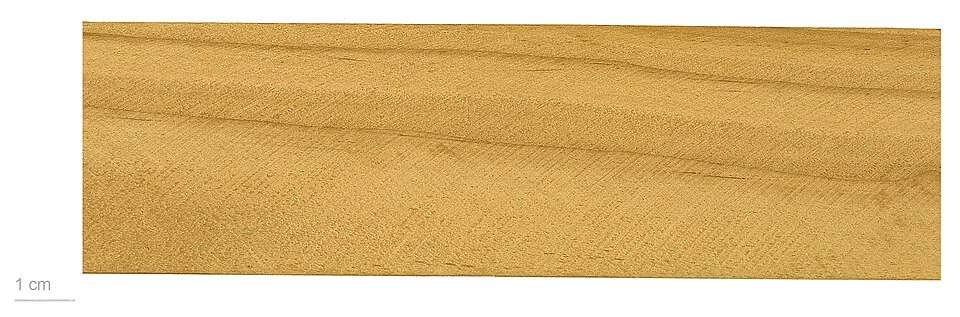
Douglas fir (Pseudotsuga menziesii) is a softwood from western North America. Despite the name it is not a true fir, and The Wood Database lists it at 620 lbf (2,760 N) on the Janka scale1, so it is clearly softer than the oaks and maples usually chosen for floors. Where it is used, the choice is mostly about its warm, straight-grained look, the cut of the board and whether you accept a floor that marks more easily.
Is Douglas fir a fir, a pine or something else?
It is none of those. The US National Park Service states that Douglas fir is not a true fir and not a hemlock, that it belongs to a separate genus, and that Pseudotsuga means "false hemlock"10. The same page describes the cones as the most diagnostic feature: they hang down from branches spread through the crown and carry three-pointed bracts that protrude between the scales10.
For flooring, the label that matters is "softwood". The National Wood Flooring Association (NWFA) explains that softwoods come from conifers and names Douglas fir among them, and it adds that softwood or hardwood status does not by itself reflect density, because some softwoods are harder than some hardwoods5.
Two varieties are recognised. A Forestry Commission bulletin describes the coastal or green type (var. menziesii or viridis) and the Rocky Mountain or blue type (var. glauca)6. The Wood Database covers var. glauca on its Douglas fir page too, but its mechanical figures are averages from four regions (coastal, interior west, interior north and interior south), with no separate coastal and interior values1.
Where does Douglas fir grow, and is it grown in Europe?
The Forestry Commission bulletin gives the natural range as running about 3,400 km north to south, from central British Columbia (55°N) to the Sierra Madre in Mexico (20°N), and from altitudes at sea level up to 3,200 m in the southern Rocky Mountains. The coastal form is confined to the Pacific side of the Coast, Cascade and Sierra ranges6.
It reached Europe in 1827, when David Douglas sent seed to Britain68. In Britain the bulletin reports that it made up 3 % of the forest area but 5 % of the standing volume of conifer forest at the last Census of Woodlands it cites (2003), and that the Rocky Mountain type was quickly discarded because it grew slowly and suffered needle cast6. Forest Research says the species has been used in British forestry for over 100 years and, in a January 2025 announcement, describes a breeding programme using 200 visually superior trees and 40 genetically superior trees7.
France is the larger European resource. FCBA says the tree arrived there around 1840, that from 1960 it replaced spruce in state-aided reforestation, and that France holds more than 100 million m³ standing on about 420,000 ha, the largest Douglas fir forest in Europe8. If the origin of a floor matters to you, ask the supplier whether the boards come from European plantations or from North America.
What does Douglas fir look like?
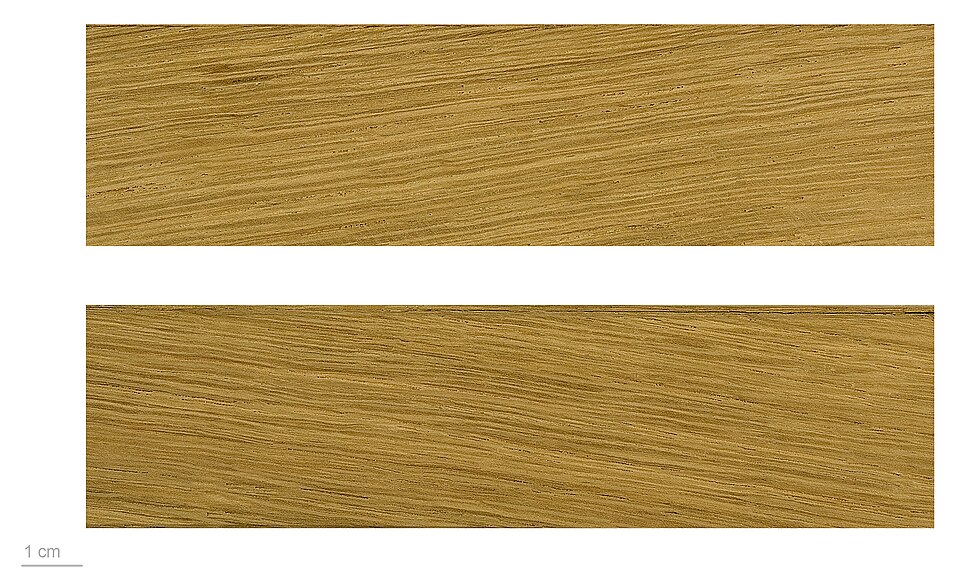
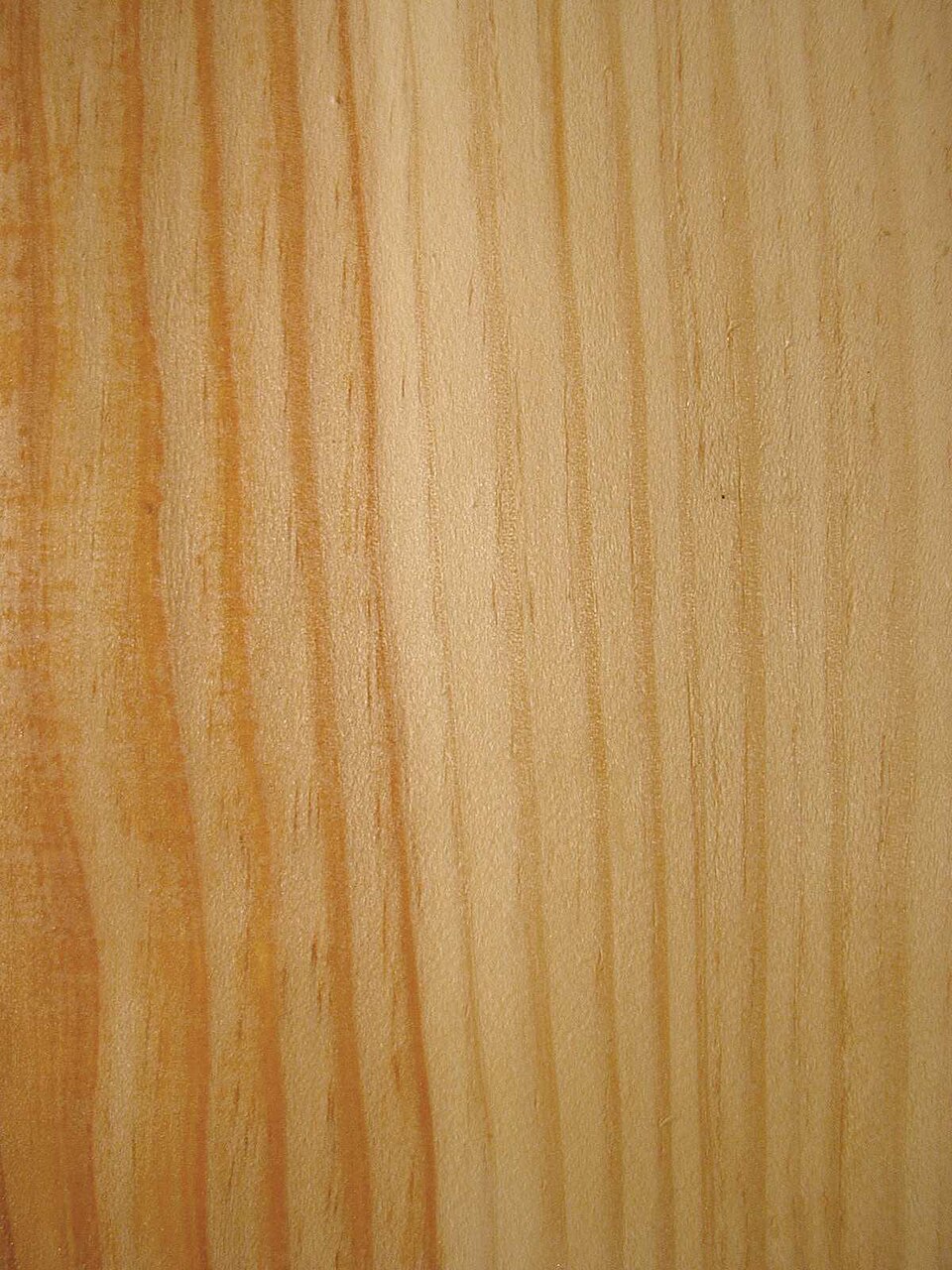
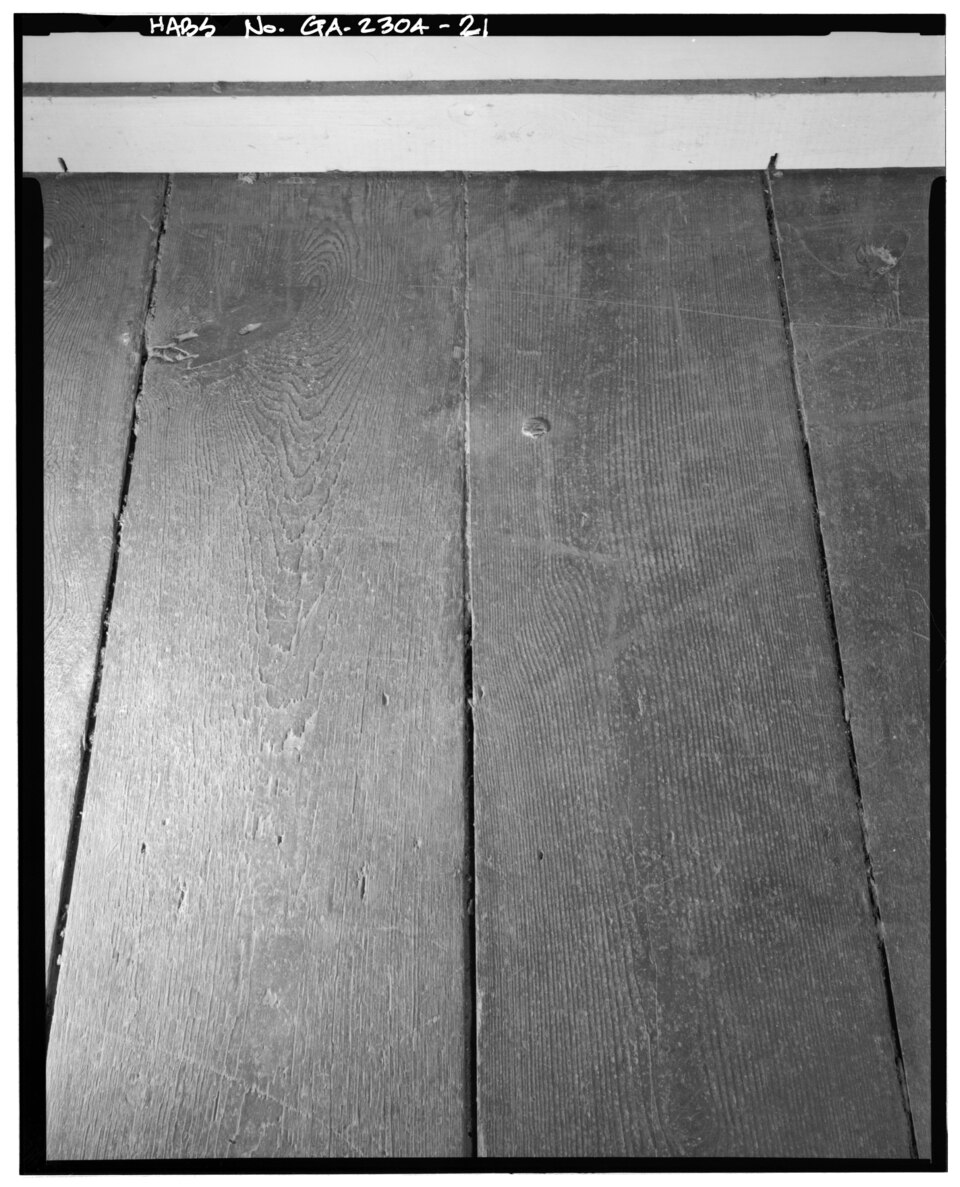
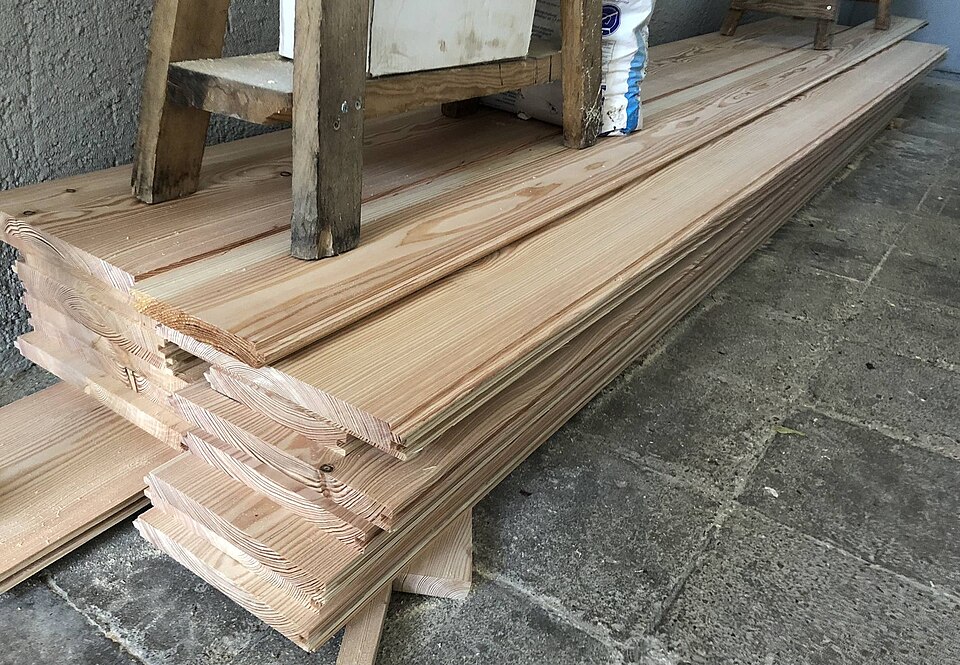
The Wood Database describes the heartwood as usually light brown with a hint of red or yellow and darker growth rings, with colour varying by tree age and location. Grain is generally straight or slightly wavy, with a medium to coarse texture and moderate natural lustre1. Lignum describes a practically white sapwood and red-brown heartwood, a wide, pronounced and well-defined latewood, resin canals, distinct growth rings and a slight smell of resin9. The Wood Database adds a distinct resinous odour when it is worked1.
How much of the pale and dark banding you see depends on the cut. The Wood Database notes that quartersawn pieces show straight, plain grain, whereas flatsawn pieces can show wild grain patterns, especially in rotary-sliced veneer1. The photograph at the top of this page is a single small sample and says little about a whole floor, so ask for a full board or a run of boards from your supplier.
How hard and dense is Douglas fir?
| Property | Figure | Source |
|---|---|---|
| Janka hardness | 620 lbf (2,760 N) | The Wood Database1 |
| Average dried weight | 32 lbs/ft³ (510 kg/m³) | The Wood Database1 |
| Specific gravity (basic, 12 % MC) | 0.45, 0.51 | The Wood Database1 |
| Air-dry density | 0.51 to 0.58 kg/dm³ | Lignum9 |
| Oven-dry density | 0.47 to 0.53 kg/dm³ | Lignum9 |
The two sources overlap but are not identical, so both are shown. Lignum calls the wood "medium hard" and easy to work9; that is a relative description on its own scale, while the Janka figure is the one to use when comparing with other floor species. Our Janka hardness guide explains how to read it, and the hardness chart places Douglas fir beside the other species on the site.
For comparison, The Wood Database lists white oak at 1,350 lbf (5,990 N)2 and hard maple at 1,450 lbf (6,450 N)3. Douglas fir is therefore under half of either figure. In practice that suggests a floor that shows heel marks, furniture feet and dropped objects sooner than European oak, American white oak or hard maple. Some owners accept that and treat the marks as part of an aged look; others will want a different species for a busy hall or kitchen.
How much does Douglas fir move?
Wood shrinks and swells as its moisture content changes below fibre saturation. The USDA Forest Products Laboratory states that wood shrinks most in the direction of the growth rings (tangentially), about half as much across them (radially), and only slightly along the grain, and that the effects can include gaps in flooring4. All the shrinkage figures below describe green to oven-dry wood, an extreme range, not the seasonal change inside a heated home.
| Source | Radial | Tangential | Volumetric |
|---|---|---|---|
| The Wood Database (average of four regions) | 4.5 % | 7.3 % | 11.6 %1 |
| Wood Handbook, coast type | 4.8 % | 7.6 % | 12.4 %4 |
| Wood Handbook, interior north | 3.8 % | 6.9 % | 10.7 %4 |
| Wood Handbook, interior west | 4.8 % | 7.5 % | 11.8 %4 |
The Wood Handbook defines coast type as Douglas fir growing in Oregon and Washington west of the Cascade summit; interior west includes California and the counties of Oregon and Washington adjacent to the east of the summit; interior north is the rest of Oregon and Washington plus Idaho, Montana and Wyoming4. These regional values differ from The Wood Database average, which is why the table shows both. The NWFA lists a tangential shrinkage of 7.3 % for Douglas fir, against 10.5 % for white oak, 9.9 % for hard maple and 11.9 % for beech5. The same list gives black cherry 7.1 % and American black walnut 7.8 %5. On those numbers Douglas fir moves less across the board than white oak, hard maple or beech and about as much as cherry or walnut, so it sits in the middle of the list rather than at its stable end.
The same NWFA guidance notes that most moisture meter manufacturers calibrate their meters to pine, Douglas fir and hemlock, and that species correction is a user-adjusted setting5. Check that setting before you trust a reading on any other species, and see moisture and acclimatisation for how to condition boards before laying.
Vertical grain or flat grain: which cut should you choose?
The NWFA defines the cuts for softwoods as follows5:
- Flat-grain (flatsawn): growth rings mostly parallel to the wide face, at 0° to 45°. More dimensionally stable in thickness and less stable in width.
- Bastard-sawn: rings at 30° to 60° to the face (riftsawn in hardwoods).
- Vertical-grain (quartersawn in hardwoods): rings at 45° to 90° to the face. More dimensionally stable in width and less stable in thickness.
Apply the Wood Handbook figures and the difference becomes concrete. The Handbook advises using tangential values to estimate the width shrinkage of plainsawn material and radial values for quartersawn material, and tangential values where the ring orientation is mixed or unknown4. For coast-type Douglas fir that is 7.6 % across a flat-grain board against 4.8 % across a vertical-grain one4, so vertical grain should open less in the joints. The same source warns that values for individual boards vary: it reports a coefficient of variation of about 15 %4.
Appearance changes with the cut as described above: straight, plain grain on vertical-grain faces and more varied figure on flat-grain faces1. We found no trusted source that gives a price or availability gap between the two cuts, so ask suppliers for both options and compare samples.
Is Douglas fir suitable for wide-plank floors?
Width and movement go together. The NWFA states that wood changes dimension in proportion to the width of the plank, and that narrow boards expand and contract less than wider boards of the same species and cut5. With a tangential shrinkage of 7.3 % to 7.6 % across the rings, a wide flat-grain Douglas fir board has more to lose across its width than a vertical-grain one, so the cut matters more as the plank gets wider. See wide-plank flooring for how width interacts with fixing and subfloor. The NWFA adds that engineered wood flooring is, in general, more dimensionally stable than solid wood flooring5, so engineered wood is worth considering for wide boards; check the wear layer thickness if you expect to sand it.
How do you finish Douglas fir?
The Wood Database says Douglas fir machines well, with a moderate dulling effect on cutters, and takes stains, glues and finishes well1. It also notes resin, and Lignum records resin canals in the wood9. Test your chosen finish on an offcut from the actual boards before committing a whole room.
Because the wood is softer, the finish does not change how easily the timber itself dents, so weigh the wear of the coating against how easily you can repair it; our guide to wood floor finishes compares the options. For future repairs, see sanding and refinishing. On dust, The Wood Database says severe reactions to Douglas fir are uncommon but lists skin irritation, nausea, dizziness and a runny nose among reported effects, so use dust extraction when sanding1.
Is a Douglas fir floor durable and sustainable?
The Wood Database describes the heartwood as moderately durable against decay but susceptible to insect attack1. Lignum gives durability class 3 to 4, medium resistance to fungi, and notes the sapwood is vulnerable to insects9. For an interior floor, the practical point is that dry conditions matter more than natural durability.
On conservation, the Wood Database reports that it is not listed in the CITES Appendices and that the IUCN classifies it as least concern1. FCBA describes it as the second most important reforestation species in France, behind maritime pine, with around 8 million plants produced a year, but warns that reduced replanting and climate change threaten its future on some sites8. Forest Research reports that the UK imports much of its Douglas fir seed from the USA or France7. Ask your supplier for certification and origin papers if either matters to you.
Where is Douglas fir used?
The Wood Database lists veneer, plywood and structural or construction lumber as its common uses, sold widely as construction lumber at a modest price, with old-growth or reclaimed boards costing considerably more1. Lignum includes parquet and floors among its uses, alongside heavily loaded construction and joinery, bridges, piles, shipbuilding, crates, veneers and barrel staves9. If you are weighing it against a hardwood, start with solid wood flooring and the other species pages on this site.
Frequently asked questions
Is Douglas fir a true fir?
How hard is Douglas fir for flooring?
What is vertical-grain Douglas fir?
Does Douglas fir move a lot with humidity?
Where is Douglas fir grown?
Is Douglas fir sustainable?
Sources
- Douglas Fir, The Wood Database. Accessed .
- White Oak, The Wood Database. Accessed .
- Hard Maple, The Wood Database. Accessed .
- Chapter 4: Moisture relations and physical properties of wood, Wood Handbook (FPL-GTR-190, Centennial edition), USDA Forest Products Laboratory. Accessed .
- Wood Flooring Installation Guidelines (revised 2025), National Wood Flooring Association. Accessed .
- Choice of Douglas Fir Seed Sources for Use in British Forests (Bulletin 129), Forestry Commission (archive hosted by Forest Research). Accessed .
- Homegrown seed that will kickstart a new breeding generation of British Douglas fir trees, Forest Research. Accessed .
- Essais FCBA sur la génétique du Douglas (FCBA INFO, September 2016, in French), FCBA. Accessed .
- Douglas (information sheet, in French), Lignum. Accessed .
- Douglas-fir, Bryce Canyon National Park, US National Park Service. Accessed .
This page compiles published data from the sources listed above. Read our editorial policy. Last updated .