Bog oak
Quick answer
Bog oak is not a separate species but oak that has lain in peat or river sediment for centuries or millennia, where tannins in the wood react with iron and darken it to brown or near black. The Wood Database lists no hardness figure for it, supply is very limited, and one published test found shrinkage roughly double that of recent oak15.
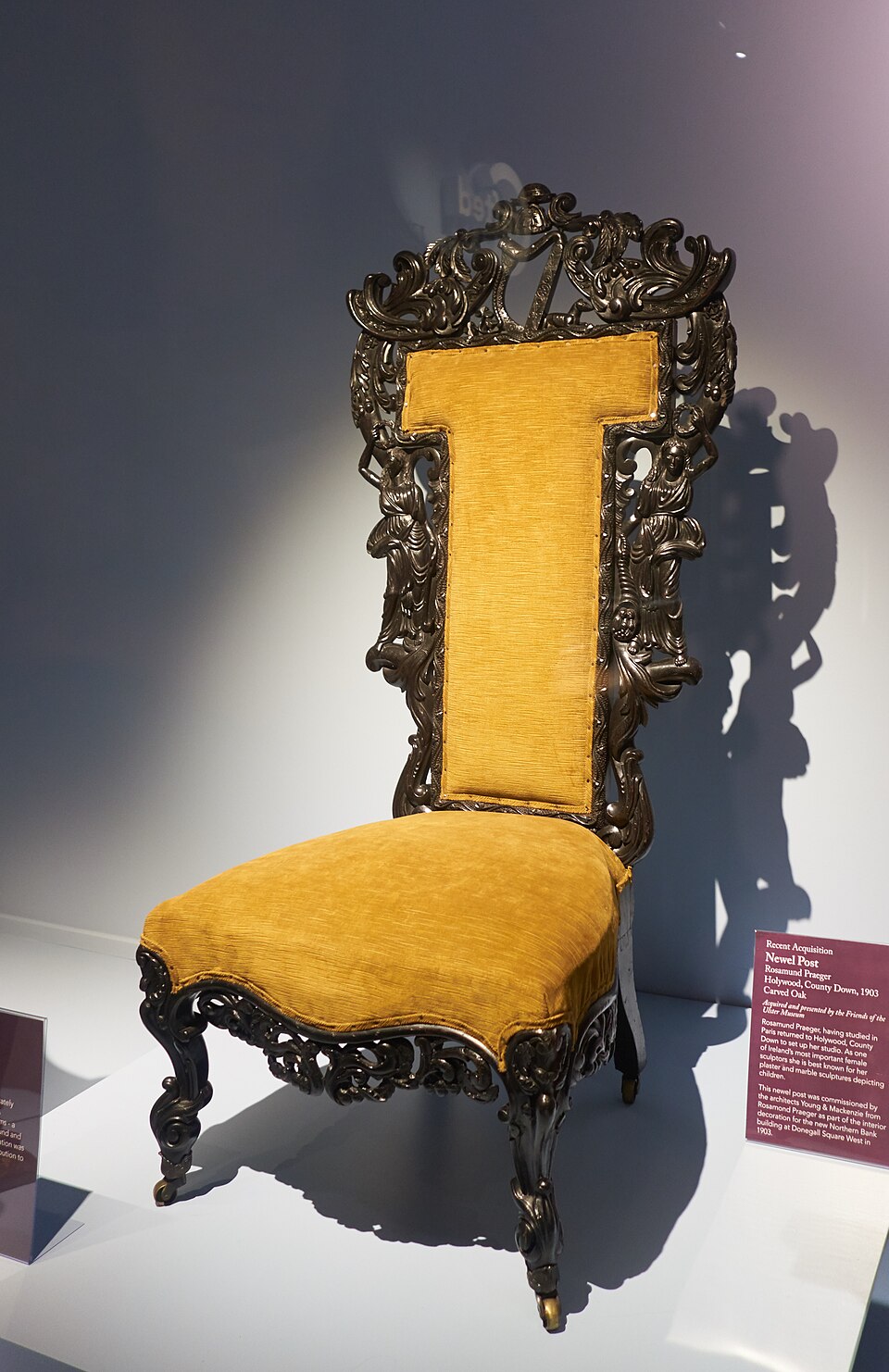
Bog oak is oak that has lain buried in waterlogged ground for centuries or thousands of years. It is not a separate species: The Wood Database calls it a term for oak preserved in peat bog, with English oak the species most commonly salvaged1. The wood is dark brown to almost black, supply is very limited, and, as far as we could verify, its hardness has never been published.
How does bog oak form?
Preservation comes first. The Wood Database explains that the very low oxygen levels in a bog protect the wood from normal decay, and that acidic peat and iron salts react with the tannins in the wood and darken it. It describes the wood as being in the early stages of fossilisation1. That is why the material is called subfossil: it is still wood, not stone.
Peat is only one setting. In southern Poland, researchers describe "black oaks" in the alluvial deposits of the Vistula and Odra. Rivers shifted their beds, felled trees on their banks and buried them in sediment, and the black colour came from a reaction between wood tannin and iron compounds in the groundwater4. In the Fens of eastern England, the Great Fen Project says trunks lay undisturbed in acidic bog conditions until drainage shrank the peat and brought them closer to the surface7. Woodland Heritage offers a theory that rising water levels swamped the trees, and that tannins in the oak and the surrounding soil produced the black colour6.
Why does bog oak turn black?
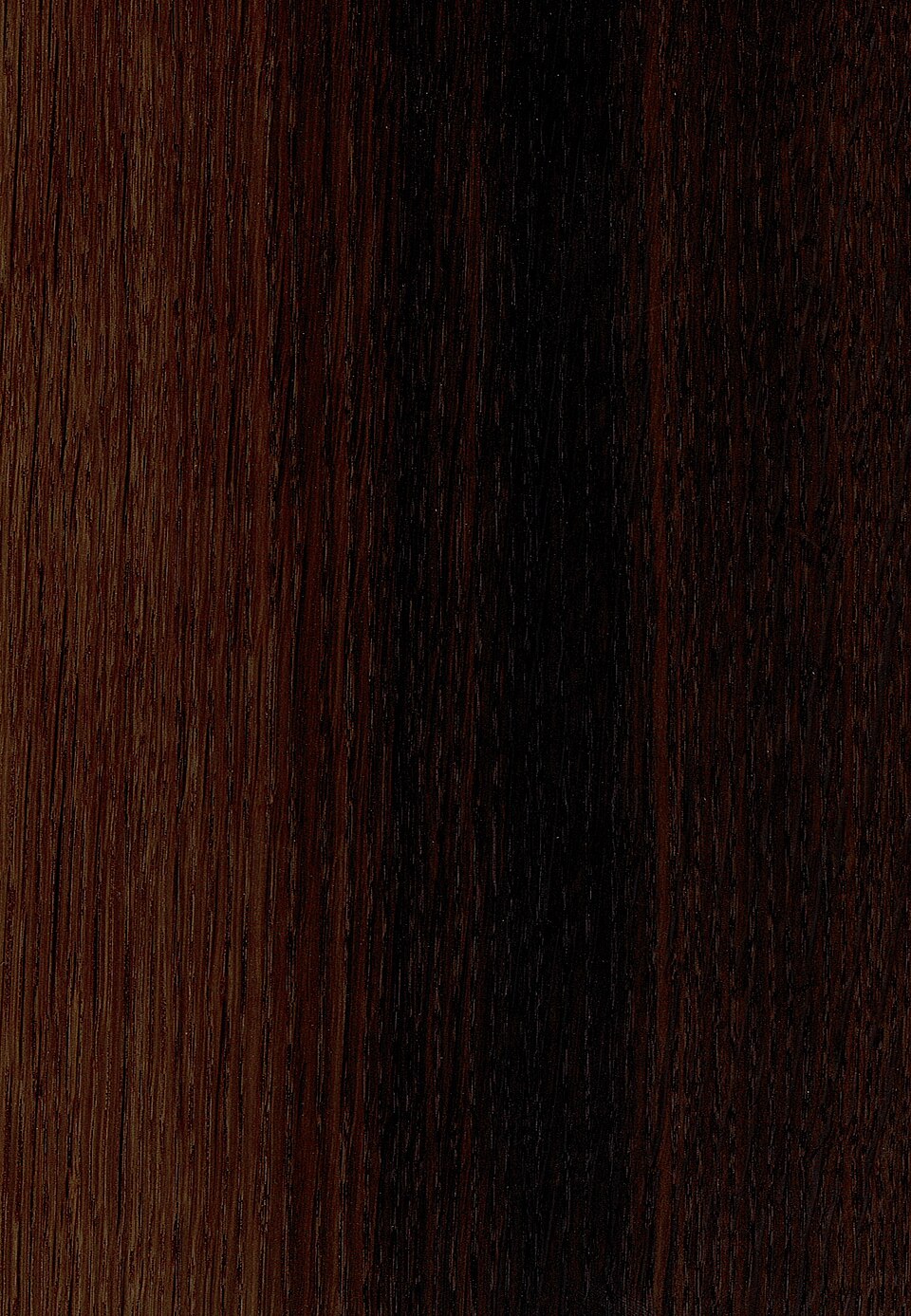
The authors of a study of a subfossil trunk from Chiarano, Italy, explain it directly: oak that lies in water for a long period may turn black because its tannins react with iron ions in the water and sediment, typically in an acid, poorly oxygenated environment3. The colour is not uniform. In that trunk it ran from black on the outside to natural light brown in the centre3. Colour therefore depends on the burial conditions and on which part of the log a board is cut from.
The same paper notes that this kind of oak was used in the past as an economical substitute for ebony in marquetry, and that it is still sought after for furniture3.
How old is bog oak and how is it dated?
Ages vary enormously. Woodland Heritage gives roughly 2,000 to 5,000 years for English bog oak, with Irish examples sometimes over 7,000 years6. The Chiarano trunk is far younger: radiocarbon dating gave 795 ± 35 years BP, a calibrated range from the second half of the 12th to the second half of the 13th century AD3. Subfossil oak is therefore defined by how it was preserved, not by a minimum age.
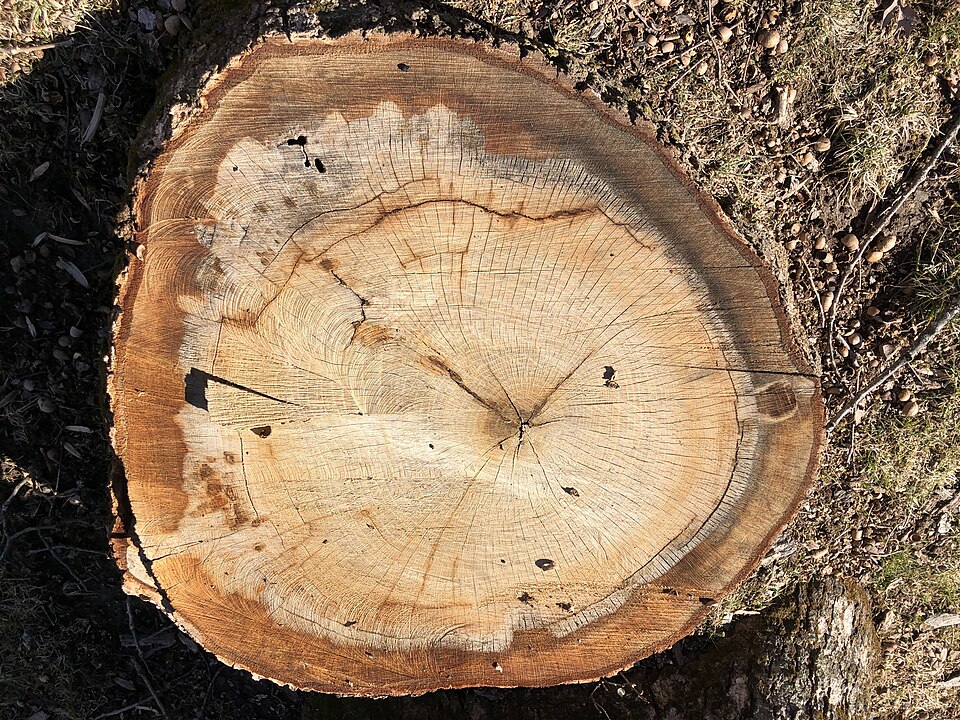
Oak is well suited to tree-ring dating because it is ring-porous and does not form false rings3. A Polish team built a chronology covering 1795 to 612 BC from subfossil trunks of the Vistula and Odra basins, plus floating chronologies fixed by radiocarbon for older periods, the earliest at about 6650 to 6150 BC4. In England, a bog oak recovered from a field drain near West Deeping had a ring series spanning 489 BC to 126 BC9. The Chiarano trunk, by contrast, could not be dated by rings alone, which is why radiocarbon was used3.
Where does it come from, and are there rules on taking it?
Most finds are accidental. Fenland farmers cleared bog oak from arable fields and piled it into clearance cairns, and some of it was burned as fuel while better pieces went to furniture and carving7. The Chiarano trunk surfaced during canal maintenance, and a Bosnian log used in the Croatian study was found during gravel extraction at about six metres depth35. The Wood Database says the wood occurs most often in the United Kingdom1. Woodland Heritage advises owners wanting to find furniture makers to contact the Worshipful Company of Furniture Makers6.
None of the sources we opened sets out a general legal rule on ownership, export or sale of bog oak, so we state none. One point is worth keeping in mind: the Chiarano trunk showed signs of felling and debranching, so it was not simply a fallen tree, and it was found in an area rich in Roman and Venetian remains3. Ask a supplier where a batch was recovered and under what permissions.
How does bog oak behave when dried and worked?
The one laboratory dataset we found is from a Bosnian log studied by a Croatian forestry team. It was recovered by gravel extraction and then dried slowly under controlled conditions. Compared with recent pedunculate oak, it had a higher absolutely dry density (0.704 g/cm³, 15.8 % higher) and slightly higher bending strength (101.3 MPa, 10.8 % higher), while compressive strength parallel to the grain was not significantly different (52.3 MPa)5. Shrinkage was much larger: total radial 10.5 %, tangential 18.6 % and volumetric 27.6 %, each roughly double the figure for recent oak5.
For scale, The Wood Database lists English oak at 4.7 % radial, 8.4 % tangential and 13.0 % volumetric shrinkage2. Those figures come from a different dataset, so treat the comparison as indicative. Properties also vary by site: the Chiarano trunk had a basic density of 0.5217 g/cm³ against 0.57 g/cm³ for healthy oak, and the authors suspected mineral matter had entered the wood during its time in river sediment3.
Practical drying is slow. The Carpenters' Company project sawed a 13 m, 5,000-year-old Fenland trunk on site and dried the planks in a purpose-built kiln over six months, a process it says reduces weight and some of the girth8. Our reading of the data: a wood that shrinks this much needs patient drying and careful acclimatisation, so read our guide to moisture and acclimatisation before specifying it.
How hard is bog oak, and what does that mean for floors?
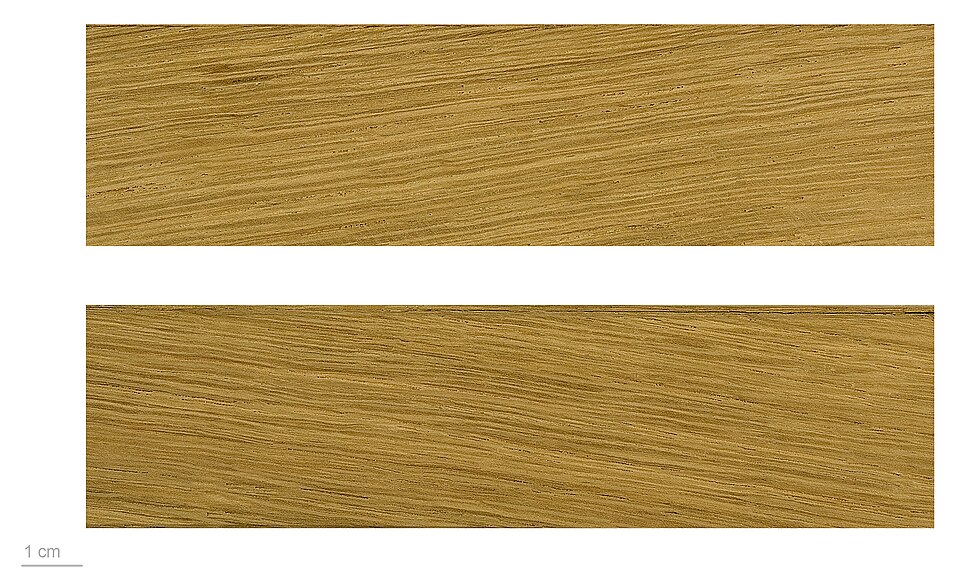
The Wood Database entry for bog oak lists neither a Janka rating nor a density1, and the Croatian study reports no hardness5. We have not invented a figure. The Janka row above is for ordinary English oak (Quercus robur): 1,120 lbf (4,980 N)2. It describes the wood before subfossilisation and should not be read as a measured value for bog oak. Our guide to Janka hardness explains why the scale is only a rough guide anyway, and the European oak page covers the living species in more detail.
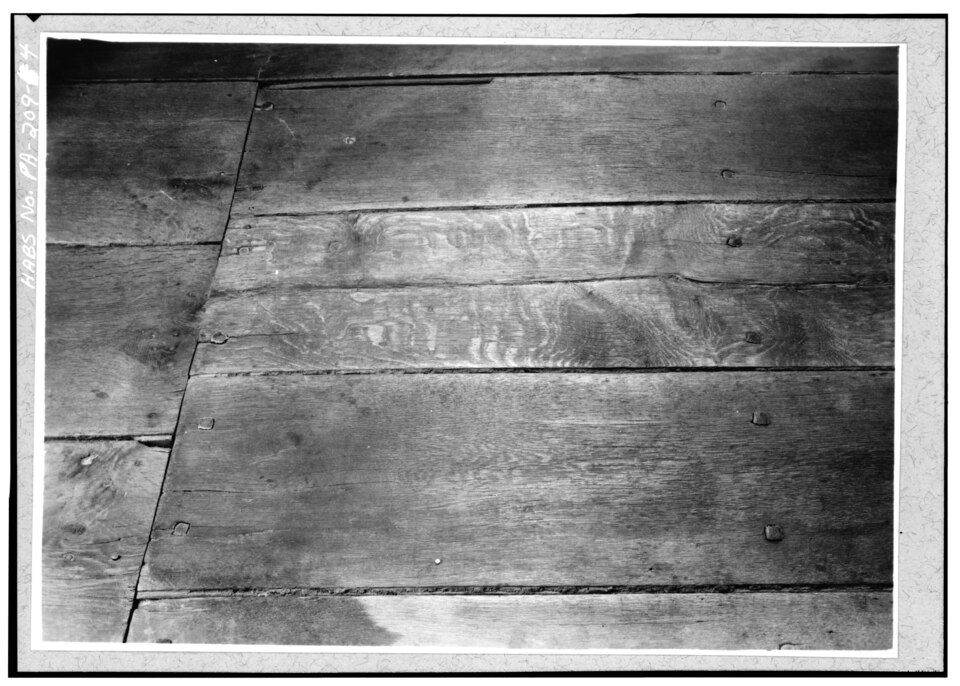
The Croatian authors say bog oak is valued for its durability, appearance, acoustic properties and age, and is used for veneer, furniture, musical instruments and sculpture5. For floors, one manufacturer's published data shows how it is sold. Havwoods lists a bog oak range of multi-layered engineered boards 20 mm thick with a 5 mm wear layer, in herringbone, chevron, plank and Versailles formats; the page describes the colour as deep and ebony and does not discuss stability or drying11. That is the maker's description, not independent test data. See engineered wood flooring for how a thin top layer works and herringbone for the pattern. Boards cut from old timbers are also sometimes confused with reclaimed wood, but reclaimed wood is timber salvaged from earlier use, whereas bog oak is a natural deposit.
Is bog oak the same as fumed or smoked oak?
No, though the finished colours can look similar. Bog oak darkens over centuries through iron and tannin chemistry in the ground3. Fumed oak is darkened on purpose: in a peer-reviewed study, oak heartwood exposed to ammonia gas for 16 days reacted intensively in a very short time, and oak had both the highest tannin content of the four species tested and the biggest drop in tannin after fuming, which suggests the ammonia reacted with it10. Both processes depend on oak's tannins, but one is a natural burial and the other is a controlled treatment.
We did not find a trusted source defining "smoked" oak, so we make no claim about it here. When a floor is described as bog oak, fumed oak or smoked oak, ask the seller which process was used and whether the colour runs through the board or sits at the surface. Our wood floor finishes guide covers what coatings do to colour. The sources we opened do not say how deep fuming colour penetrates, so we make no claim about that either.
What should you check before buying?
- Origin and recovery. Ask where the logs were recovered, as above.
- Drying. Ask how the timber was dried. The Carpenters' Company's six months in a kiln for one trunk gives a sense of the timescale8.
- Build. Check thickness and wear layer, as with the Havwoods figures above11.
- Colour variation. The Chiarano trunk shows that colour can change from outside to centre3, so ask to see several boards, not one sample.
Frequently asked questions
Is bog oak a species of oak?
How hard is bog oak?
Why is bog oak black?
Is bog oak the same as fumed or smoked oak?
Why is bog oak so expensive?
Sources
- Bog Oak, The Wood Database. Accessed .
- English Oak, The Wood Database. Accessed .
- The Subfossil Trunk of Chiarano (TV), Conservation Science in Cultural Heritage 15(2), 41-52 (2015), Conservation Science in Cultural Heritage (University of Bologna). Accessed .
- Holocene dendrochronological standards for subfossil oaks from the area of southern Poland, Studia Quaternaria 18, 47-63 (2001), Studia Quaternaria (Polish Academy of Sciences). Accessed .
- Comparison Some Physical and Mechanical Properties of Abonos and Recent Oak (Quercus robur L.), Šumarski list 133(11-12) (2009), Šumarski list (Croatian Forestry Society). Accessed .
- Bog oak, Woodland Heritage. Accessed .
- Bog oak, Great Fen Project. Accessed .
- The Diamond Jubilee Fenland Black Oak Project, The Carpenters' Company. Accessed .
- Dendrochronological and Radiocarbon Analysis of a Bog Oak, West Deeping (English Heritage report 66-2010), Lincolnshire Historic Environment Record. Accessed .
- Wood color changes by ammonia fuming, BioResources 7(3), 3767-3778 (Miklečić, Španić, Jirouš-Rajković, 2012), BioResources (NC State University). Accessed .
- Bog Oak Flooring - Rare & Timeless Wood, Havwoods. Accessed .
This page compiles published data from the sources listed above. Read our editorial policy. Last updated .