Herringbone wood flooring
Quick answer
Herringbone is a parquet pattern in which rectangular pieces with square ends meet at right angles to form a broken zigzag. Because the pattern is directional, boards are supplied as mirror-image left and right pieces. In French it is called parquet à bâtons rompus, and it is easy to confuse with chevron, which has mitred ends.
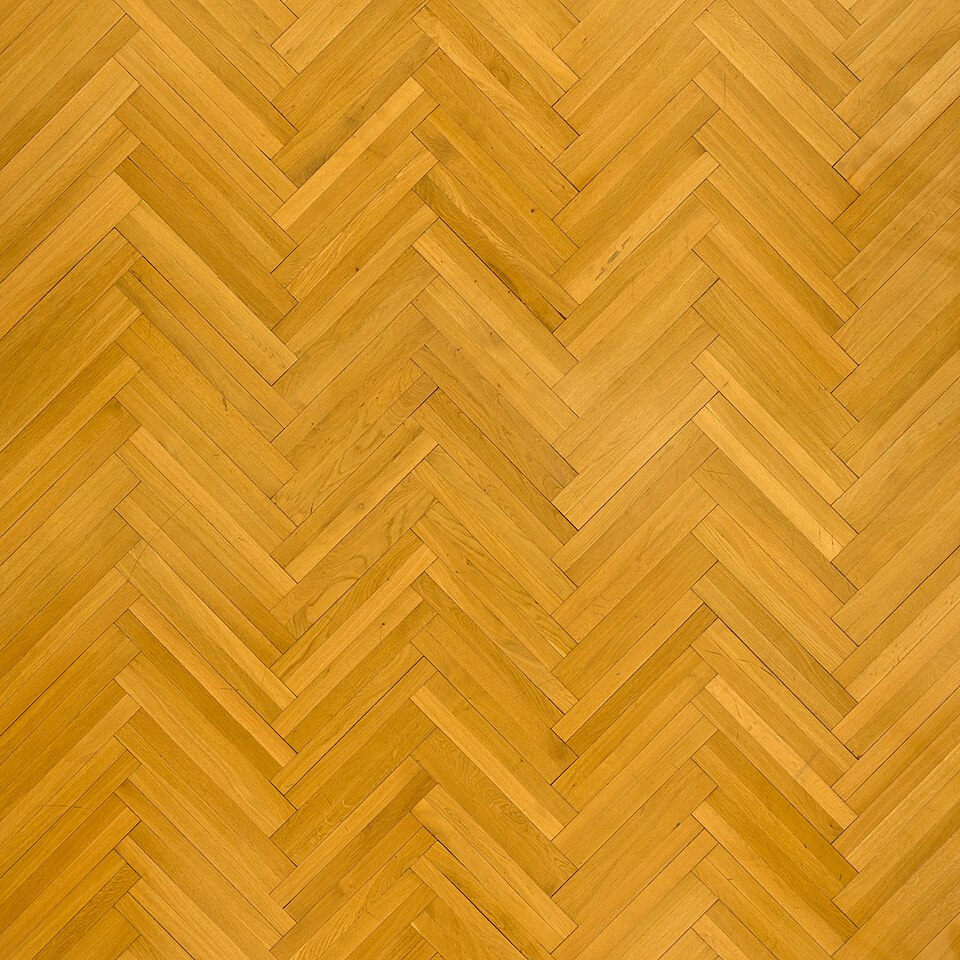
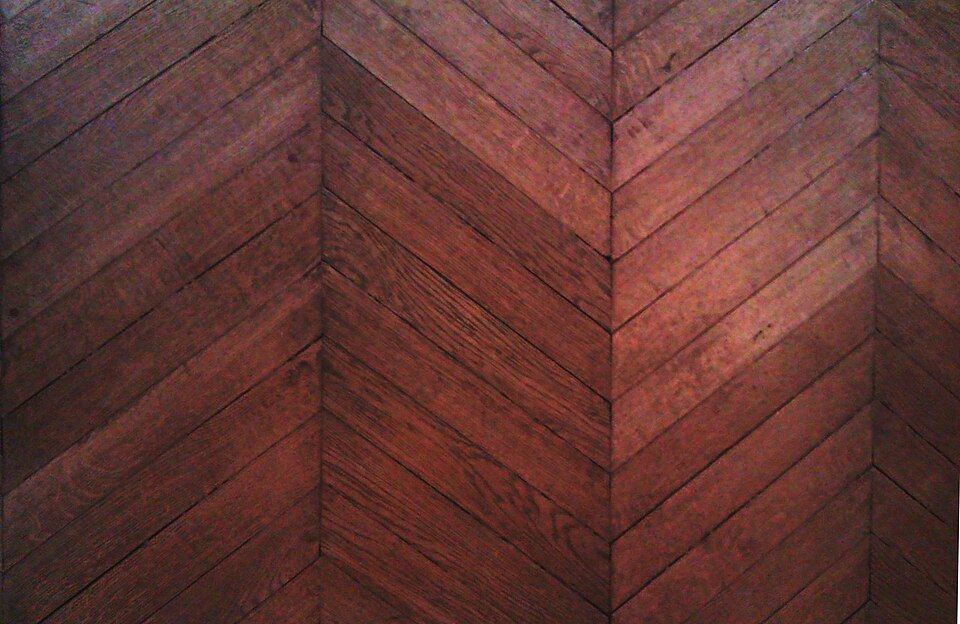
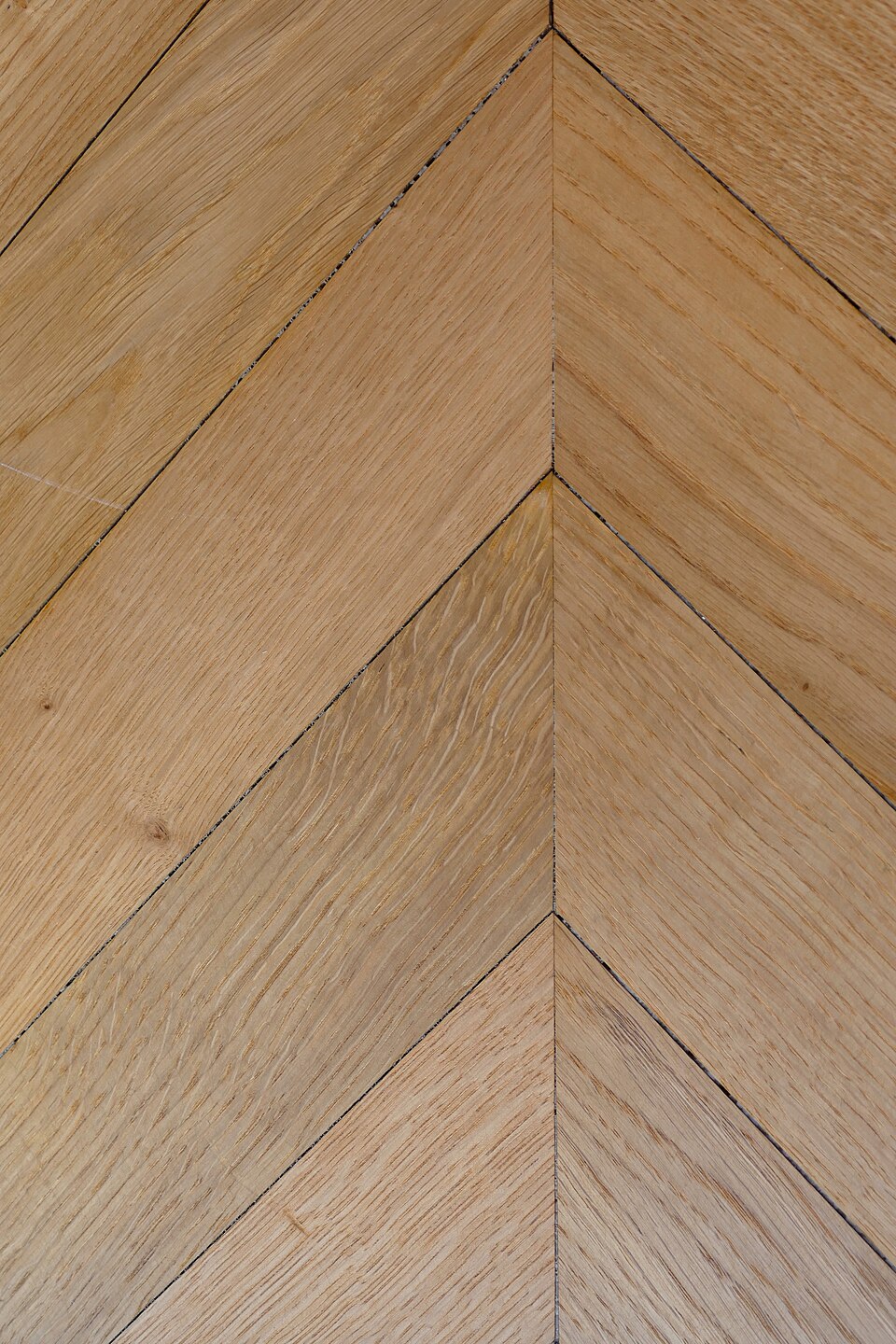
Herringbone is a parquet pattern made from rectangular pieces with square ends, set at right angles to one another so that they form a broken zigzag4. The pattern points in a direction, so the pieces are made as left and right boards that mirror each other1. It can be solid or engineered, and it is easily confused with chevron flooring, whose ends are cut at an angle (read our detailed comparison in herringbone vs chevron).
What is herringbone flooring?
The National Wood Flooring Association (NWFA) groups herringbone with chevron and the traditional finger-block pattern as common parquet patterns, and defines parquet as any pattern that is geometric in shape rather than linear2. Havwoods describes the herringbone layout as complete rectangular blocks or planks that meet at a right angle to form a broken V, in contrast to chevron pieces, which have their short ends cut at an angle4.
Herringbone is a flooring pattern, not a species or a construction. The same layout can be made from solid boards or from engineered boards, and NWFA notes that parquet material may be solid or engineered and varies in thickness from 5/16 in to 3/4 in1.
Why are there left and right boards?
Each piece in a herringbone floor leans one way. NWFA explains that herringbone floors can be ordered with "left" and "right" pieces because the pattern is directional, and that when you look at the face, the two are mirror images of each other. A universal form has grooves on both ends, and a slip-tongue or spline is used at each end connection1. We have not found a standards body that fixes other labels for the two boards, so check how your supplier names them before ordering.
What are the French names and where does the pattern come from?
In French, the square-ended layout is bâtons rompus. The CNRS-backed dictionary CNRTL defines a parquet à bâtons rompus as one whose blades of identical size are laid parallel to each other in bays3. It defines a parquet en point de Hongrie as one whose blades are laid like the bâtons rompus pattern but have their ends cut on the mitre, which is the chevron3. Bauwerk, a Swiss manufacturer, describes French bâtons rompus laying as having seen a strong revival of interest in interior design6.
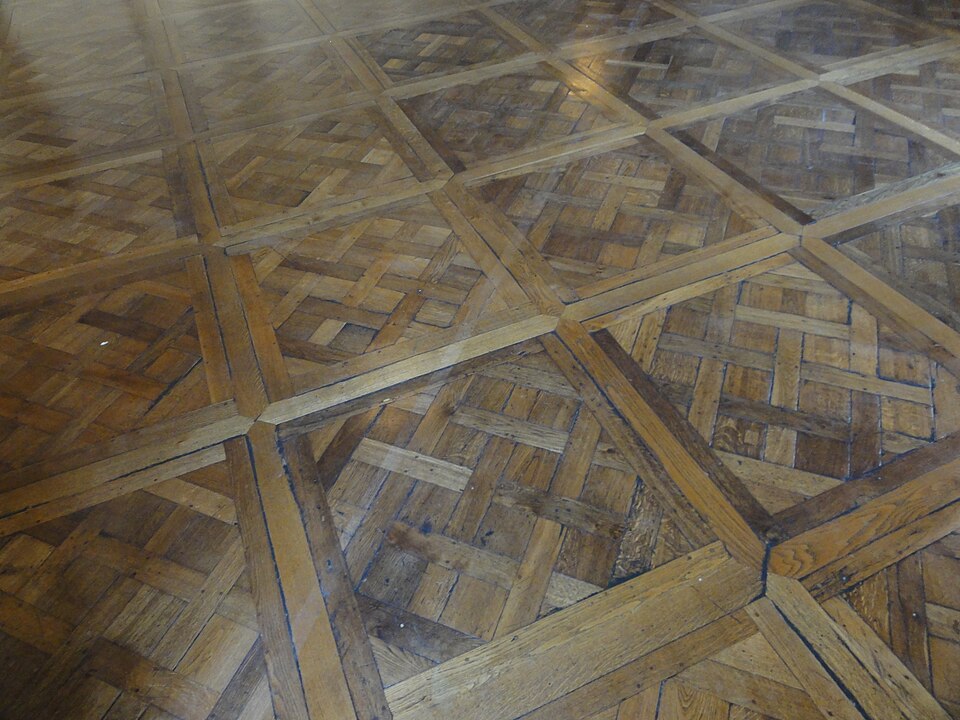
We found no authoritative source that dates the herringbone pattern in wooden floors, so we give no date. The same dictionary's earliest cited use of "parquet" as a floor covering is from 1664, for compartmented assemblies laid on joists, which refers to panel parquet rather than herringbone3. For that older panel tradition, see Versailles panels.
What sizes does herringbone come in?
Sizes vary by maker, so these are examples rather than a standard:
| Example | Construction | Dimensions | Source |
|---|---|---|---|
| Dinesen Douglas Pattern | Solid Douglas planks | Range 200-350 mm wide and 80-140 cm long; one herringbone project used 28 mm thick, 300 mm wide, 1.2 m long | 5 |
| OscarOno Rompu | Flatgrain select oak, 12 mm with a 4 mm top layer | 150 or 190 mm widths | 7 |
OscarOno Paris makes the oak herringbone collection Rompu, named for bâtons rompus, finished by lacquering7. NWFA notes that parquet is typically made of individual pieces, sometimes assembled into panels held together by wire, mesh, tape or paperface1. When ordering, it advises basing measurements on the actual dimension of the pattern, because the quantity of pieces is set by the jobsite layout and the repetition of the pattern itself1.
How is herringbone flooring laid?
NWFA's guidance for herringbone and chevron installation gives these points1:
- Herringbone is often glued down. It can be nailed using the appropriate nailing schedule if the pattern keeps an exposed side tongue, but a pneumatic nailer's impact can force pieces out of place and knock the pattern out of square.
- Use the centre-layout method: strike main control, perpendicular and diagonal lines, then find the true centre of the pattern to set working lines. For herringbone, working lines fall through the corners of each alternating slat.
- Lay out from several bundles or packages for variation.
- Keep the installation square, for example with a plywood square the size of the pattern anchored at the intersection of the working lines.
- Start with the tongue facing the build direction and install one row at a time, checking squareness regularly. For direct glue, do not spread adhesive over the working lines.
- Choose the direction with the client. The points may look best toward the longest dimension of the room or a major focal point.
Our installation methods guide explains glue-down, nail-down and floating methods in more detail.
Where does herringbone suit, and what should you check?
Herringbone suits any room where the subfloor can take the chosen fixing method. Check three things before you buy. First, the thickness and construction, since parquet can be solid or engineered1. Second, the fixing method the maker allows, since glue-down is common1. Third, the species, because a pattern floor still moves like any wood floor; for a common choice see European oak. If you want a layout with continuous points instead, compare chevron flooring.
Frequently asked questions
What is the difference between herringbone and chevron?
Why are herringbone boards sold as left and right?
Can herringbone flooring be nailed down?
Which way should the herringbone point?
Sources
- Wood Flooring Installation Guidelines (revised 2025), National Wood Flooring Association. Accessed .
- Environmental Product Declaration: Solid Wood Flooring (industry average), National Wood Flooring Association / ASTM International. Accessed .
- Parquet (definition), CNRTL, Trésor de la langue française informatisé (CNRS / ATILF). Accessed .
- Chevron flooring vs herringbone flooring, Havwoods. Accessed .
- Douglas Pattern: herringbone and chevron, Dinesen. Accessed .
- Formpark Rombico product leaflet, Bauwerk Parkett. Accessed .
- Rompu collection, OscarOno Paris. Accessed .
This page compiles published data from the sources listed above. Read our editorial policy. Last updated .