Wood flooring and underfloor heating
Quick answer
Most wood flooring can go over underfloor heating if the surface temperature is capped, usually at 27 °C (80 °F), the whole build-up stays low in thermal resistance, and the room humidity is controlled. Stable formats and species, such as engineered boards, narrow or quartersawn boards and walnut or cherry, cope best. Always follow the floor maker's approval for the specific heating system.
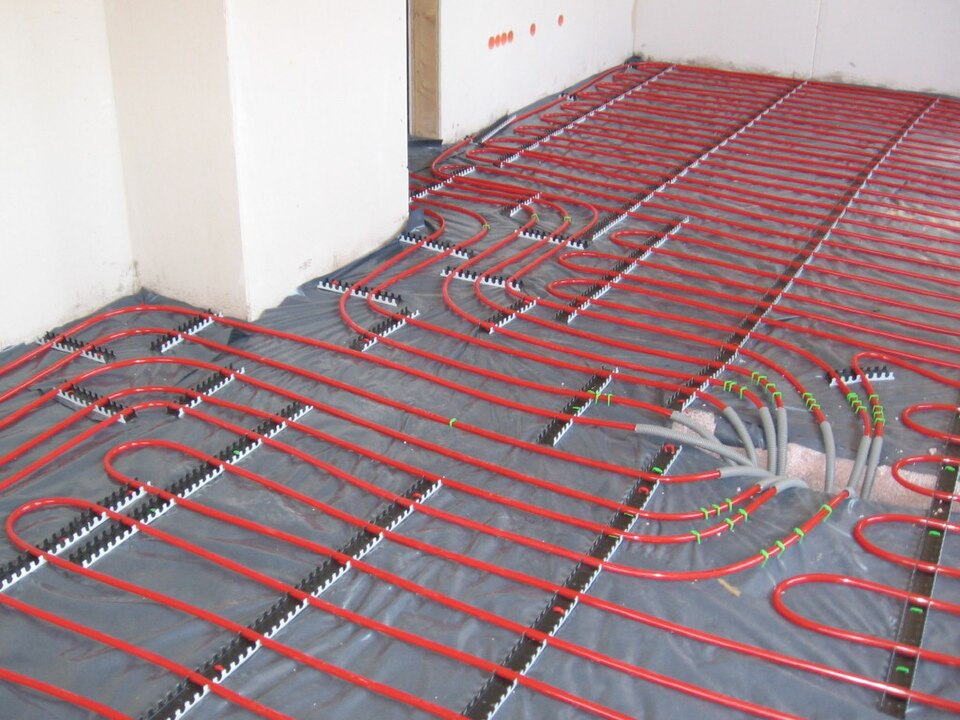
Most wood flooring can be installed over underfloor heating if the conditions are met. NWFA says exactly that, adding that success depends on the heating designer, the heating installer, the flooring installer and the owner all understanding what the whole system requires1. The core limits are a capped surface temperature, a low total thermal resistance, a stable species and format, and controlled humidity.
What surface temperature can a wood floor take?
Sources converge on about 27 °C, with one wider limit for the building system as a whole.
| Source | Limit stated |
|---|---|
| NWFA | Operating temperature restricted so the installed wood floor surface never exceeds 80°F (about 27 °C), unless the maker specifies otherwise1 |
| Junckers | Temperature on the surface of the boards should not exceed 27 °C2 |
| Kährs | Surface temperature of the wooden floor must never exceed 27°C / 80°F8 |
| Weitzer | DIN EN 1264 and Austrian standard B5236 stipulate a maximum floor surface temperature of 29°C for living areas; Weitzer's parquet surface must never exceed 27°C5 |
| NBS | For water-filled systems, a maximum floor temperature of 27°C9 |
The 29 °C and 27 °C figures answer different questions. The first is the limit for the heated floor surface in the building standard that Weitzer cites; the second is the limit the parquet maker applies to its product. The wood maker's figure is the one to follow.
NWFA adds that the heat-loss design should limit hydronic systems to a maximum heat gain of 20 BTU/hr/sf per room, and says a supplementary heat source is needed if the room cannot reach 70°F at that output1. On a straight unit conversion that is roughly 63 W/m². Junckers gives an indicative maximum of 100 W/m² and says the maximum surface temperature also defines the maximum output2. These two figures do not match, which is another reason to ask the heating and flooring makers for their combined approval.
Wood floors also dislike rapid temperature swings. NWFA says the surface should vary by no more than 3°F anywhere on the floor, should not fluctuate by more than 5°F per day, and that set-back or programmable thermostats could breach that limit and should not be used1. For hot-water systems, Junckers says the flow temperature needed for a 27 °C surface depends on the system, floor structure and covering, and will normally lie between 35 and 45 °C2.
How much thermal resistance can the floor have?
Thermal resistance is the thickness of a layer divided by its thermal conductivity, expressed in m²K/W, and the figures for each layer add together2. The UK trade often quotes tog instead: NBS gives 1 tog as 0.1 K·m²/W, and says figures quoted for carpet and underlay vary between 1.5 and 2.5 tog9.
| Item | Thermal resistance |
|---|---|
| Whole surface structure, Weitzer's limit | Not more than 0.15 m² K/W (1.5 tog on the NBS conversion)59 |
| Junckers 14 mm / 22 mm solid boards | 0.08 / 0.13 m²K/W2 |
| Junckers PolyFoam underlay with membrane | 0.07 m²K/W2 |
| HARO 3-layer parquet, series 2500 / 3500 / 4000 | 0.102 / 0.071 / 0.110 m² K/W7 |
Junckers' worked example adds a 14 mm clip floor (0.08) to PolyFoam (0.07) for a total of 0.15 m²K/W2, which lands exactly on Weitzer's ceiling. In practice that means a thick board on a thick underlay can use up the whole allowance. Weitzer also says wooden floor coverings should not be more than 24 mm thick under the Austrian standard it cites5. Kährs recommends an underlay with low thermal resistance and a vapour barrier between subfloor and wood8. NWFA warns that underlay R-values vary and can compromise radiant heat efficiency1.
Which species and formats are most stable?
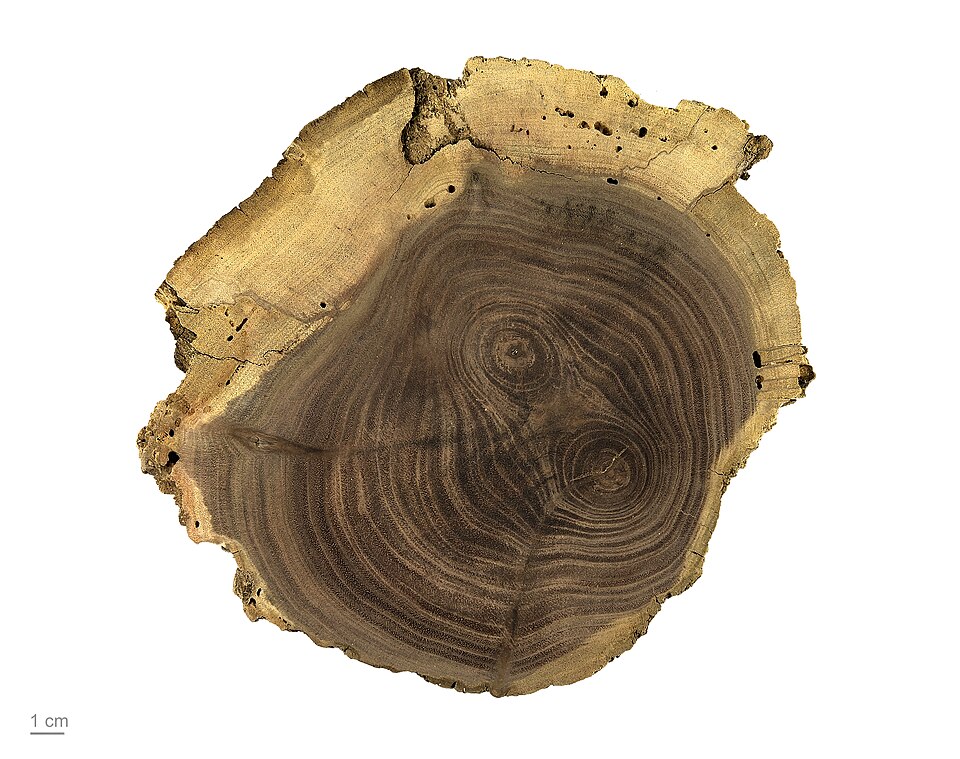
Wood shrinks and swells most along the growth rings: the Wood Handbook says tangential shrinkage is about twice as great as radial10. NWFA translates this into selection rules for radiant heat1:
- Quartersawn and riftsawn boards are more stable in width than plainsawn or end-grain.
- Narrow boards move less than wide boards of the same species and cut.
- Engineered flooring is in general more dimensionally stable than solid, though not every engineered product is approved over heat.
- Wood made for use above 9% moisture content or 50% RH should not be used unless the maker says so.
NWFA's tangential shrinkage (green to oven-dry) table gives the species ranking1:
| Species | Tangential shrinkage, % |
|---|---|
| Hickory (true) | 12.6 |
| Beech | 11.9 |
| White oak | 10.5 |
| Hard maple | 9.9 |
| Black walnut | 7.8 |
| Black cherry | 7.1 |
| Teak (Thai/Burmese) | 5.3 |
NWFA calls walnut and cherry known for inherent stability and describes hickory, beech and maple as less suitable over radiant heat; Kährs does not recommend beech, Canadian maple, American hickory or American hard maple because they expand and contract more than other species18. See hickory, black walnut, hard maple, European beech and American cherry for species detail. For a solid board, NBS advises strips of no more than 75 mm width, kiln dried to 6 to 9% moisture content9. NWFA says engineered floors with a hickory, beech or maple wear layer are not normally best over radiant heat unless the maker suggests otherwise1; read our engineered wood guide for construction.
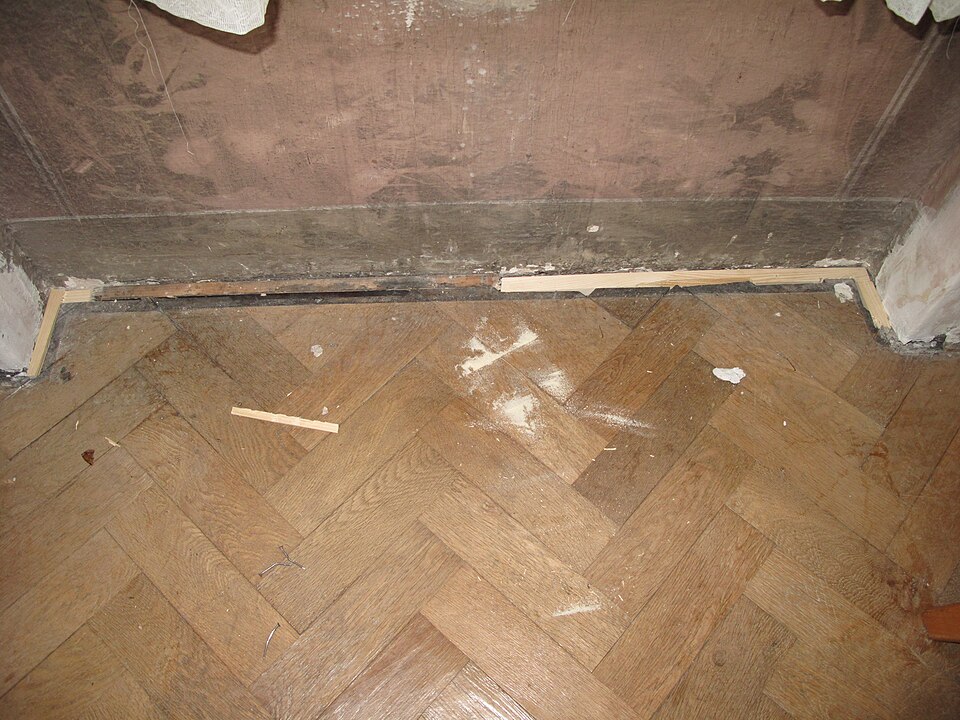
Gaps are normal. Junckers says wood contracts when heated from below, larger gaps than usual form in the heating season, and gaps are bigger under bookcases and insulating carpets2.
Which installation method is used over underfloor heating?
The sources agree that the method must be approved for the heating system but differ on floating.
- Glue-down. Weitzer says full-surface bonding is the best solution for heat transfer5. Kährs says gluing gives the lowest thermal resistance with underfloor heating8. NWFA says the heat must be reduced or even turned off during glue-down to avoid skinning of the adhesive, and the subfloor surface must never exceed 80°F at installation1.
- Floating. Weitzer says floating is suitable only to a limited extent because it increases thermal resistance and raises the risk of creaking noise5. HARO says its modern parquet can be laid floating or glued over underfloor heating6. NWFA covers floating engineered floors over heat and tells you to include the underlay R-value in the heating design1.
- Nail-down. NWFA allows nailing over wood subfloors but says to avoid penetrating tubes or elements; where the fastener schedule cannot be followed it suggests nail-assisted glue-down, full-spread glue-down or floating1.
Our installation methods guide covers the mechanics.
How should you heat up the system before the floor goes down?
NWFA says radiant systems should be fully operational for at least 5 days before flooring is delivered to force out moisture1. HARO describes a longer screed programme: at least 21 days of drying for cement screed and 7 days for calcium sulphate screed, then functional heating of at least 7 days, then ready-to-cover heating of at least 7 and usually 14 days6. HARO's example protocol starts at 25 °C, raises the flow temperature by 10 °C per day to 55 °C or the design maximum, holds it for 11 days without night setback, then reduces by 10 °C daily; the screed is ready when CM readings are at most 1.8% for cement and 0.3% for anhydrite screed6. Weitzer gives the same CM limits and says cement screed must harden for at least 21 days and anhydrite screed for at least 7 days before heating starts5.
Check against the screed or heating maker's own schedule, since protocols differ by system.
How do you keep humidity right?
Radiant heat dries the air and the floor. NWFA recommends specifying supplemental humidification to keep the space between 30% and 50% RH, or as the wood maker requires, running before, during and after installation1. Weitzer recommends a relative humidity of at least 40% during heating periods and a seasonal range of 30 to 65%5. Junckers expects the building to be within its in-use humidity range (35 to 65% RH for residential buildings) before laying starts2. See the moisture and acclimatisation guide for how equilibrium moisture content follows humidity.
What about underfloor cooling and covering the floor?
NWFA says radiant cooling systems are never recommended under wood flooring1. HARO says its floors suit underfloor cooling when a dew point monitor is integrated into the controls6. The advice conflicts, so treat cooling as a case for written approval from the flooring maker.
Covers matter in use. Junckers says that when a heated floor is covered for protection, only a breathable covering of the thinnest possible type should be used4, and Weitzer says carpets can raise surface temperature and increase gapping and cracking in those areas, and that the surface temperature must be lowered before cleaning5.
Frequently asked questions
What is the maximum surface temperature for a wood floor over underfloor heating?
What thermal resistance can the floor have?
Can solid wood go over underfloor heating?
How long should the heating run before the floor is installed?
Sources
- Wood Flooring Installation Guidelines, revised 2025 (Substrates: Radiant Heat), National Wood Flooring Association (NWFA). Accessed .
- Underfloor heating, general information, E 4.0, Junckers. Accessed .
- General information, solid hardwood floors, C 1.0, Junckers. Accessed .
- Cleaning and maintenance, lacquered floors, G 4.0, Junckers. Accessed .
- Information Sheet MB 020: Parquet on subfloor heating (07-2025), Weitzer Parkett. Accessed .
- How to install your underfloor heating under parquet, HARO. Accessed .
- Parquet plank construction: multi-layer construction and solid wood planks in comparison, HARO. Accessed .
- FAQ about flooring, Kährs. Accessed .
- Underfloor heating: the cover up, NBS (Norman Carless, 2007). Accessed .
- Wood Handbook (FPL-GTR-282), Chapter 4: Moisture Relations and Physical Properties of Wood, USDA Forest Products Laboratory. Accessed .
This page compiles published data from the sources listed above. Read our editorial policy. Last updated .