Iroko
Quick answer
Iroko (Milicia excelsa and Milicia regia) is a durable African hardwood with a Janka hardness of 1,190 lbf (5,310 N) and an average dried weight of 660 kg/m³. Its yellow to golden brown heartwood darkens with time, and hard calcium carbonate deposits can blunt cutting edges13. It is sometimes sold as African teak, although it is not related to true teak.
Iroko is a durable African hardwood with a Janka hardness of 1,190 lbf (5,310 N), a little harder than teak, and an average dried weight of 660 kg/m³12. The yellow to golden brown heartwood darkens over time, and hard calcium carbonate deposits can dull tools13. Check species, origin and EU due diligence documents before you buy.
What is iroko?
Iroko is the trade name for two closely related African trees, Milicia excelsa and Milicia regia, formerly placed in the genus Chlorophora1. PROTA says timber of the two is usually sold as iroko without distinction, and that M. excelsa is also known as odum in Ghana, kambala and mvule3.
The Wood Database says iroko is sometimes called "African teak", although that name is more often applied to afrormosia, and neither is botanically related to true teak1. The same source lists iroko as an African lookalike and substitute for teak, and says the two can be told apart by their endgrain, because iroko is strictly diffuse porous2.
Where does iroko grow?
The Wood Database gives the distribution simply as tropical Africa, with trees 30 to 40 m (100 to 130 ft) tall and trunks 1 to 1.5 m (3 to 5 ft) in diameter1. PROTA says M. excelsa is native from Guinea-Bissau east to Ethiopia and south to Angola, Zimbabwe and Mozambique, and has been introduced to India and the United States3.
What does iroko look like, and does it change colour?
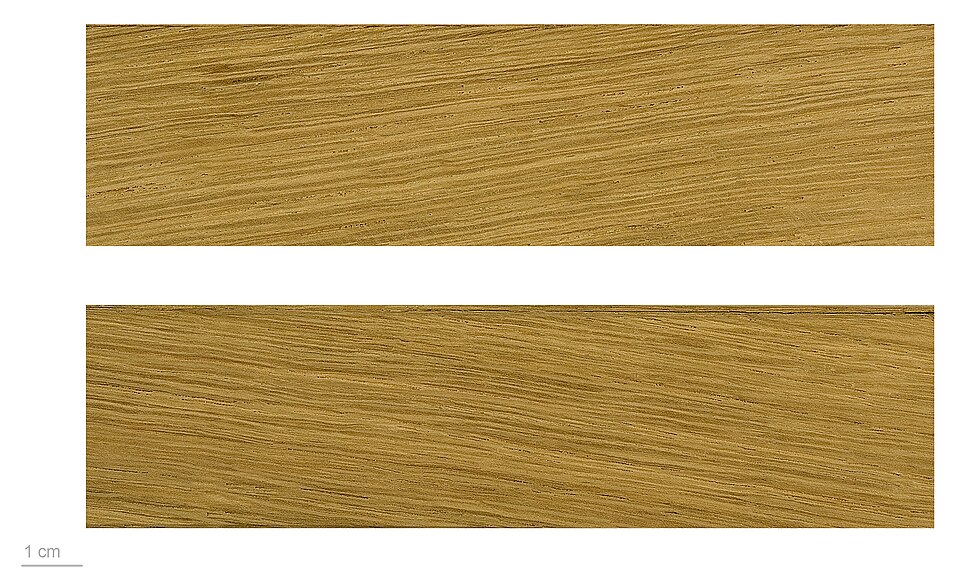
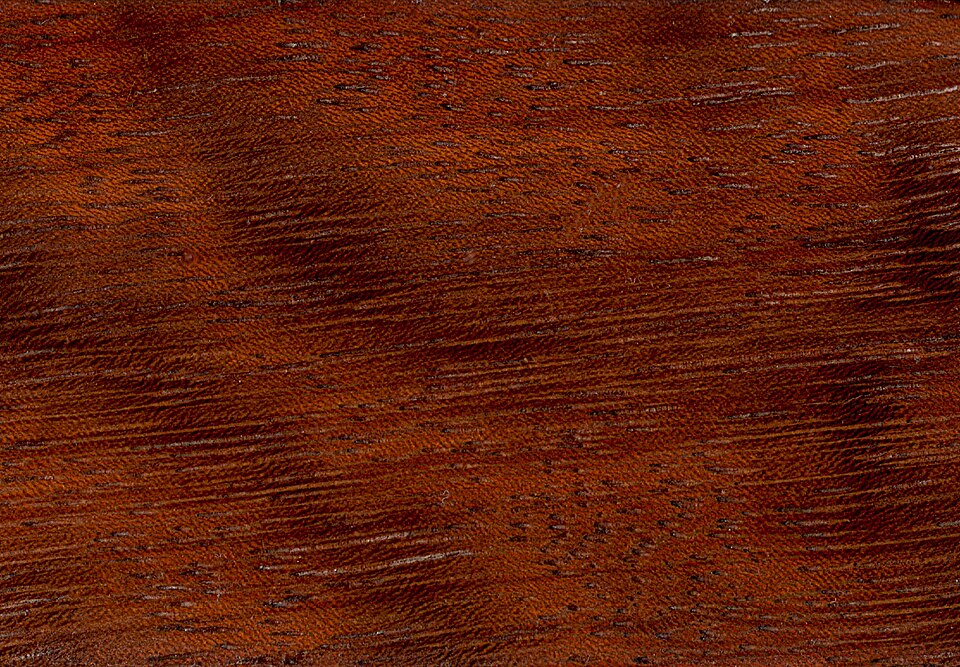
The heartwood is usually yellow to golden or medium brown, with a clearly demarcated pale yellow sapwood1. PROTA describes heartwood that is pale yellow to yellow when fresh, darkening to yellowish or greenish brown, or sometimes chocolate brown, with a yellowish white sapwood 5 to 7.5 cm wide3.
The grain is interlocked and sometimes irregular, with a medium to coarse texture and good natural lustre. The Wood Database adds that unfinished surfaces can feel greasy or oily1. Expect a new iroko floor to look lighter and more yellow than the same floor after some years of light exposure.
How hard and dense is iroko?
| Property | Wood Database | PROTA |
|---|---|---|
| Janka hardness | 1,190 lbf (5,310 N) | not stated |
| Density | 660 kg/m³ (41.2 lb/ft³) average dried weight; basic specific gravity 0.56 and 0.66 | 550 to 750 kg/m³ at 12% moisture content |
| Shrinkage | Radial 3.3%, tangential 4.8%, volumetric 8.8% | Green to oven dry: 1.7 to 4.1 (to 5.6)% radial, 2.4 to 6.3 (to 9.8)% tangential |
Sources:13. The two sources use different bases, so the shrinkage figures are not directly interchangeable. For context on what the Janka number means in use, see Janka hardness explained. Teak, at 1,070 lbf (4,740 N) on the Wood Database, is slightly softer; compare it on the teak page2.
Is iroko stable and durable?
The Wood Database rates the heartwood as very durable, with resistance to both rot and insect attack1. PROTA broadly agrees, calling the heartwood generally very durable and resistant to fungi, but notes that reports on resistance to marine borers and termites vary. It also says the sapwood is liable to Lyctus beetle attack and the heartwood is impermeable to preservatives3.
On drying, PROTA says iroko dries well with little degrade, and gives the example of 4.2 cm boards being kiln-dried from 60% to 15% moisture in 8 days at 50 to 80°C3. Even so, all solid timber moves with humidity, so follow the guidance on moisture and acclimatisation before laying.
What are iroko stones, and do they matter for floors?
PROTA describes hard deposits called "iroko stones", mainly calcium carbonate, which make the wood rather abrasive and can blunt cutting edges3. The Wood Database says the wood is generally easy to work, but that calcium carbonate deposits can significantly dull cutters, and that interlocked grain may cause tearout during surfacing1.
For a floor, this is mainly a workshop and installation issue: machining, cutting to length and sanding may wear tools faster. Plan for sharp or carbide-tipped tooling and check the sanding and refinishing guide before you commission work. Both sources agree the wood glues and finishes well, although PROTA also reports that chlorophorin in the wood stops oil-based paints from drying and corrodes metal in contact with it13.
Is iroko used for flooring?
Yes. The Wood Database lists flooring among iroko's common uses, alongside veneer, furniture, cabinetry, boatbuilding and turned items1. PROTA lists "flooring and profile boards for decorative and structural uses" among many others, including joinery, stairs, doors and garden furniture3. For the general trade-offs of the format, see solid wood flooring. The Wood Database describes iroko as imported at a moderate price1.
Are there health concerns with iroko dust?
The Wood Database reports iroko as a sensitizer. Most reactions are eye, skin and respiratory irritation, though sensitive individuals may experience asthma-like symptoms, boils and hypersensitivity pneumonitis; severe reactions are uncommon1. PROTA says wood and sawdust may cause dermatitis, nose and throat irritation and asthmatic reactions, attributed to chlorophorin3. This matters most to people cutting or sanding the timber, so installers should control dust.
Is iroko sustainable and legal to buy?
The Wood Database says iroko is not listed in the CITES Appendices. It reports that on the IUCN Red List M. excelsa is near threatened and M. regia is vulnerable, because of a population reduction of over 20% in the past three generations1. PROTA cites a 2006 IUCN listing of "lower risk but near threatened" for M. excelsa, naming habitat loss, overexploitation and Phytolyma attacks as threats. It also notes log export bans in Côte d'Ivoire, Ghana, Cameroon and Tanzania3. These status details come from secondary sources, not from the IUCN Red List itself.
For buyers in the EU, the European Commission says the deforestation regulation repeals the EU Timber Regulation, with transitional provisions. Operators placing wood products on the market must show they are deforestation-free, legally produced and covered by a due diligence statement. Application dates are 30 December 2026 for large and medium operators and 30 June 2027 for micro and small enterprises4. Ask your supplier for the species, country of harvest and the due diligence documentation.
Frequently asked questions
Is iroko the same as teak?
Is iroko harder than teak?
What are iroko stones?
Does iroko dust cause health problems?
Is iroko a threatened species?
Sources
- Iroko, The Wood Database. Accessed .
- Teak, The Wood Database. Accessed .
- Milicia excelsa (PROTA), PROTA via Pl@ntUse (Plant Resources of Tropical Africa). Accessed .
- Regulation on deforestation-free products, European Commission, Directorate-General for Environment. Accessed .
This page compiles published data from the sources listed above. Read our editorial policy. Last updated .