Jatoba (Brazilian cherry)
Quick answer
Jatoba (Hymenaea courbaril) is a very hard, dense South American timber sold for flooring as Brazilian cherry, although it is unrelated to cherry. The Wood Database gives it a Janka hardness of 2,690 lbf (11,950 N) and an average dried weight of 910 kg/m³, and its reddish heartwood darkens with light exposure12.
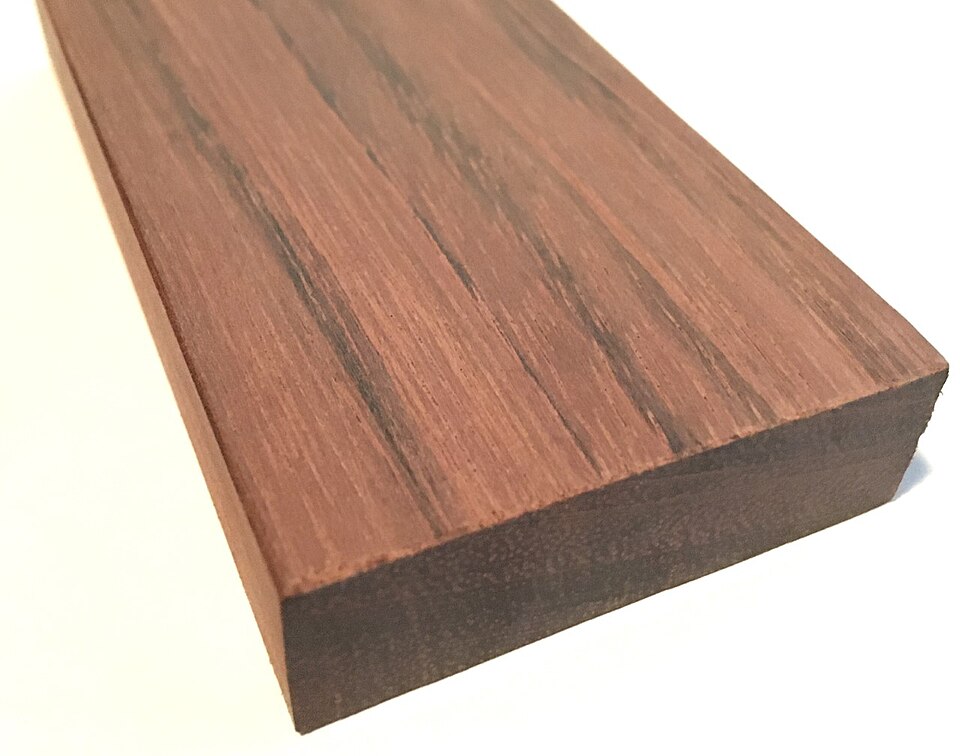
Jatoba, Hymenaea courbaril, is a very hard, heavy tropical timber that flooring sellers call Brazilian cherry. It has a Janka hardness of 2,690 lbf (11,950 N) and an average dried weight of 910 kg/m³, and it is unrelated to cherry1. The colour is reddish brown and deepens with light, so expect the floor to look different after a few years than on the showroom sample2.
What is jatoba, and why is it called Brazilian cherry?
Jatoba is the Brazilian name for Hymenaea courbaril, a legume tree whose natural range runs from Central America and southern Mexico to northern South America and the West Indies1. Hardwood Floors Magazine, the magazine of the National Wood Flooring Association, lists other names including West Indian locust, algarrobo, copal and jatai vermelho2. CIRAD's technical sheet, which uses the French name courbaril, gives the same botanical name and lists Jatoba, Jutai, Algarrobo and Guapinol among its commercial names3.
"Brazilian cherry" is a trade name. The Wood Database says it is mostly used by flooring sellers, that the wood is unrelated to domestic cherry (Prunus serotina), and that its natural colour resembles stained domestic cherry1. If you want the real thing, see American cherry, which The Wood Database lists at 950 lbf (4,230 N) and 560 kg/m³, against 2,690 lbf and 910 kg/m³ for jatoba41. In practical terms the two behave very differently underfoot and under a sander, so always specify the botanical name.
What does jatoba look like, and how does it change?
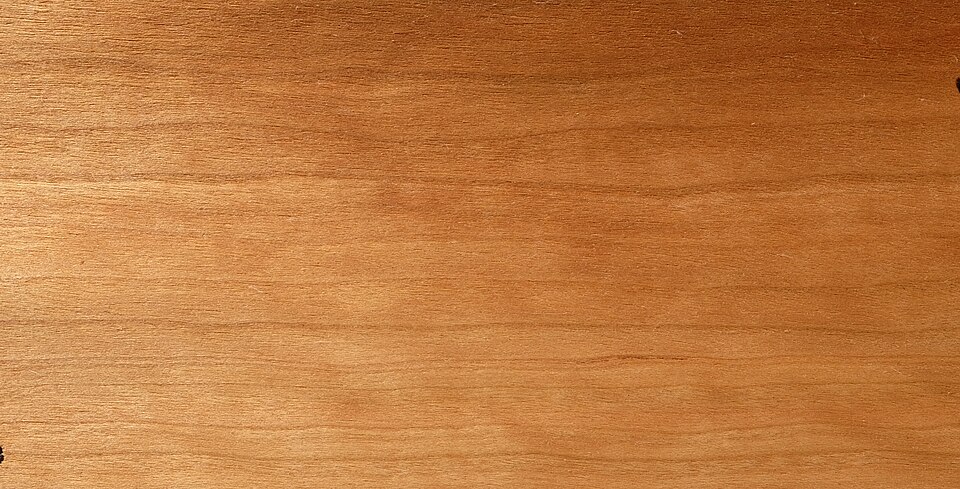
The Wood Database describes the heartwood as light orangish brown to darker reddish brown, sometimes with darker greyish brown streaks, and the sapwood as light greyish yellow and clearly distinct1. Hardwood Floors Magazine gives a similar range, from salmon-red through light orange-brown to darker russet, and says dark contrasting streaks are often present2. The grain is typically interlocked, with a medium to coarse texture and good natural lustre1.
Both sources say the colour darkens with light exposure12. Hardwood Floors Magazine adds that white spots or specks may appear after finishing or with ageing, which it identifies as calcium carbonate, a natural part of the species2. If a rug or piece of furniture covers part of the floor, the covered area may therefore look different from the exposed area.
How hard and dense is jatoba?
| Measure | Jatoba (Hymenaea courbaril) | American cherry (Prunus serotina) |
|---|---|---|
| Janka hardness | 2,690 lbf (11,950 N) | 950 lbf (4,230 N) |
| Average dried weight | 910 kg/m³ (57 lb/ft³) | 560 kg/m³ (35.0 lb/ft³) |
Figures are from The Wood Database14. Hardwood Floors Magazine also gives an average Janka figure of 2690 and a specific gravity of 0.912.
Sources differ a little on density. CIRAD gives 780 to 970 kg/m³ at 12% moisture, with an average of 860 kg/m³, and classes the wood as heavy and hard3. That sits below The Wood Database average of 910 kg/m³, but the ranges overlap, and the spread within the species is wide. Our Janka hardness guide explains what the figure measures and what it does not.
How stable is jatoba?
Movement figures differ by source and by how they are measured, so treat them as a range:
| Source | Radial | Tangential | Volumetric |
|---|---|---|---|
| The Wood Database (green to oven-dry) | 4.2% | 8.0% | 12.1% |
| Hardwood Floors Magazine (green, 30% MC, to oven-dry) | 4.5% | 8.5% | not given |
| CIRAD (total shrinkage) | 3.7% | 7.8% | 12.3% |
Sources:123. CIRAD notes that, unlike other woods of similar density, courbaril has a relatively low volumetric shrinkage, so it is little sensitive to humidity changes and stays stable once installed3. Hardwood Floors Magazine says it is stable once properly dried and has shown slight movement in use, but that a longer acclimation may be needed2. See moisture and acclimatisation for how to condition boards before laying.
How is jatoba used in flooring, and what is it like to work?
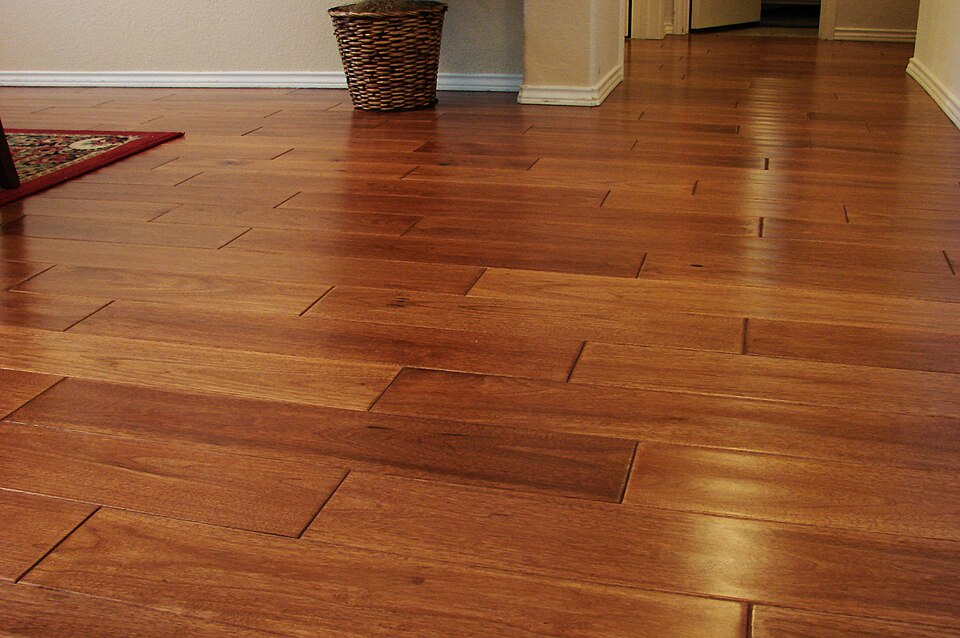
The Wood Database lists flooring first among its uses, alongside furniture, cabinetry, tool handles and shipbuilding, and calls the timber inexpensive for an imported wood1. CIRAD's sheet considers parquet and stair use feasible3.
On site the hardness is the main factor. Hardwood Floors Magazine says it makes fastener penetration difficult, advises adjusting compressor pressure to avoid splitting the tongue, and says 18-gauge cleats work best2. The Wood Database calls it difficult to work because of its density and hardness, with moderate cutter dulling and some tear-out when planed because of the interlocked grain1.
For sanding, Hardwood Floors Magazine says not to skip grits2; our sanding and refinishing guide covers the general process. It also says the wood stains and finishes very nicely but that stains and finishes often need extended dry times2. The Wood Database agrees that it glues, stains and finishes well1. CIRAD reports a high content of solvent extractives, such as resins and waxes, of 10 to 15% of the wood3. None of the sources we read ties this to adhesive or finish failures, so follow the finish maker's instructions and test a sample board.
The Wood Database notes that severe reactions are uncommon but skin irritation has been reported1, so use a dust mask and gloves when cutting and sanding.
Is jatoba legal and sustainable to buy?
The Wood Database and Hardwood Floors Magazine both say jatoba is not listed in the CITES Appendices and that the IUCN considers it a species of least concern12. CIRAD's older sheet says French Guiana inventories found limited volumes there, which is a statement about that region, not about the whole range3.
A CITES exemption does not mean no rules apply. In the EU, the European Commission says the Regulation on deforestation-free products covers wood and certain products made from it, that Annex I defines the scope, and that it repeals the EU Timber Regulation with transitional provisions. It requires that products are deforestation-free (not from land deforested after 31 December 2020) and legally produced under the laws of the country of production, supported by a due diligence statement with geolocation information. The Commission page lists application dates of 30 December 2026 for large and medium-sized operators and 30 June 2027 for micro and small enterprises, after postponements, so confirm the current dates5. We did not find a source tying jatoba to a specific certification scheme, so ask your supplier for proof of legal origin and for any certificate to be checked against the shipment.
How does jatoba compare with other species?
- American cherry: a different genus with far lower hardness (950 lbf), and also darkens with light.
- Teak: 1,070 lbf, much softer than jatoba, with its own sourcing and legal questions.
- Hickory: a hard North American option for readers who want something dense but temperate.
Frequently asked questions
Is Brazilian cherry the same as cherry?
How hard is jatoba?
Will jatoba change colour?
Is jatoba protected under CITES?
Is jatoba difficult to install and finish?
Sources
- Jatoba, The Wood Database. Accessed .
- Species Specs: Jatoba (Brazilian Cherry), Hardwood Floors Magazine (National Wood Flooring Association). Accessed .
- Courbaril (Hymenaea courbaril) technical sheet, CIRAD (Centre Technique Forestier Tropical). Accessed .
- Black Cherry, The Wood Database. Accessed .
- Regulation on deforestation-free products, European Commission, Environment. Accessed .
This page compiles published data from the sources listed above. Read our editorial policy. Last updated .