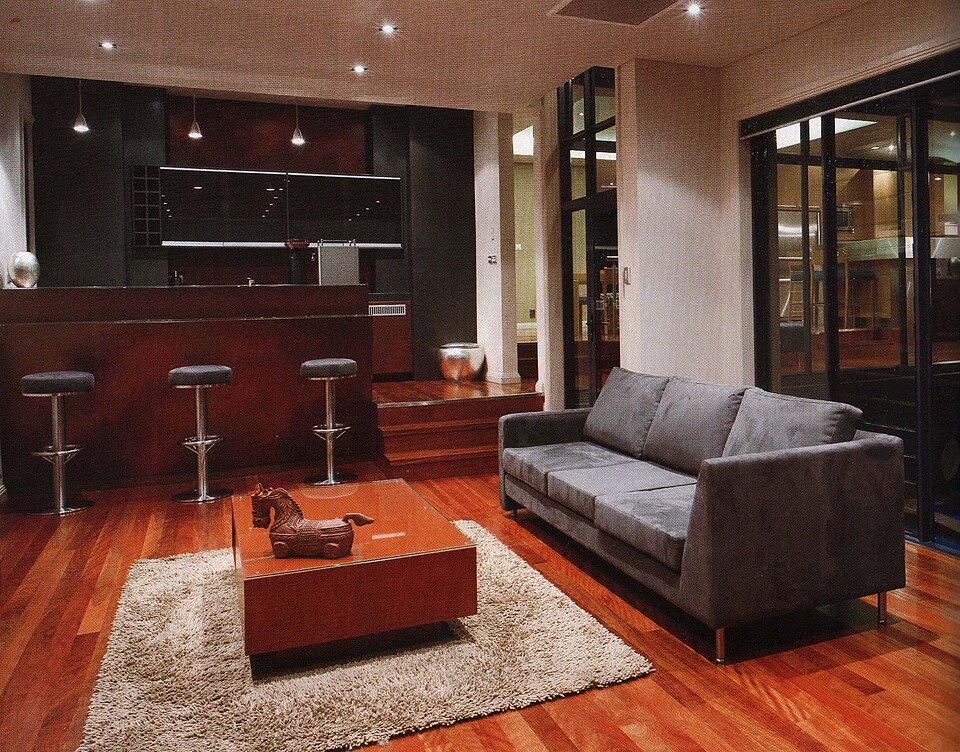
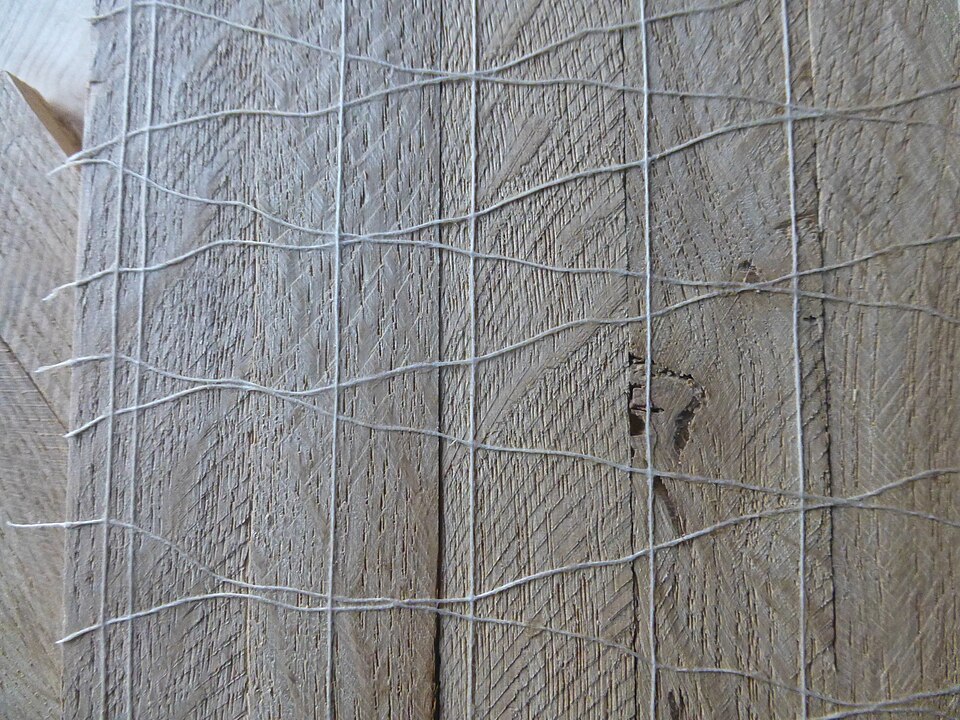
Zambezi teak
Quick answer
Zambezi teak (Baikiaea plurijuga), also called Rhodesian teak, is a legume from southern Africa and not a true teak. The Wood Database gives it a Janka hardness of 2,990 lbf (13,300 N) and a density of 890 kg/m³ at 12% moisture content, and PROTA describes it as particularly suitable for heavy flooring13.
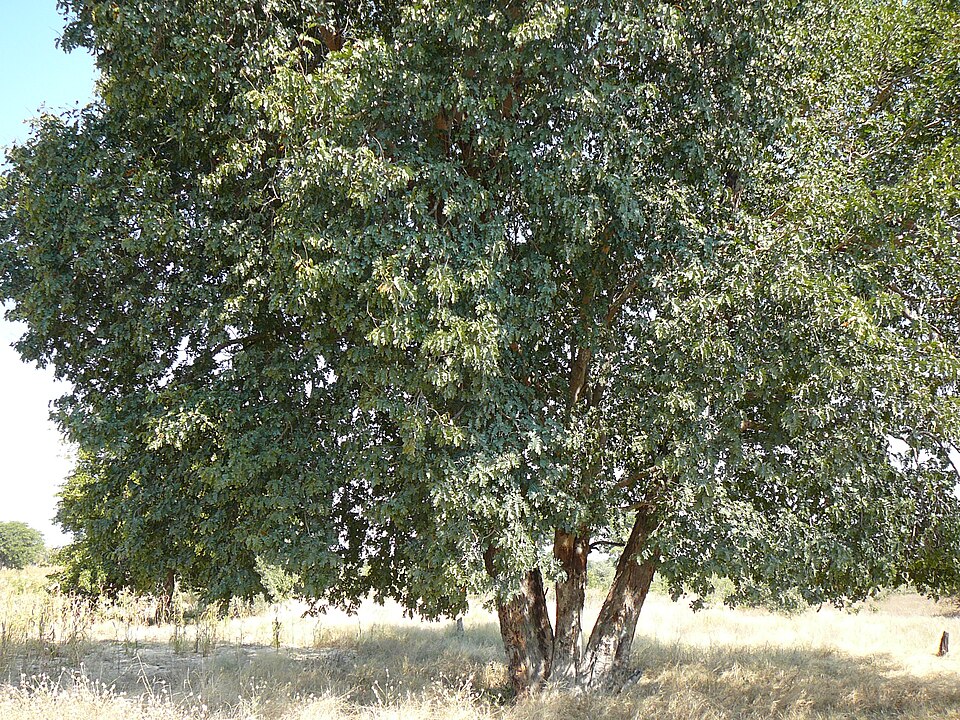
Zambezi teak, Baikiaea plurijuga, is a dense southern African hardwood with a Janka hardness of 2,990 lbf (13,300 N) and a density of 890 kg/m³ at 12% moisture content1. It is a legume, not a true teak, and PROTA calls it particularly suitable for heavy flooring because of its abrasion resistance, low shrinkage and appearance23. It is hard on tools and sourced from a species rated near threatened, so both the installer and the supply chain deserve attention.
Is Zambezi teak a true teak?
No. FAO describes Baikiaea plurijuga as a Caesalpinioid legume, locally called mukusi, that is quite distinct botanically and structurally from the so-called true teak, Tectona grandis, although its wood properties are similar2. The Wood Database lists the common names Rhodesian teak and Zambesi redwood, and notes that luthiers sometimes call it Mukushi or Zambian Teak1. Our page on teak covers the genuine species and its separate sourcing questions.
Where does Zambezi teak grow?
FAO says the species is native to the Kalahari Sands of south-western Zambia and neighbouring parts of Angola, Botswana, Namibia and Zimbabwe, and that the best remaining stands are in Zambia's Sesheke District2. PROTA gives the same five countries: Zambia, southern Angola, northern Namibia, northern Botswana and Zimbabwe. It adds that introductions to Burundi and Madagascar have had little success3. The Wood Database describes a tree of 15 to 20 m (50 to 65 ft) with a trunk 0.3 to 0.6 m (1 to 2 ft) across1.
How hard and dense is it?
| Property | Zambezi teak (Baikiaea plurijuga) | Teak (Tectona grandis) |
|---|---|---|
| Janka hardness | 2,990 lbf (13,300 N) | 1,070 lbf (4,740 N) |
| Density at 12% moisture | 890 kg/m³ | 655 kg/m³ average dried weight |
| Shrinkage, radial / tangential | 2.6% / 4.5% | 2.6% / 5.3% |
| Volumetric shrinkage | 6.9% | 7.2% |
Figures are from The Wood Database14. PROTA gives a density range of 815 to 955 (to 1,000) kg/m³ at 12% moisture content, so expect natural variation between boards3. The hardness gap is large; if the Janka scale is new to you, read our Janka hardness guide, or compare other species on the hardness chart. For another dense tropical option see jatoba.
What does it look like?
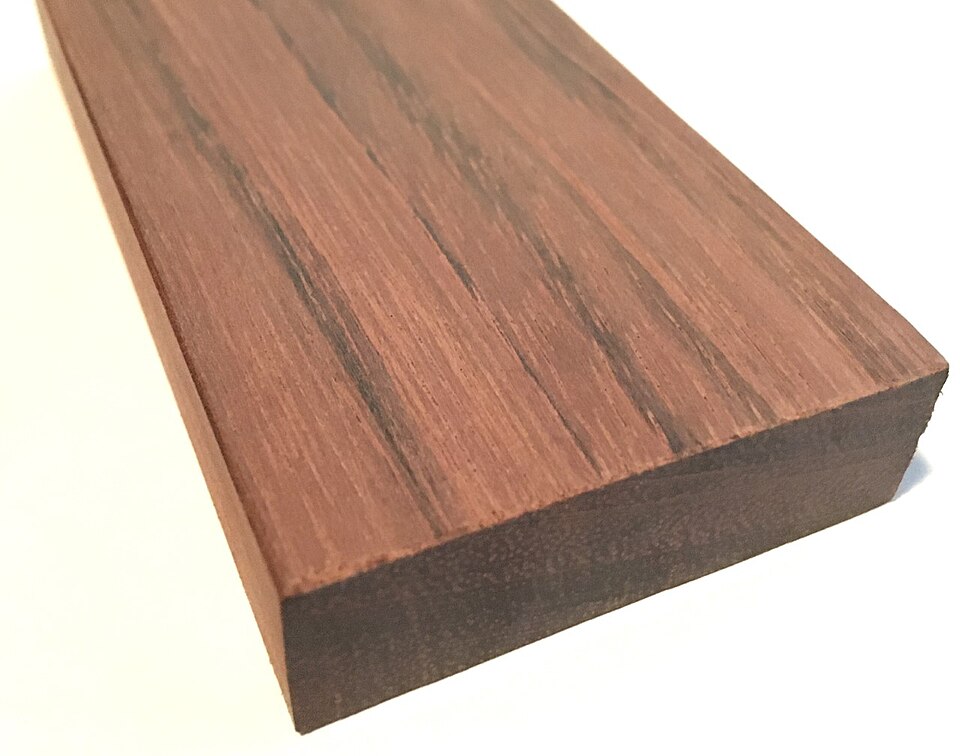
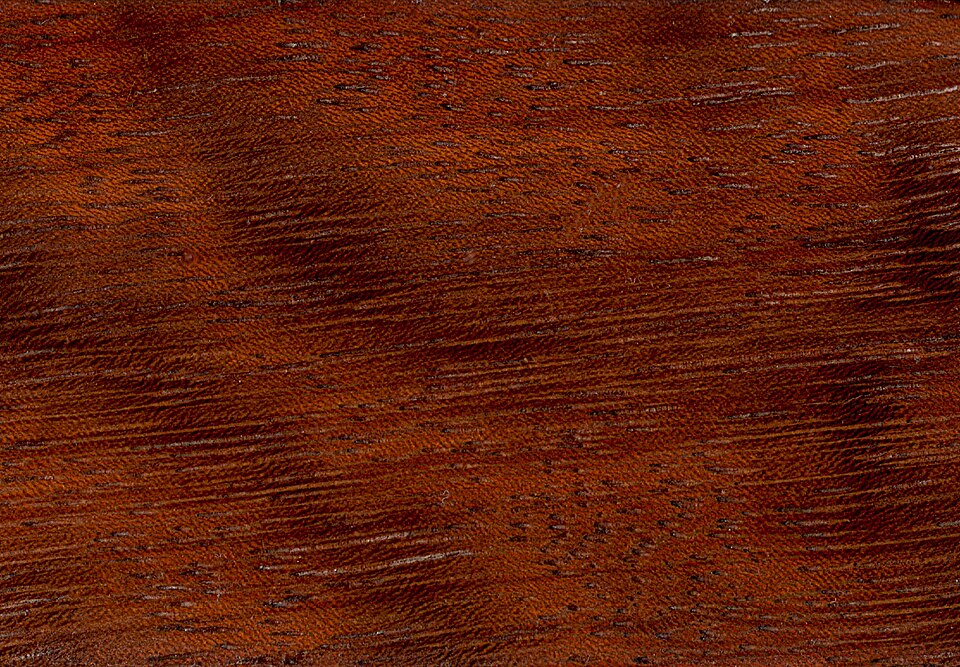
The Wood Database describes the heartwood as medium reddish brown, often with black streaks, against a pale pinkish yellow, sharply defined sapwood. The grain is straight to interlocked, with a fine, even texture and low natural lustre1. PROTA says freshly cut heartwood is brown with irregular dark markings, turns dark red to dark red-brown on exposure and takes a yellow tinge over time. Its sapwood band is 2.5 to 5 cm wide3. Floors will therefore darken and warm in service, and boards that mix heartwood and sapwood will look more contrasted.
How does it work, glue and finish?
Working is the main drawback. The Wood Database calls it difficult, with high cutting resistance, slow sawing and a tendency to ride up over jointer knives, and says its high silica content blunts cutting edges quickly. It does say the wood is stable in service and glues, turns and finishes well1. PROTA recommends stellite-tipped saw teeth and tungsten-carbide-tipped cutting edges, notes that gum can clog saw teeth, and adds that the wood planes well at a 20° cutting angle, polishes well and needs pre-boring for nailing3. Heartwood is very resistant to preservative impregnation, which matters little for interior floors3. Ask your installer whether they have the tooling; our guides to installation methods and sanding and refinishing explain the general process.
How durable is it?
PROTA says the heartwood is resistant to fungi and termites, while the sapwood is susceptible to powder-post and longhorn beetles3. The Wood Database rates the heartwood very durable with good insect resistance, and says the sapwood is prone to insect attack1. Both sources point the same way: heartwood is the durable part.
What is its history as sleepers and parquet?
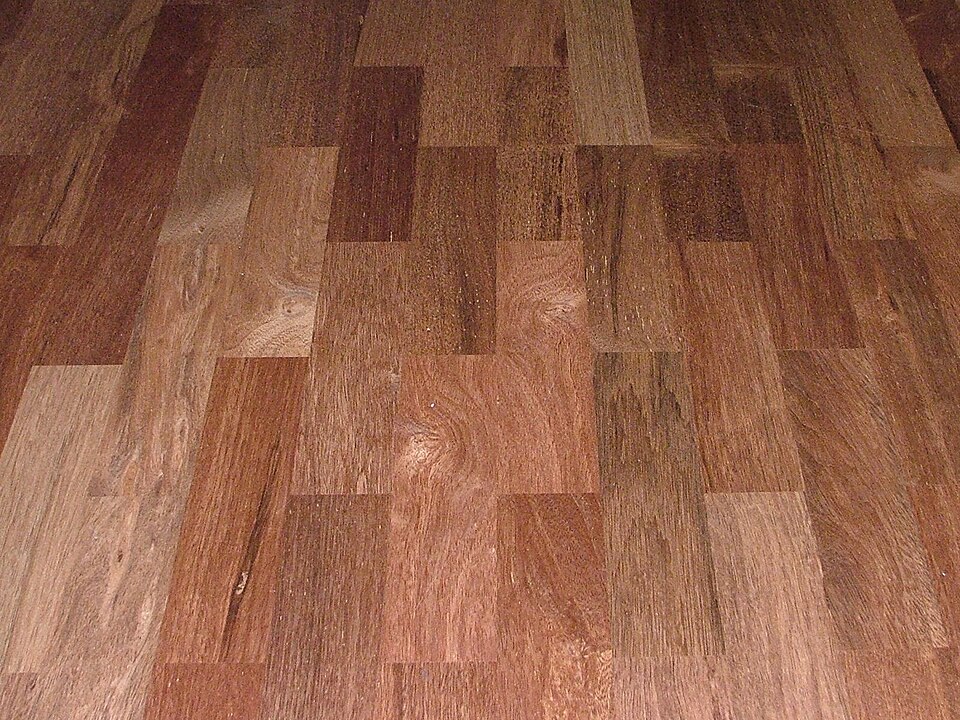
Commercial use began around the time the species was scientifically described in 1903. FAO notes that the railway reached Victoria Falls in 1902 and that the timber's potential for railway sleepers was soon realised. The first Northern Rhodesian sawmill opened in Livingstone in 1911, and the Livingstone forests were exhausted by the late 1920s, so operations moved west along the Mulobezi Railway2. PROTA says it was the most important railway sleeper timber in southern Africa in the first half of the 20th century, and that parquet flooring was a main Zambian export product until the 1980s, with South Africa as the main export market3. When FAO wrote, most production was heartwood converted to sleepers, with a small share of mixed heartwood and sapwood going to parquet strips2. For how parquet is laid, see mosaic parquet.
Is Zambezi teak sustainable?
The evidence calls for care. The Wood Database says the species is not in the CITES Appendices and that the IUCN lists it as near threatened1. PROTA says the Red List entry is lower risk / near threatened and needs updating. It also reports that Zimbabwe warned in the 1980s of possible genetic impoverishment or extinction, and that Namibia protects the species under its Forestry Ordinance because of over-exploitation and clearing for agriculture3.
FAO's older assessment lists fire, agricultural clearing and slow natural regeneration as problems. It describes difficult natural regeneration and largely failed artificial regeneration, and estimates a rotation to 30 cm diameter of 80 to 100 years2. That article is from the 1980s, so treat its figures as history rather than current data. Ask any supplier for documents showing the country of origin and the legal harvesting basis. Sourcing claims vary between suppliers. For example, OscarOno Paris says its Zambezi teak parquet made from fallen trees uses trees that are never felled and are recovered only after they fall; as with any supplier, ask for the documents behind such a claim.
How does it compare with other floors?
On the Janka scale Zambezi teak is far harder than teak, and for other tropical flooring timbers you can compare iroko and merbau. The trade-off for that hardness is difficult machining. For how boards are constructed, see solid wood flooring.
Frequently asked questions
Is Zambezi teak a real teak?
How hard is Zambezi teak compared with teak?
Is Zambezi teak difficult to work?
Is Zambezi teak endangered?
Where does Zambezi teak grow?
Sources
- Rhodesian Teak, The Wood Database. Accessed .
- How to save the Zambezi teak forests (Unasylva No. 152), Food and Agriculture Organization of the United Nations (FAO). Accessed .
- Baikiaea plurijuga (PROTA), PROTA, via Pl@ntUse. Accessed .
- Teak, The Wood Database. Accessed .
This page compiles published data from the sources listed above. Read our editorial policy. Last updated .