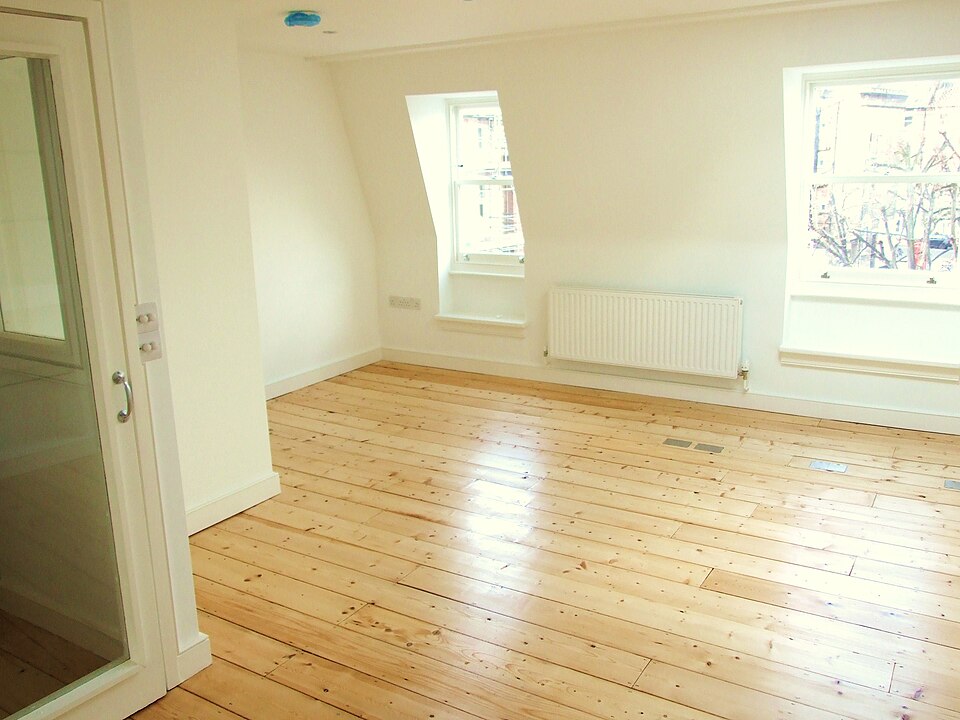
Merbau
Quick answer
Merbau (Intsia bijuga and Intsia palembanica) is an orangey to reddish-brown tropical hardwood with a Janka hardness of 1,840 lbf (7,620 N) and an average dried weight of 815 kg/m³, listed by Tropix as a stable wood used for flooring. Its yellow mineral deposits are water-soluble and can stain, and NGO investigations document illegal logging of merbau in Papua, so origin and paperwork matter123.
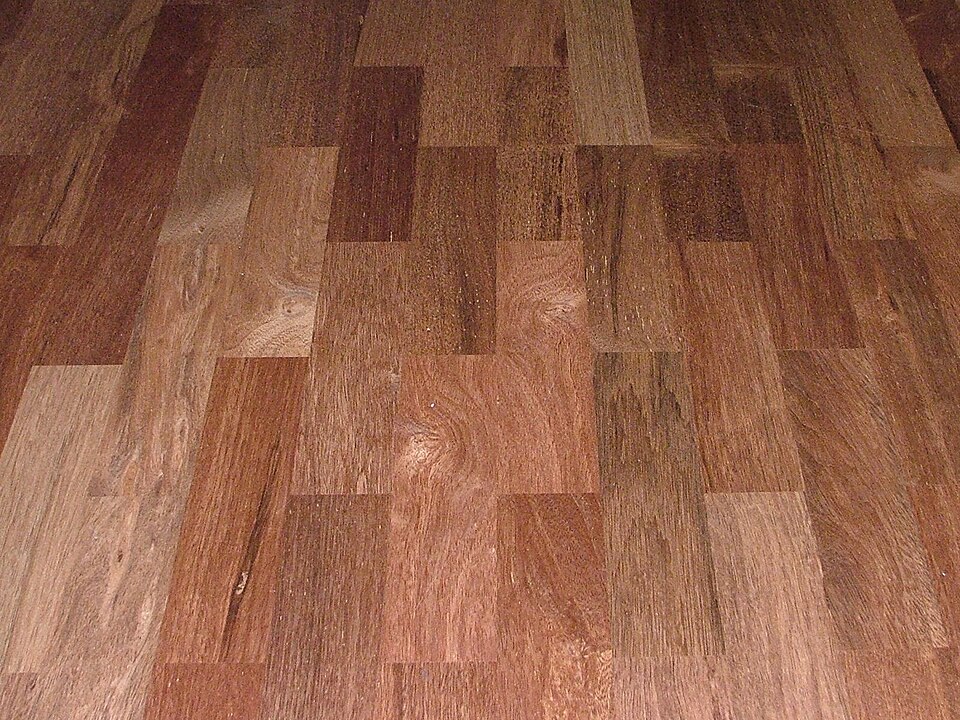
Merbau is an orangey to reddish-brown tropical hardwood with a Janka hardness of 1,840 lbf (7,620 N), and Tropix rates it a stable wood12. The cautions are a water-soluble yellow deposit that can stain and a documented illegal-logging problem in part of its range. Check the species, the origin and the paperwork before you specify it.
What is merbau?
"Merbau" is the trade name for Intsia bijuga and Intsia palembanica, and The Wood Database lists the wood as Intsia spp., also called kwila or ipil1. Tropix treats Intsia bijuga as the main entry, with Afzelia bijuga among its synonyms, and records local names including merbau in Indonesia and Malaysia, kwila in Papua New Guinea, ipil in the Philippines, vesi in Fiji and kohu in New Caledonia2. TRAFFIC names both species as the ones commonly traded5.
Where does merbau grow?
The Wood Database says it is native from East Africa through Southeast Asia to Australia, mainly New Guinea, and reaches 40 to 60 m (130 to 200 ft) with a trunk 1.2 to 1.5 m (4 to 5 ft) across1. Tropix lists Australia, China, Fiji, Indonesia, Madagascar, Malaysia, New Caledonia, Papua New Guinea, the Philippines, Thailand and Viet Nam as main producing countries2. The Wood Database describes supply as sporadic, in generous widths and lengths, at a moderate price for an imported hardwood1.
What does merbau look like?
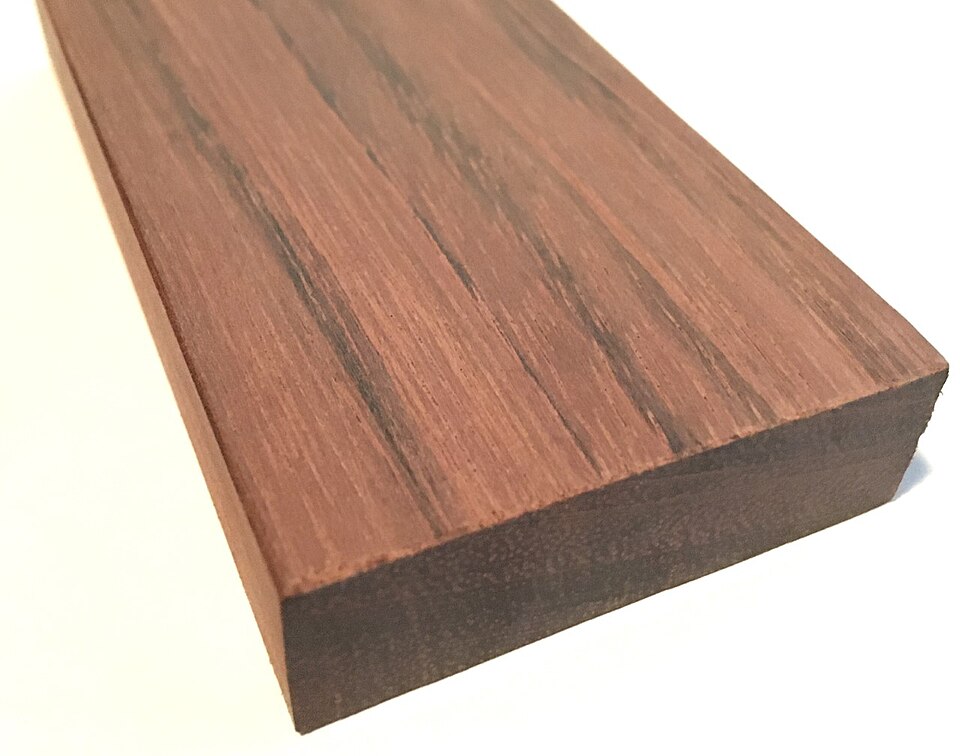
Freshly cut wood is orangey brown and darkens to reddish brown with age, and colour varies widely between boards1. Tropix describes heartwood that turns dark red-brown or dark brown with light, with a clearly demarcated sapwood2. Grain is straight to interlocked and texture is coarse with moderate natural lustre1. Both sources mention small yellow deposits, which The Wood Database calls mineral deposits and Tropix calls sulphur deposits12.
How hard, dense and stable is merbau?
| Property | The Wood Database | Tropix (CIRAD) |
|---|---|---|
| Janka hardness | 1,840 lbf (7,620 N) | not given (Monnin hardness 8.8) |
| Specific gravity at 12% moisture | 0.82 | 0.83 |
| Average dried weight | 815 kg/m³ (51 lb/ft³) | not given |
| Radial shrinkage | 2.9% | 2.7% |
| Tangential shrinkage | 4.8% | 4.4% |
| T/R ratio | 1.7 | 1.6 |
The two databases differ slightly, which is normal for a wood that, as Tropix warns, can vary significantly with origin and growing conditions12. Tropix classes merbau as stable wood, with a slow drying rate and a slight risk of distortion and checking2. For how to read the hardness figure, see Janka hardness explained, and compare other species on the hardness chart. Whatever the species, moisture and acclimatisation still apply.
Can merbau stain, and does it affect finishing?
The Wood Database says the small yellow mineral deposits throughout the wood are water-soluble and can cause staining1. Tropix lists a risk of dripping from tannin-type coloured chemical compounds, which can cause aesthetic damage to nearby structures2. Neither source tests how this interacts with a particular floor finish, so ask your supplier how the product was treated and read the wood floor finishes guide.
On workability, The Wood Database says merbau glues and finishes well, but that sawing can be difficult because the wood gums up and dulls saw teeth, and that sawing or sanding gives off a distinctive smell that can irritate1. Tropix rates nailing and screwing as good but with pre-boring necessary, notes a tendency to split, and advises following the glue maker's instructions because of the high density2.
Is merbau used for flooring?
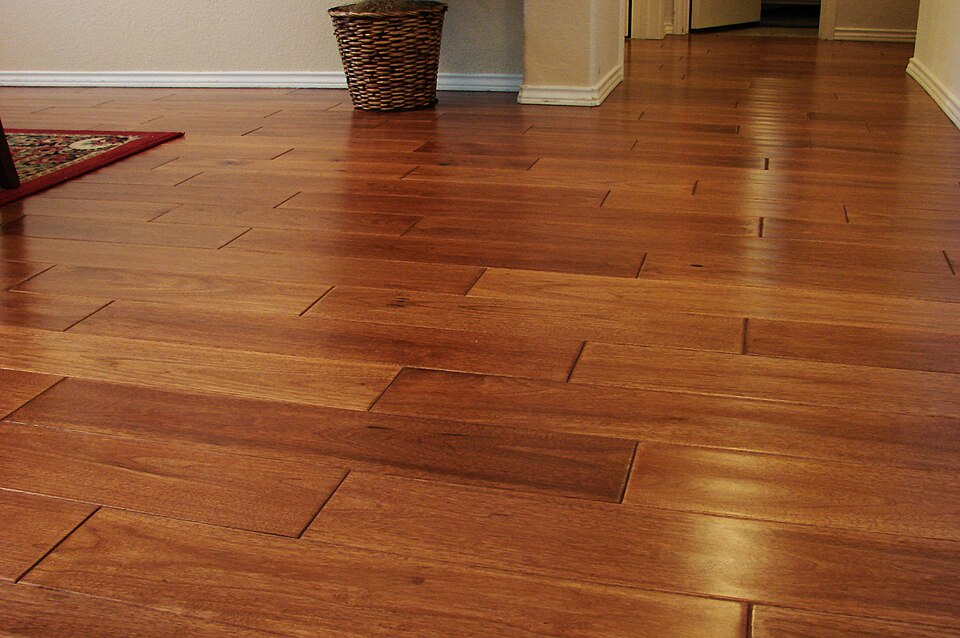
Yes. The Wood Database lists flooring first among its common uses, and Tropix lists flooring and industrial or heavy flooring among end-uses, alongside decking and interior joinery12. Tropix rates the heartwood as durability class 1-2 against fungi, and as not permeable to preservative2. See solid wood flooring for how such boards are made, and teak for another tropical floor timber.
Is merbau a protected or threatened species?
CITES. Tropix states that merbau is not listed in the CITES Appendices (Washington Convention, 2025), and The Wood Database also says it is not listed21. We could not open the Species+ database itself, so check the current appendices for any purchase.
IUCN. Sources disagree, and we could not open the IUCN assessment page. The Wood Database says the IUCN Red List classes it as Vulnerable, citing a population decline of over 20% in three generations from range loss and exploitation1. A 2022 paper in the Journal of Threatened Taxa says Intsia bijuga is categorised Near Threatened and has been on the Red List since 1998, and says its range in Indonesia has shrunk to Papua and Maluku4. Treat the category as unconfirmed here, and look up the current assessment.
What are the illegal logging concerns?
This section reports what named bodies found, and does not claim all merbau is illegal.
- Indonesia. EIA and Kaoem Telapak write that illegal loggers and traders have particularly focused on high-value species such as merbau. Their 2017 investigation covered illegal merbau logging in Papua and West Papua and its trade to Surabaya3. They estimate roughly 50% of Indonesian merbau timber product exports go to China, where uses include flooring3.
- Enforcement gaps. The same report found inconsistent enforcement. It says some companies found guilty of trading illegal timber still held a SVLK legality certificate, and describes a concern that illegal merbau can be "greenwashed" into the legal supply chain3.
- Papua New Guinea. A Global Witness presentation (2017) quotes Chatham House (April 2014) as concluding that the majority of PNG timber production is illegal in some way6. That is a country-wide finding, not a merbau-specific one, though PNG is a main producing country for merbau2.
What due diligence applies to buyers?
In general terms, the rules turn on legal origin.
- United States. APHIS says it is against the law to import any illegally harvested plant or plant product under the Lacey Act. Importers file a declaration, and are advised to learn each plant's scientific name and where it was harvested8.
- European Union. The Commission says the Deforestation Regulation requires operators placing wood on the market to show that it was produced in line with the laws of the country of production and does not originate from land deforested after 31 December 2020. It also requires a due diligence statement including the plot's geolocation, and it replaces the EU Timber Regulation7. The Commission's page records postponements, with application dates of 30 December 2026 for large and medium operators, so confirm the current dates7.
Ask any supplier for the species name, country and region of harvest, and the legality documents they hold. Read the full texts, since this page is not legal advice.
How does merbau compare with other floor timbers?
Our teak page gives that species' own cited hardness for comparison with merbau's 1,840 lbf (7,620 N)1. Hardness is only one factor: stability, finishing and sourcing matter too. Pair merbau with the moisture and acclimatisation advice, and consider whether engineered construction suits the room.
Frequently asked questions
How hard is merbau flooring?
Can merbau stain things?
Is merbau protected by CITES?
Is merbau an endangered tree?
Is merbau timber ever illegally logged?
What due diligence applies when importing merbau?
Sources
- Merbau, The Wood Database. Accessed .
- Merbau (Tropix data sheet, last update 22 October 2025), CIRAD - ITTO (Tropix). Accessed .
- Criminal Neglect: Failings in enforcement undermine efforts to stop illegal logging in Indonesia, Environmental Investigation Agency (EIA) and Kaoem Telapak. Accessed .
- Morphology characterization and phytochemical overview of the Moluccan Ironwood Intsia bijuga, Journal of Threatened Taxa. Accessed .
- Focus on merbau trade, TRAFFIC. Accessed .
- Illegal logging in Papua New Guinea and links to global supply chains (presentation, 18 October 2017), Global Witness. Accessed .
- Regulation on deforestation-free products, European Commission. Accessed .
- Lacey Act, USDA Animal and Plant Health Inspection Service (APHIS). Accessed .
This page compiles published data from the sources listed above. Read our editorial policy. Last updated .